My Account
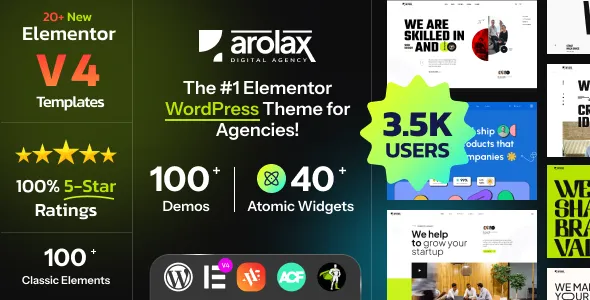
Arolax | Elementor V4 Creative Digital Agency Theme
Arolax | Elementor V4 Creative Digital Agency Theme is a modern website design solution for creative agencies, digital marketing companies, branding studios, design professionals, freelancers, and businesses that want to establish a distinctive online presence. Built around WordPress and Elementor-based website customization, Arolax is intended for creative projects that require visually engaging layouts, professional presentation, and flexible ways to communicate services, showcase completed work, and attract potential clients. Whether you operate a digital agency, creative studio, advertising company, web design business, or independent consultancy, this theme can provide a foundation for building a website that reflects your brand and communicates your value to the right audience.
A creative agency website needs to do more than display attractive graphics. It should explain what the business offers, demonstrate its expertise, establish credibility, and encourage visitors to take the next step. Prospective clients often compare several agencies before making contact, so a well-organized website can make an important difference in how they understand your services and evaluate your business. Arolax can be used to develop a structured digital presence with dedicated service sections, portfolio presentations, project details, team information, testimonials, and contact opportunities, depending on the available layouts and configuration.
The combination of WordPress and Elementor provides a flexible approach to managing website content and customizing page layouts. Businesses can adapt their messaging, visual identity, and page structure to reflect their particular market and service offerings. From a minimalist branding studio to a full-service digital marketing agency, a carefully configured Arolax website can help present information in a polished and consistent format.
What Is Arolax Elementor V4 Creative Digital Agency Theme?
Arolax is a creative agency-oriented WordPress theme designed for websites that prioritize branding, visual storytelling, portfolio presentation, and professional services. Its intended audience includes businesses that need an engaging website to communicate ideas, highlight their work, and convert visitors into inquiries.
The theme’s Elementor-focused approach allows website owners to work with a visual page-building workflow, subject to the installed theme version, supported Elementor features, and available templates. Rather than relying entirely on custom-coded layouts, users can organize page content through compatible editing tools and tailor the presentation to their business requirements.
The term Elementor V4 in the product name identifies the theme’s stated design or builder positioning. Before installation, users should check the current product documentation to confirm the precise Elementor version or feature compatibility, required plugins, and available editing capabilities.
Arolax can serve as a starting point for different types of creative websites, including digital agencies, design studios, advertising firms, marketing consultants, portfolio websites, and technology-focused service providers. Its overall suitability depends on the specific layouts and features included with the version being purchased.
Modern Design for Creative Businesses
Visual presentation plays an important role in the creative industry. Clients often expect an agency’s website to demonstrate the same attention to detail, originality, and design thinking that the business promises to deliver. An outdated or confusing website can make even a capable agency appear less professional.
Arolax can help establish a contemporary visual foundation for a creative business. A thoughtful combination of typography, spacing, imagery, colors, and page composition can make the website feel consistent with the agency’s brand identity. Large visual sections can introduce the business, while carefully organized content blocks can explain services and direct visitors toward important information.
Creative websites benefit from having a clear visual hierarchy. The main headline should communicate the agency’s purpose, supporting text should explain its value, and primary calls to action should guide visitors toward relevant next steps. Portfolio imagery should support the story rather than distract from the message.
A design agency might choose a restrained layout that highlights project photography and typography, while a digital marketing company may prefer a more energetic presentation that emphasizes measurable business outcomes and campaign capabilities. Arolax can be configured around the identity of the business using the options supported by the theme and its compatible tools.
Elementor-Based Visual Website Customization
Elementor is a visual website-building tool for WordPress that allows users to construct and customize page layouts through a graphical editing interface. Its workflow can help website owners make changes to page content and presentation without manually writing every layout element in code.
With an Elementor-compatible Arolax installation, users can organize content sections, update text, replace images, adjust styling, and structure pages according to the available editing controls. Depending on the theme package and required extensions, the workflow may support reusable layouts and design components that help maintain consistency across the website.
For example, an agency can create a homepage that introduces its capabilities, a services page that explains its offerings, a portfolio page that displays completed work, and a contact page that encourages prospective clients to get in touch. Consistent design patterns across these pages help create a more coherent browsing experience.
Before making extensive changes, users should confirm which templates are editable with their installed Elementor version and whether any premium Elementor features or companion plugins are required. Not every theme feature is necessarily controlled by the same editor, and some global settings may depend on the theme’s own configuration options.
Ideal for Digital Marketing Agencies
Digital marketing agencies need websites that explain their services, demonstrate expertise, and encourage potential clients to discuss their business objectives. Common services include search engine optimization, paid advertising, social media marketing, content strategy, email campaigns, conversion optimization, and digital analytics.
Arolax can provide a visual foundation for presenting these services through dedicated content sections and service pages. The homepage can communicate the agency’s main proposition, introduce its specializations, and direct visitors toward case studies or consultation inquiries.
Each service page should explain what the agency does, which businesses it supports, and how the service can address a specific challenge. For example, an SEO page can discuss technical website improvements, content planning, keyword research, and organic search visibility. A paid advertising page can explain campaign strategy, audience targeting, landing page optimization, and performance reporting.
Businesses should avoid making unsupported promises about rankings, sales, or advertising results. Instead, they can use real project examples, clear explanations, and transparent reporting methods to establish credibility.
A professionally structured agency website makes it easier for visitors to understand the company’s capabilities and determine whether its services align with their needs.
A Professional Website for Branding and Design Studios
Branding studios help businesses define their identity, communicate their positioning, and create a recognizable visual language. Their websites should reflect the quality of their creative work while explaining the strategic thinking behind each project.
Arolax can be adapted for branding agencies that want to highlight logos, brand systems, packaging, typography, visual identities, and digital design projects. Portfolio-focused sections can introduce selected work, while individual project pages can explain the client’s objectives, creative process, and final deliverables.
A strong branding portfolio should present projects in a clear and intentional order. Instead of showing every completed assignment without context, agencies can select examples that demonstrate the type of work they want to attract. Each project can explain the original challenge, the agency’s contribution, and the results or outcomes that can be accurately documented.
Consistent imagery and concise descriptions help visitors understand the studio’s approach. The website should also communicate whether the business specializes in brand strategy, visual identity, packaging, digital experiences, or a combination of services.
By combining a coherent visual identity with informative project presentations, a branding studio can use its website as both a portfolio and a practical business development tool.
Creative Portfolio and Case Study Presentation
A portfolio is often one of the most important sections of a creative agency website. Potential clients want to see evidence of the agency’s experience, visual style, and ability to solve relevant problems.
Arolax can serve as a starting point for organizing selected projects into a visually consistent portfolio, depending on the templates and portfolio features available in the installed version. Projects can be grouped by service, industry, format, or client type to help visitors explore the work most relevant to them.
Individual case studies can provide more value than images alone. A useful case study explains the client’s challenge, the agency’s objectives, the strategy used, the creative process, and the final deliverables. Where reliable data is available, the case study may also discuss measurable outcomes without exaggerating the agency’s contribution.
For a website design project, the portfolio could show interface designs, responsive page layouts, and key user journeys. For a marketing campaign, it could present creative assets, campaign objectives, and verified performance indicators. For a branding assignment, it could demonstrate how the visual identity was applied across different materials.
Portfolio images should be optimized for fast loading while retaining enough quality to communicate the details of the work. Alt text should describe meaningful images, and project pages should include descriptive titles and relevant supporting copy.
Suitable for Web Design and Development Agencies
Web design and development companies need to explain both the visual and technical sides of their services. Their websites should demonstrate design quality while making their capabilities, working process, and project experience easy to understand.
Arolax can be used to introduce services such as website design, WordPress development, eCommerce development, landing page creation, website redesign, user interface design, and ongoing maintenance. Each service can have its own page or clearly defined section according to the agency’s business structure.
A professional website should also explain how projects move from initial discovery to launch. Clients may want to understand how requirements are gathered, how designs are approved, how content is prepared, and how testing is completed before publication.
Clear process information helps set expectations and can reduce uncertainty for prospective customers. A service page can also explain which types of businesses the agency works with, what deliverables are provided, and how interested clients can request a quotation.
For agencies that specialize in WordPress, a website built on WordPress can also demonstrate familiarity with the platform. However, the agency should ensure that its own website follows sound practices for performance, accessibility, security, and maintenance.
Flexible Homepage Sections and Content Structure
The homepage is often the first major point of contact between an agency and a prospective client. It should quickly communicate what the business does, whom it serves, and why visitors should continue exploring.
An effective Arolax homepage can be structured around several core sections. A hero area can introduce the agency and its main value proposition. A short introduction can explain the business, followed by selected services, featured projects, client feedback, and a clear contact opportunity.
Additional sections may include industry specializations, team introductions, working methods, frequently asked questions, recent articles, or featured clients. The precise arrangement should depend on the agency’s goals rather than a desire to include every possible content element.
For example, a small creative studio may benefit from a concise homepage with a strong portfolio and a personal introduction. A larger digital agency may need more detailed service navigation, industry-specific content, team information, and case studies.
The most important information should appear early enough for visitors to discover it without unnecessary scrolling. Repeated calls to action can be useful when they appear naturally throughout the page, but excessive promotional elements may make the website feel cluttered.
Service Pages That Communicate Business Value
Service pages help potential clients understand the agency’s offerings in greater detail. They also create dedicated destinations for visitors arriving from search engines, advertisements, social media, referrals, or email campaigns.
Arolax can provide the basis for creating service-focused pages with clear headings, supporting descriptions, visual examples, and inquiry links. Each page should focus on a specific service or closely related group of services so that visitors can find the information they need.
A useful service page usually explains the problem being addressed, the agency’s approach, the expected deliverables, and the types of businesses that may benefit. It can also answer common questions about timelines, collaboration, and project requirements.
For example, a branding service page may describe brand discovery, positioning, visual identity, and brand guidelines. A website development page might explain planning, design implementation, content integration, testing, and launch support.
The language should focus on client needs instead of relying on generic marketing statements. Specific, understandable explanations help prospective customers decide whether to make contact.
Where services have different levels of complexity, the website can outline typical project scopes or explain that pricing depends on the requirements. Clear expectations can make the inquiry process more efficient for both the agency and its potential clients.
Responsive Design for Mobile and Desktop Visitors
A professional agency website should be usable on smartphones, tablets, laptops, and desktop monitors. Potential clients may discover an agency through a mobile search, review a portfolio on a tablet, or return later from a desktop computer.
Arolax should be evaluated for responsive behavior across the devices and screen sizes relevant to its audience. Users should test the homepage, service pages, portfolio galleries, navigation menus, forms, and other key sections rather than relying on a single desktop preview.
On mobile screens, headings should remain readable, images should fit their containers, and buttons should be easy to select. Navigation should make it straightforward to access services, projects, and contact information without unnecessary effort.
Responsive behavior can also be affected by custom CSS, third-party widgets, embedded media, and changes made through a page builder. A layout that appears correct on one screen may require adjustments at narrower widths.
Before publishing the website, test the pages on multiple viewport sizes and review any sections with large images, complex columns, animations, or overlapping elements. Consistent mobile usability helps the website present a professional impression across different browsing environments.
Customization for a Distinct Brand Identity
Every creative agency has its own positioning, audience, and design preferences. A theme should therefore be treated as a foundation that can be adapted to the business rather than a finished identity that must remain unchanged.
Depending on the customization options included with Arolax, website owners may be able to adjust colors, typography, spacing, page layouts, images, navigation, and other presentation details through supported theme settings and Elementor tools.
A branding agency may choose a restrained color palette and editorial typography, while a digital marketing company may prefer brighter accents and more prominent service sections. A technology-focused consultancy may emphasize clarity, structured content, and evidence of technical expertise.
Consistency is more important than adding visual effects to every section. A defined set of brand colors, heading styles, body text styles, button treatments, and image guidelines can help the website feel cohesive.
Agencies should also ensure that their logo, page titles, service descriptions, contact information, and calls to action remain consistent throughout the website. A recognizable identity helps visitors connect the visual presentation with the business itself.
Before implementing significant design changes, users should review the theme documentation, check whether a child theme is recommended for code customizations, and keep a backup of the working website.
Search Engine Optimization for Agency Websites
Search engine optimization can help creative agencies reach people who are actively looking for their services. A well-structured theme can support an SEO-friendly website, but rankings depend on the combined quality of the content, technical setup, competition, and the site’s reputation.
An agency website should use descriptive page titles, useful meta descriptions, logical heading structures, clean URLs, and relevant internal links. Service pages should explain the offering clearly and include terminology that matches the language potential clients use when searching for solutions.
For example, a business offering WordPress development may create a dedicated service page explaining its development process, supported project types, maintenance services, and relevant experience. A creative branding studio may publish detailed case studies and service pages for brand strategy and visual identity.
Local agencies may benefit from accurate business contact information and locally relevant content where it genuinely serves their audience. Supporting content, such as project breakdowns and practical guides, can also help answer questions that arise during the client decision-making process.
Image optimization is important for portfolio-heavy websites. Descriptive image file names, meaningful alt text, appropriate image dimensions, and efficient compression can support accessibility and performance.
Compatible SEO plugins may assist with metadata, XML sitemaps, redirects, and supported structured data. Website owners should monitor indexing, broken links, duplicate URLs, and page performance as the site develops.
No theme can guarantee top rankings or immediate traffic. Effective SEO requires useful content, technical maintenance, relevant authority, and continuous improvement.
Content Marketing and Agency Blogging
A blog can help an agency demonstrate expertise, share practical advice, and answer common questions from prospective clients. WordPress provides content-management tools that can be used to publish articles alongside service pages and portfolio content.
A digital marketing agency might write about campaign planning, content strategy, or website conversion improvements. A design studio could publish articles about visual identity, typography, and design systems. A web development company might explain website maintenance, performance optimization, or WordPress best practices.
Arolax can serve as the website foundation for presenting these articles, subject to the layouts and blog features supported by the installed theme version. Content should be organized into meaningful categories and displayed with clear titles, readable typography, and links to relevant services.
Useful articles should answer genuine audience questions rather than simply repeat target keywords. They can include examples, checklists, explanations, and practical recommendations that help readers understand a topic.
Internal links can connect articles to related services, case studies, and contact pages. This creates a more useful browsing journey and helps visitors move from learning about a problem to exploring how the agency can address it.
A consistent publishing schedule is more valuable than publishing large amounts of shallow content. Agencies should prioritize accuracy, relevance, originality, and usefulness.
Lead Generation and Client Inquiries
For many agencies, the primary purpose of a website is to generate qualified inquiries. The site should make it easy for potential clients to understand the services available and contact the business when they are ready.
Arolax can be configured to include prominent contact opportunities through supported page layouts, buttons, and compatible form tools. These may direct visitors toward a contact page, consultation request, quotation form, or project inquiry process.
A useful inquiry form asks for information that helps the agency understand the potential project without overwhelming the visitor. Depending on the service, relevant fields may include the client’s name, business email, company name, requested service, project summary, approximate budget, and desired timeline.
The form should explain what happens after submission and display clear validation or confirmation messages. Agencies should also ensure that submitted information is handled securely and that their privacy practices are appropriate for the data they collect.
Calls to action should be specific and relevant to the surrounding content. For example, a portfolio page may invite visitors to discuss a similar project, while a service page may encourage them to request a consultation.
The business should regularly test its contact forms, email delivery, and follow-up process. A well-designed inquiry journey can help reduce friction between a visitor’s interest and the first business conversation.
Testimonials, Reviews, and Social Proof
Potential clients often look for evidence that an agency can deliver reliable work. Testimonials, verified reviews, recognizable client projects, and detailed case studies can help provide that evidence when presented accurately.
Arolax can be used as a foundation for displaying client feedback and project information if suitable layouts or compatible components are available. Testimonials should be genuine, approved for publication, and attributed appropriately. Agencies should never invent customer quotes or imply endorsements that have not been granted.
Case studies can provide stronger context than brief testimonials alone. They can explain the original challenge, the agency’s responsibilities, the solution delivered, and the documented outcome. Where metrics are included, the business should make sure they are accurate and presented with appropriate context.
Client logos can also help communicate experience, provided the agency has permission to use them and does not imply a relationship that does not exist.
Social proof should support the agency’s message rather than dominate the website. A balanced combination of useful service information, relevant portfolio examples, and authentic client feedback helps visitors evaluate the business more confidently.
Team and About Pages for Building Trust
The About page gives potential clients an opportunity to understand the people, values, and working philosophy behind the agency. This can be especially important for businesses that rely on close collaboration and long-term client relationships.
Arolax can be adapted to present the agency’s background, team members, experience, and approach using the content layouts supported by the theme. A clear introduction should explain why the business exists, the types of clients it serves, and the principles that guide its work.
Team profiles may include professional roles, relevant experience, areas of expertise, and approved photographs. The goal is to help visitors understand who they may work with and how responsibilities are organized.
The About page can also describe the agency’s process, from initial consultation through project planning, delivery, and ongoing support. This information can reduce uncertainty and help prospective clients determine whether the agency’s working style suits their needs.
Agencies should keep this information accurate as team members and services change. Outdated staff profiles, old project references, or incorrect contact details can weaken the credibility that the page is intended to establish.
Website Performance and Loading Speed
Performance is an important part of the user experience, particularly for creative websites that contain high-resolution images, portfolio galleries, animation, and embedded media.
The actual speed of an Arolax website depends on its theme implementation, hosting environment, image sizes, installed plugins, fonts, scripts, and third-party integrations. A visually impressive layout should still be tested to ensure that it loads efficiently on typical connections and devices.
Start by optimizing portfolio images and using appropriate image dimensions. Large photographs can often be compressed without noticeably reducing their usefulness. Modern image formats may also reduce file sizes when supported by the website’s image workflow.
Caching, suitable hosting, database maintenance, and a content delivery network may improve performance depending on the site’s configuration. However, these tools should be selected based on measured needs rather than installed without evaluation.
Animations and interactive effects should be used selectively. They may contribute to the visual identity, but excessive motion or heavy scripts can slow down pages and distract users from important content.
Performance tests should cover the homepage, service pages, portfolio pages, and contact journey. Regular monitoring helps identify issues introduced by new content, plugins, or design changes.
Accessibility and User-Friendly Navigation
A professional website should be usable by as many visitors as reasonably possible, including people who navigate with keyboards, use assistive technology, or need stronger text contrast.
When configuring Arolax, website owners should use meaningful heading structures, readable font sizes, sufficient color contrast, descriptive link text, and appropriate labels for form fields. Images that communicate important information should have suitable alternative text, while purely decorative images can be handled accordingly.
Interactive elements should remain understandable and usable without relying exclusively on visual effects. Visitors should be able to identify links, buttons, navigation options, and form controls clearly.
The navigation structure should use familiar labels and avoid unnecessary complexity. Services, portfolio, about, blog, and contact sections are common destinations for agency visitors, although the final menu should reflect the site’s actual content.
Accessibility also depends on how pages are built and which third-party components are installed. Automated testing tools can identify some problems, but manual keyboard testing and practical usability reviews remain valuable.
Making these improvements can create a more inclusive experience and help visitors focus on the information they came to find.
Integrations and Supporting WordPress Plugins
A creative agency website may require additional tools for contact forms, search engine optimization, analytics, security, backups, caching, email marketing, and project inquiries. WordPress supports an extensive plugin ecosystem, but every integration should be selected carefully.
Arolax should be used with plugins that are compatible with the installed WordPress, Elementor, and theme versions. Before adding a plugin, review its documentation, update history, support information, and compatibility requirements.
A form plugin may be useful for collecting project inquiries. An SEO plugin may assist with page metadata and sitemap configuration. Analytics tools can help the agency understand which pages visitors use and how they interact with calls to action, subject to appropriate consent and privacy requirements.
Backup and security tools can support website maintenance, while caching and image optimization tools may help improve performance. The exact setup depends on the website’s hosting provider and operational needs.
Avoid installing multiple plugins that perform the same function unless there is a clear reason. Redundant tools can introduce conflicts, complicate maintenance, and affect loading performance.
After adding or updating an integration, test the key pages and workflows. This is especially important for contact forms, navigation, dynamic content, and responsive layouts.
Who Should Use Arolax Elementor V4 Creative Digital Agency Theme?
Arolax may suit businesses and professionals looking for a creative, portfolio-oriented WordPress website.
Digital marketing agencies: Companies offering SEO, paid advertising, content strategy, social media management, and digital campaign services can use the website to explain their capabilities and showcase relevant projects.
Branding and design studios: Creative teams can present brand identities, visual systems, packaging, graphic design, and selected client work.
Web design and development companies: Agencies can introduce their website design, WordPress development, eCommerce, maintenance, and technical consulting services.
Advertising and creative agencies: Businesses working on campaigns, creative concepts, and marketing materials can organize their services and portfolio in a professional format.
Freelancers and independent consultants: Individual professionals can develop a website that introduces their expertise, displays selected projects, and provides a clear path for client inquiries.
UI and UX designers: Interface designers can present case studies, design systems, prototypes, and examples of digital product work, subject to the available portfolio layouts.
Technology and startup consultants: Service providers can explain their offerings, highlight relevant experience, and provide information about their approach to client projects.
Creative entrepreneurs: New studios can use a structured website as a starting point for communicating their brand and developing an online presence.
Before selecting the theme, users should compare the available templates and features with their actual requirements, especially if the website depends on specific Elementor capabilities, animations, portfolio functions, or third-party integrations.
Tips for Building a Successful Website with Arolax
A good theme provides a starting point, but the quality of the final website depends on how well the content, design, and business goals work together.
Begin by defining the primary purpose of the website. Determine whether the main objective is to attract service inquiries, present a portfolio, introduce the team, promote specialized expertise, or support several of these goals.
Next, identify the audience the agency wants to reach. A website serving small businesses may need clear explanations and straightforward packages, while a studio working with enterprise clients may need detailed case studies, industry experience, and information about project management.
Prepare the essential content before customizing every section. This includes the agency introduction, service descriptions, project examples, team information, contact details, and calls to action. Real content makes it easier to evaluate the layout and identify which sections are actually necessary.
Use a consistent design system for colors, typography, buttons, and spacing. Replace placeholder images and sample text with accurate material that represents the business. Ensure that portfolio projects are authorized for publication and that client claims can be supported.
Test the website on mobile and desktop devices, review its accessibility, and measure page performance before launch. Check all navigation links, forms, email notifications, and important user journeys.
Finally, maintain the website after publication. Update WordPress, the theme, Elementor, and compatible plugins as appropriate, while keeping backups and testing major changes before applying them to the live site.
Final Thoughts on Arolax Elementor V4 Creative Digital Agency Theme
Arolax | Elementor V4 Creative Digital Agency Theme provides a potential starting point for businesses that want to build a visually distinctive WordPress website for creative services, digital marketing, branding, web development, and portfolio presentation. Its Elementor-oriented approach is relevant to agencies that want to customize page layouts and develop a website aligned with their identity and business goals.
A thoughtfully configured website can introduce services, showcase successful projects, communicate the agency’s working process, present authentic testimonials, and make it easier for prospective clients to request information. Service pages, portfolio case studies, responsive layouts, clear navigation, and useful content can work together to create a professional online presence.
The theme is one component of the complete website solution. The final result also depends on the installed theme version, Elementor compatibility, content quality, hosting performance, security practices, accessibility, and the selection of suitable WordPress plugins. Businesses should review the product documentation and test the required features before launching a production website.
For creative agencies, freelancers, designers, and digital service providers, Arolax can be evaluated as a foundation for presenting expertise and building stronger online visibility. With a clear brand message, original portfolio content, useful service information, and a well-maintained WordPress setup, an agency can create a website that supports its professional reputation and long-term business development.