My Account
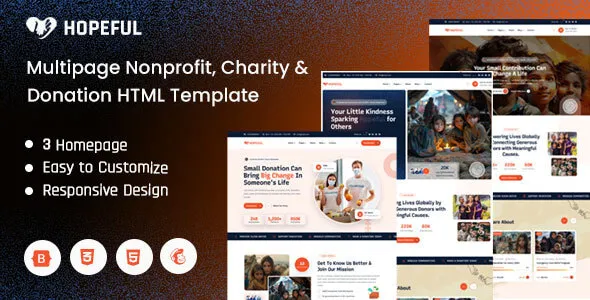
Hopeful – Multipage Nonprofit Charity & Donation HTML Template
Hopeful – Multipage Nonprofit Charity & Donation HTML Template is a website design solution created for nonprofit organizations, charitable foundations, fundraising initiatives, social enterprises, community projects, humanitarian groups, and organizations dedicated to making a positive difference. With a charity-focused design direction and an HTML template foundation, Hopeful provides a starting point for building an informative, engaging, and professional online presence. Whether you want to introduce a nonprofit organization, promote a social cause, present community development programs, share humanitarian activities, or encourage supporters to contribute to a fundraising campaign, this template can help structure your website around your mission.
A well-designed charity website does more than display organizational information. It helps visitors understand the purpose of a cause, learn about ongoing projects, explore opportunities to volunteer, and discover how their support can contribute to meaningful change. Donors and supporters often want to know who an organization helps, how its programs operate, and what objectives its campaigns aim to achieve. A clear and accessible website can make these details easier to find while communicating the organization’s values and priorities.
Hopeful – Multipage Nonprofit Charity & Donation HTML Template is intended for projects that need a dedicated online space to present charitable activities and social initiatives. Its multipage format offers a foundation for organizing different types of content into separate sections, allowing website owners to develop pages for their mission, campaigns, projects, team members, news, and contact information according to their requirements. Developers can adapt the design, update text and images, and customize page structures to match the identity of a particular organization.
The template can be considered by web designers, freelance developers, digital agencies, nonprofit teams, and social impact organizations looking for a starting point for a charity-related website. The final features depend on the supplied package and implementation, so buyers should review the current documentation to confirm the included pages, layouts, scripts, and functional components before choosing it for a specific project.
A Dedicated Website for Nonprofit Organizations
Nonprofit organizations work across many areas, including education, healthcare, environmental conservation, poverty reduction, animal welfare, disaster relief, child support, community development, and humanitarian assistance. Each organization has its own mission, audience, and approach to creating positive change. A professional website helps communicate that mission and explain how the organization works toward its goals.
Hopeful provides a starting point for presenting nonprofit information in a structured digital format. Organizations can customize the website to introduce their history, explain their values, describe their programs, and highlight the communities they serve. Dedicated pages can help visitors explore different activities without requiring every detail to fit on a single homepage.
For a small community charity, the website may focus on its mission, current projects, upcoming events, and ways to get involved. A larger nonprofit may require more extensive content covering multiple programs, regional initiatives, partnerships, reports, and fundraising campaigns. The multipage structure makes it possible to plan the website around these different content requirements, subject to the layouts available in the template.
A consistent design can also help reinforce organizational credibility. Clear typography, relevant photography, straightforward navigation, and well-written content allow visitors to focus on the cause rather than struggle to understand the website. When supported by accurate information and transparent communication, a professional online presence can help build stronger relationships with donors, volunteers, beneficiaries, and community partners.
Multipage Layout for Organized Charity Content
A multipage website is useful when an organization needs to communicate more than a brief introduction and a single fundraising message. Separate pages allow visitors to explore the information most relevant to them while helping the organization maintain a clear content hierarchy.
Hopeful – Multipage Nonprofit Charity & Donation HTML Template can serve as a foundation for organizing content into sections such as Home, About Us, Our Causes, Projects, Campaigns, Volunteers, News, and Contact. The exact pages available should be confirmed from the current product package, and additional pages may require customization.
The homepage can introduce the organization through a mission statement, a prominent visual section, featured initiatives, and clear links to important information. An About page can explain the nonprofit’s background, values, goals, and approach. A Causes page can introduce the social issues the organization addresses, while individual project pages can provide more detailed information about particular initiatives.
A dedicated news or updates section can keep visitors informed about recent activities, community achievements, and upcoming events. Contact information can be placed on a separate page so that donors, volunteers, media representatives, and prospective partners can easily find the appropriate communication channels.
Separating content into logical pages helps reduce clutter and makes future updates more manageable. It also creates opportunities to provide detailed information for different audiences without overwhelming first-time visitors with too much text.
Designed for Charity Campaigns and Fundraising Initiatives
Fundraising is an important activity for many charitable organizations. Campaigns may support school supplies for children, emergency food distribution, healthcare services, clean water initiatives, disaster recovery, environmental projects, or long-term community development programs.
A customized Hopeful website can provide a dedicated space for introducing these campaigns and explaining their objectives. Each campaign page can describe the problem being addressed, identify the intended beneficiaries, outline the proposed activities, and explain how supporters can participate.
Where appropriate, campaign content can include a featured image, a fundraising target, a progress indicator, a deadline, or a summary of planned outcomes. Such elements should be connected to accurate information and maintained regularly. A displayed fundraising amount or progress bar should reflect real data rather than a decorative placeholder.
Clear campaign descriptions can help visitors understand why an initiative matters and what kind of assistance is needed. Instead of relying entirely on emotional language, organizations should explain the practical goals of each project and provide relevant evidence about the needs being addressed.
If the organization wants visitors to contribute money directly through the website, additional functionality may be required. A visual donation button does not automatically process payments. Online donations generally require a compatible payment gateway, secure server-side processing, appropriate validation, and a reliable way to record transactions. Before launch, confirm whether the supplied template includes any working donation integration or only provides a front-end design that can be connected to a suitable service.
Present Your Mission and Organizational Values
A nonprofit website should clearly communicate what the organization stands for and why its work matters. Visitors need a straightforward explanation of the mission before they can decide whether to support a campaign, volunteer, or share the organization’s information with others.
Hopeful can be customized to present an organization’s mission statement, vision, core values, and long-term objectives. These elements can appear on the homepage or in a dedicated About section, depending on the structure chosen for the finished website.
An effective mission statement should be understandable, specific, and connected to the organization’s actual activities. For example, a nonprofit working in education might explain how it supports access to learning resources, while an environmental organization might describe its conservation and community awareness programs.
The About page can also introduce the organization’s history, leadership, community partnerships, and development over time. Where relevant, the organization can explain the needs it addresses, the approach it follows, and the principles that guide its work.
Authentic information is especially important for charitable organizations. Avoid unsupported claims about achievements, beneficiary numbers, partnerships, or impact. Accurate and verifiable details help establish trust and allow supporters to make informed decisions about where to direct their attention and contributions.
Showcase Causes and Social Impact Projects
Many nonprofit organizations manage several initiatives simultaneously. A charity might provide educational support, organize health awareness events, distribute essential supplies, and assist vulnerable families through different programs. A structured project presentation helps visitors understand the scope of this work.
Hopeful can provide a starting point for organizing individual causes and projects into clear sections. Each project can have its own description, objectives, images, progress updates, and relevant participation information. The page structure can be adjusted to accommodate short-term campaigns as well as ongoing programs.
For education-focused initiatives, project pages might explain scholarship opportunities, school supply distribution, tutoring programs, or learning facility improvements. A healthcare nonprofit might present health awareness campaigns, medical assistance programs, or community outreach activities. Environmental organizations could highlight conservation projects, recycling initiatives, tree planting, or wildlife protection.
Project descriptions should explain the need being addressed, the actions planned, and the intended outcomes. When reliable results are available, organizations can publish updates that describe what has been completed and what remains in progress.
A consistent project layout can make the website easier to maintain as new initiatives are introduced. Visitors can compare programs, explore different causes, and find the information that best aligns with their interests. This structure also gives nonprofit teams a practical way to communicate progress over time.
Support Donor Engagement Through Clear Information
Donors often want to understand how an organization uses its resources, what its programs aim to achieve, and how contributions support its mission. A well-organized website can make this information more accessible and encourage informed participation.
A customized Hopeful website can include donation guidance, campaign descriptions, program updates, financial transparency information, and answers to common supporter questions. Depending on the organization’s needs, a donation information page may explain accepted payment methods, recurring contribution options, receipt procedures, or the process for making a larger contribution.
Transparency should be treated as an ongoing responsibility rather than a one-time design feature. Organizations should publish accurate information about their activities and provide financial or impact reports where appropriate. Any statements about how funds are allocated should reflect the organization’s actual policies and practices.
Donation calls to action should use clear language so visitors understand what happens when they click. If a button leads to an external donation platform, identify that destination appropriately. If donations are collected directly, the payment process should be secure and tested before the website becomes publicly available.
A positive donor experience also depends on what happens after a contribution is made. Donation confirmations, receipts, thank-you messages, and follow-up communications may require integration with an external fundraising platform or custom backend functionality. These features should not be assumed to exist merely because a template includes donation-related visual elements.
Volunteer Recruitment and Community Participation
Volunteers help nonprofit organizations deliver services, organize events, distribute resources, raise awareness, and support local communities. A website can explain these opportunities and help interested individuals understand how to participate.
Hopeful can be adapted to introduce volunteer programs, describe available roles, and communicate the skills or time commitments associated with different activities. A dedicated volunteer page can explain the organization’s expectations, provide basic eligibility information where relevant, and direct visitors toward the appropriate next step.
For example, a charity may need event volunteers, administrative support, educational mentors, community outreach assistants, fundraising helpers, or professional specialists. Explaining these roles clearly can help potential volunteers identify opportunities that match their abilities and availability.
An online volunteer inquiry form may also be added if it is supported by the template or developed separately. Such a form should request only the information needed to assess or respond to an application. It should also provide an appropriate privacy notice and send submitted information to a secure destination.
Volunteer recruitment content should accurately describe the work involved. If an opportunity requires training, a background check, a minimum time commitment, or specific qualifications, these conditions should be explained before applicants submit their information.
Suitable for Different Types of Charitable Causes
Nonprofit organizations operate across a wide range of sectors, and their websites should reflect the needs of the people and communities they serve. Hopeful can be customized for different charitable purposes by adjusting its messaging, imagery, navigation, and project categories.
Education and child development: Schools, education charities, scholarship programs, and child support organizations can present educational projects, learning resources, fundraising initiatives, and volunteer opportunities.
Healthcare and medical assistance: Health-focused nonprofits can communicate awareness campaigns, patient assistance programs, community outreach, and other verified services. Sensitive information should be handled with care and published only with appropriate permission.
Environmental protection: Conservation groups and sustainability initiatives can showcase environmental campaigns, habitat protection activities, cleanup projects, and public education programs.
Poverty relief and community support: Organizations serving vulnerable communities can explain their assistance programs, present resource distribution activities, and provide clear information about eligibility and participation.
Animal welfare: Animal rescue groups and animal protection charities can introduce rescue initiatives, adoption information, welfare campaigns, and responsible volunteering opportunities.
Disaster relief and humanitarian aid: Relief organizations can communicate current needs, explain their response activities, share verified updates, and guide supporters toward appropriate donation or assistance channels.
Community and social development: Local nonprofits can present neighborhood projects, public events, community services, and opportunities for residents to contribute to shared goals.
The visual presentation should be matched to the organization’s actual mission. Relevant photographs, accessible language, and accurate descriptions can help the website communicate its purpose without making every nonprofit project look identical.
A Professional and Trustworthy Visual Presentation
Visual design influences how visitors perceive an organization. A cluttered interface can make important information difficult to locate, while a coherent design helps the organization communicate its purpose in a more professional way.
Hopeful provides a starting point for establishing a recognizable visual identity for a charity website. Organizations can customize the color palette, logo, typography, imagery, content blocks, and navigation where the supplied implementation permits these changes.
A consistent color system can connect the website to the organization’s existing branding. Typography should remain readable, with clear distinctions between main headings, supporting text, captions, and calls to action. Buttons and links should be easy to identify, and important information should not be hidden among too many competing visual elements.
Photography can help explain the organization’s work, but images should be selected responsibly. Use photographs that accurately represent the programs and communities described, and obtain appropriate permissions when images feature identifiable people, especially children or vulnerable individuals.
A trustworthy website should avoid manipulative design practices. Donation amounts, progress figures, beneficiary statistics, and campaign deadlines should be accurate. Urgent messages should be used only when the situation genuinely requires urgent attention.
When visual design is combined with clear information and ethical communication, the website can support the organization’s credibility and help visitors understand its mission.
Responsive Website Experience Across Devices
Supporters may visit a charity website from a desktop computer, laptop, tablet, or smartphone. A usable experience across different screen sizes is therefore an important consideration during implementation.
Before publishing a Hopeful-based website, verify the responsive behavior of the supplied pages. If responsive styles are included, test the navigation, content sections, campaign information, forms, images, and calls to action at multiple viewport sizes. Additional CSS adjustments may be necessary to resolve layout issues.
Mobile visitors should be able to read campaign descriptions, access contact details, and understand donation instructions without excessive zooming or horizontal scrolling. Buttons should be comfortable to tap, text should remain legible, and navigation should be easy to use on smaller screens.
Responsive testing should cover more than the homepage. A campaign page with a long description, an image-heavy project page, or a contact form may behave differently from the main landing page. Testing these different page types can help reveal problems before launch.
The final mobile experience depends on the template’s implementation and the changes made during development. Always test the actual finished website rather than relying solely on a general description of the product.
HTML5 Foundation for Flexible Development
HTML5 provides a foundation for building structured web pages using elements for headings, paragraphs, images, links, forms, navigation, and other content. For developers who prefer direct control over front-end code, an HTML template can provide a starting point for a custom website.
Hopeful is intended for charity and nonprofit website projects that need an HTML-based design foundation. Developers can inspect the supplied files and customize their content, styling, and page structure according to project requirements and the template’s licensing conditions.
Common customization tasks may include replacing sample text, updating images, adding an organization’s logo, changing colors, adjusting spacing, and revising navigation labels. More extensive work might involve creating additional pages, connecting forms to a backend, adding a content management system, or integrating an external fundraising platform.
An HTML template is not automatically a complete content management system or donation application. Features that require stored data, secure accounts, payment processing, administrative dashboards, or automated communications generally need additional implementation unless explicitly included in the package.
Developers should also review any included CSS frameworks, JavaScript libraries, fonts, icons, and third-party dependencies. Understanding these components before making changes can help prevent compatibility issues and simplify maintenance.
Easy Content Updates and Long-Term Website Maintenance
A nonprofit website needs regular updates to remain useful. Campaigns end, new projects begin, volunteer opportunities change, and organizational contact details may need revision. An update-friendly content structure helps teams keep information accurate over time.
When customizing Hopeful, developers should establish a consistent method for maintaining common content elements. Project descriptions, campaign statistics, contact details, event information, and organizational announcements should be stored and updated in an organized way.
For a simple static website, content updates may involve editing HTML files and redeploying the changes. Organizations that publish updates frequently may benefit from a content management system or a separate backend that allows authorized staff to manage content without editing code directly.
A maintenance plan should include checking links, reviewing campaign statuses, updating contact information, replacing outdated images, and removing expired announcements. Technical maintenance may also involve updating dependencies, reviewing hosting configuration, testing forms, and checking that the website continues to work across supported browsers.
Before making significant changes, maintain a backup of the current website files and test updates in a development environment when possible. These practices can reduce the risk of disrupting a live fundraising campaign or losing important organizational information.
SEO-Friendly Structure for Nonprofit Websites
Search engine optimization can help people discover charitable organizations, community programs, fundraising initiatives, and volunteer opportunities when searching online. A well-structured website makes it easier for visitors and search engines to understand the content of each page.
Hopeful can serve as the design foundation for an SEO-focused nonprofit website, but actual search performance depends on content quality, technical implementation, competition, website authority, and ongoing maintenance.
Each important page should have a descriptive title, a unique meta description, a clear primary heading, and useful body content. An organization should avoid using identical descriptions across every campaign or project page. Instead, explain the purpose of each initiative and include the specific details that make it relevant to visitors.
For example, an environmental charity can create informative pages about its conservation programs, while an education nonprofit can explain its learning initiatives and volunteer requirements. Campaign pages should describe the actual cause, the target audience, the intended outcomes, and the available ways to participate.
Descriptive URLs and relevant internal links can help visitors navigate related information. Images should be optimized and given appropriate alternative text when they convey meaningful information. Technical tasks may include configuring canonical URLs, XML sitemaps, indexing directives, structured data where appropriate, and suitable redirects.
An HTML template does not guarantee search engine rankings. SEO requires useful information, accessible page structure, reliable performance, and ongoing attention to how the website serves its audience.
Website Speed and Media Optimization
Performance is important for charity websites because visitors may arrive through social media campaigns, email newsletters, search results, or links shared by supporters. A website that loads reliably can help visitors access campaign details without unnecessary delays.
Before launching a website based on Hopeful, review the size of images, fonts, scripts, and stylesheets. Large campaign banners and project photographs can increase loading times if they are not optimized for the dimensions at which they appear.
Use appropriately sized images, compress assets where suitable, and remove files that are not needed. Modern image formats can be considered when supported by the intended browsers and hosting environment. Below-the-fold images may be configured for lazy loading when appropriate, while important visible content should remain readily available.
Third-party integrations can affect performance too. Analytics scripts, social media embeds, video players, and external widgets should be reviewed to determine whether they are necessary for the site’s objectives.
Performance testing should examine both desktop and mobile behavior. Browser tools and website auditing services can help identify large assets, render-blocking resources, layout shifts, and other issues that may affect the visitor experience.
Actual speed depends on the finished code, hosting provider, network conditions, and content. Optimization should therefore be performed and tested after the organization’s real images, content, and integrations have been added.
Accessibility and Inclusive Communication
Nonprofit organizations serve diverse communities, so website accessibility should be an important part of development. Visitors may use keyboards, screen readers, magnification tools, captions, or other assistive technologies to access information.
Developers working with Hopeful should use semantic HTML, logical heading structures, descriptive link text, meaningful alternative text, and properly labeled form controls. Keyboard focus should remain visible, and interactive navigation should not depend exclusively on a mouse.
Text and buttons should have sufficient contrast against their backgrounds. Important instructions should not rely on color alone, and content should remain understandable when users increase text size. Donation forms and volunteer inquiries should provide clear labels, helpful instructions, and accessible error messages.
Inclusive communication also involves writing in clear language. Explain unfamiliar terms, avoid unnecessary jargon, and make campaign instructions easy to understand. Where the organization serves multilingual communities, additional language versions may be useful, although multilingual functionality may require extra development.
Accessibility should be verified through a combination of automated tools and manual testing. Organizations should review applicable standards and legal requirements and evaluate the finished website before publishing it.
Integrating Donation and Payment Services
For charities that accept online contributions, a secure and understandable donation process is essential. Hopeful can provide a starting point for the visual presentation of donation-related content, but the exact payment functionality must be verified against the product package.
If the template does not include a working payment system, developers can explore integrating an appropriate third-party fundraising service or payment gateway. The best option depends on the organization’s country, registration status, payment methods, compliance obligations, and operational needs.
A complete donation workflow may involve selecting a contribution amount, collecting the necessary donor details, processing a payment securely, recording the transaction, displaying confirmation, and issuing a receipt where applicable. Recurring donations may require additional subscription or billing functionality.
Sensitive payment details should be handled through appropriately secured and compliant payment infrastructure rather than being collected through an ordinary static HTML form. Organizations should also ensure that the donation process communicates any relevant fees, restrictions, refund policies, and recurring payment conditions.
After integration, test successful payments, declined transactions, interrupted sessions, confirmation messages, and receipt delivery. Donation records should be managed securely, and access should be restricted to authorized personnel.
Contact Forms and Supporter Communication
A charity website often needs to support communication with donors, volunteers, beneficiaries, media representatives, and partner organizations. Clear contact information and working inquiry forms help visitors reach the appropriate team.
A customized Hopeful website can include a contact page with an organizational email address, telephone number, office location where appropriate, and other relevant communication channels. The page should explain the best way to contact the organization for common requests.
If a contact form is required, developers should confirm whether a functional submission mechanism is included or whether a backend service is needed. A form that displays fields on the page is not necessarily capable of sending messages or securely storing submissions.
Forms should use clear labels, appropriate validation, and useful confirmation or error messages. They should collect only the information required for the stated purpose and include relevant privacy information. Spam prevention may also be necessary, depending on the form’s exposure and traffic.
Organizations should establish a process for reviewing and responding to incoming messages. A functional website is only part of the communication process; timely responses and accurate guidance are equally important for maintaining positive relationships with supporters.
Suitable for Freelancers and Web Development Agencies
Freelancers and digital agencies frequently build websites for charities, nonprofit associations, fundraising campaigns, and community organizations. A specialized HTML template can help establish an initial design direction for these projects.
Hopeful may be suitable as a starting point for client work when its layout, code structure, and licensing terms match the project’s requirements. Developers can tailor the presentation to the client’s mission, brand identity, content strategy, and intended audience.
A practical workflow begins with gathering the client’s requirements and identifying the pages needed for launch. The developer can then review the available template layouts, map the content to the appropriate sections, customize the design, and identify any required integrations.
Testing should cover responsive behavior, navigation, forms, links, image loading, accessibility, and the accuracy of published information. If the website includes online fundraising, the entire contribution workflow should be tested before the organization directs donors to it.
Agencies should also review the template license before delivering a finished website to a client. Included fonts, photographs, icons, and external libraries may have separate terms, and permission to use the template does not necessarily permit unrestricted redistribution of all bundled assets.
Why Choose Hopeful – Multipage Nonprofit Charity & Donation HTML Template?
Choosing a website template involves evaluating how well it supports the project’s content, development process, and long-term goals. Hopeful is designed around nonprofit, charity, and donation-related website use cases, making it a candidate for organizations that want a dedicated presentation for their mission and activities.
Its multipage approach can help separate organizational information, causes, projects, fundraising campaigns, volunteer opportunities, and contact details into manageable sections. This is useful when visitors need to explore different parts of an organization’s work rather than rely on a single long page.
The HTML foundation gives developers a starting point for customizing the front-end experience. Depending on the supplied package, the design can be adjusted to reflect an organization’s visual identity, while additional development can be planned for requirements such as dynamic project management, volunteer registration, or online donations.
The most appropriate use depends on the features actually included. Buyers should evaluate the current demonstration, documentation, code quality, responsive behavior, licensing terms, and compatibility with their intended hosting and integration requirements before purchasing.
Conclusion
Hopeful – Multipage Nonprofit Charity & Donation HTML Template provides a starting point for creating a professional website for nonprofit organizations, charitable foundations, social initiatives, community groups, fundraising projects, and humanitarian causes. Its charity-focused purpose and multipage approach make it relevant to websites that need to explain a mission, present campaigns, showcase projects, recruit volunteers, and communicate with supporters.
By customizing the content and visual identity, organizations can develop a website that reflects their values and makes essential information easier to discover. Clear project descriptions, accessible navigation, accurate campaign details, optimized images, and consistent page structures can all contribute to a more useful online experience.
For organizations accepting donations online, remember that a template’s visual design and a working payment system are separate considerations. Secure payment processing, transaction records, confirmation messages, privacy safeguards, and any required fundraising integrations should be verified and implemented before launch.
If you are planning a nonprofit or charity website, Hopeful – Multipage Nonprofit Charity & Donation HTML Template is worth evaluating as a potential foundation for presenting your cause online. Pair the design with trustworthy communication, regular content updates, accessibility testing, and suitable technical integrations to create a digital presence that helps supporters understand your mission and discover meaningful ways to participate.