My Account
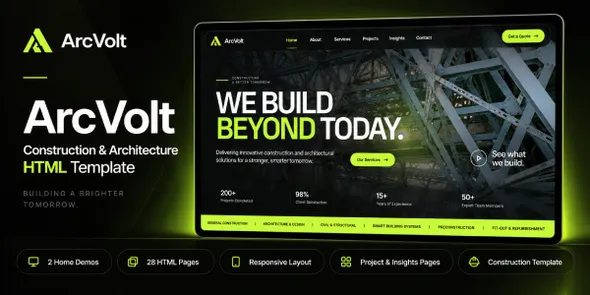
ArcVolt – Construction, Architecture & Engineering HTML Template
ArcVolt – Construction, Architecture & Engineering HTML Template is a modern website design solution created for construction companies, architectural studios, engineering consultancies, contractors, infrastructure developers, and building service providers seeking a professional online presence. Designed around the needs of the construction and built-environment industries, ArcVolt provides a customizable starting point for presenting company information, showcasing projects, describing professional services, and communicating a brand’s expertise. Its industry-focused positioning makes it suitable for businesses that want to introduce their capabilities, highlight completed developments, and build stronger connections with potential clients through a well-organized website.
In the competitive construction and architecture market, a professional website helps businesses demonstrate their experience, explain their services, and establish credibility with customers, property developers, and project partners. Visitors often want to understand the company’s specialties, review examples of previous work, learn about its working process, and find a straightforward way to request a consultation. ArcVolt – Construction, Architecture & Engineering HTML Template offers a foundation for organizing this information into a clear and visually engaging digital experience.
Whether you operate a construction firm, architectural practice, civil engineering consultancy, interior design company, renovation business, or infrastructure development organization, ArcVolt can be adapted to reflect your brand identity and project requirements. Its HTML-based structure provides a starting point for developers who want to customize website layouts, content, styling, and interactive elements for different business objectives.
Modern Website Design for Construction Businesses
Construction and engineering websites need to communicate professionalism, reliability, and technical capability. Potential customers may be comparing contractors, researching architectural services, or looking for a company capable of managing a complex building project. A clear and organized website can help visitors understand what a business offers and determine whether its services match their requirements.
ArcVolt is positioned for construction, architecture, and engineering websites, making it relevant to businesses operating across the building and infrastructure sectors. Developers can adapt the template to present company introductions, service descriptions, project information, team profiles, and contact details according to the layouts available in the supplied package.
A well-designed construction website should balance visual presentation with useful information. High-quality project photography can help demonstrate the company’s work, while concise descriptions explain the scope and purpose of each project. Clear navigation allows visitors to explore different services without having to search through unrelated content.
ArcVolt can serve as a starting point for creating this type of professional presentation. Businesses can customize the visual style, imagery, page structure, and written content to reflect their specialties, whether they focus on residential construction, commercial buildings, industrial facilities, architecture, or civil engineering.
HTML-Based Website Development
HTML provides the structural foundation of websites by defining headings, paragraphs, images, links, forms, and other content elements. An HTML website template gives developers direct access to the source files so they can adapt the page structure and appearance to their project’s requirements.
ArcVolt – Construction, Architecture & Engineering HTML Template is suitable for developers who prefer a direct frontend development workflow. Depending on the included package, customization may involve editing HTML markup, adjusting CSS stylesheets, modifying JavaScript interactions, replacing image assets, and updating navigation links.
This approach allows businesses and developers to build a website around their own requirements without necessarily relying on a specific content management system. Additional technologies can be introduced when needed, provided they are compatible with the template’s implementation.
Before starting customization, review the supplied folder structure, documentation, stylesheet organization, JavaScript dependencies, and available page layouts. The exact frameworks, plugins, and components should be confirmed from the current product package rather than assumed from its name.
An organized development workflow can make it easier to maintain consistency across pages and simplify future updates.
Construction Company Website Development
Construction companies need websites that explain their capabilities and help prospective clients evaluate their suitability for a project. These businesses may provide general contracting, residential construction, commercial building, renovation, project coordination, or specialized construction services.
ArcVolt can be customized for construction companies that want to present these offerings in a structured and professional way. A tailored website might introduce the business, outline its core services, showcase selected projects, explain its approach to quality and safety, and provide contact details for inquiries.
Each service description should clearly explain the work performed and the types of projects the company handles. For example, a commercial contractor may focus on office buildings, retail spaces, and industrial facilities, while a residential builder may emphasize new homes, extensions, and renovations.
A strong construction website should use authentic information and project imagery. Details such as certifications, insurance, licenses, project timelines, and warranties should be published only when they accurately reflect the business.
With relevant content and thoughtful customization, ArcVolt can help construction companies create an online presence that communicates their services and supports prospective customer inquiries.
Architecture Studio and Design Firm Websites
Architectural practices need websites that communicate their design philosophy, present their portfolio, and demonstrate their ability to respond to different project requirements. Visual presentation is particularly important because visitors often evaluate architecture through photographs, drawings, renderings, and descriptions of completed work.
ArcVolt can be adapted for architecture studios that work on residential homes, commercial buildings, hospitality spaces, institutional facilities, or other built-environment projects. Developers can organize the website around the studio’s design approach, service categories, selected projects, and professional background.
A useful architecture portfolio should provide more than attractive imagery. Project descriptions can explain the design objectives, building context, materials, spatial planning, and relevant constraints. Where appropriate, information about the project’s location, scale, and completion status can help visitors understand the work.
Architectural websites should also consider image quality and performance. Large portfolio photographs may need optimized formats and suitable dimensions to preserve visual detail without making pages unnecessarily slow.
By combining a coherent visual identity with informative project presentations, ArcVolt can provide a starting point for architecture studios seeking a professional portfolio and business website.
Engineering and Infrastructure Services
Engineering firms support construction and infrastructure projects through technical planning, analysis, design, coordination, and specialist consultancy. Their websites need to communicate technical services clearly while remaining accessible to clients who may not have an engineering background.
ArcVolt is relevant to engineering-focused website projects that require a structured presentation of professional capabilities. Depending on the company’s services, a customized site might cover civil engineering, structural engineering, building systems, infrastructure planning, construction consultancy, or project coordination.
Service pages should explain the types of challenges the firm addresses and the expertise it provides. For instance, a structural engineering consultancy might describe its work on building structures and technical assessments, while a civil engineering company may focus on site development, drainage, transportation infrastructure, or related services.
Technical information should be accurate and presented at the appropriate level of detail for the intended audience. Prospective clients may need a concise overview before exploring more specialized information.
ArcVolt can serve as a visual foundation for organizing these service descriptions and presenting the company in a professional, easy-to-navigate format.
Portfolio and Project Showcase
A project portfolio is often one of the most valuable parts of a construction or architecture website. It gives visitors an opportunity to review examples of previous work and understand the types of projects a company has handled.
ArcVolt can be customized to showcase completed developments, ongoing projects, architectural concepts, engineering assignments, or renovation work, depending on the layouts included in the template. Each portfolio entry should use authentic information and relevant images.
A project page may include the project title, category, location, completion date, service scope, and a short description of the challenge and approach. Additional details can explain the materials, design decisions, technical requirements, or construction process where that information is available and appropriate to share.
Organizing projects into useful categories can help visitors find examples relevant to their needs. A construction company might group its work into residential, commercial, and industrial projects, while an architecture studio could organize its portfolio by building type or design discipline.
Project photography should be optimized for web delivery while retaining sufficient detail. Descriptive alternative text can also improve accessibility when images convey meaningful information.
A carefully maintained portfolio can help businesses communicate experience more effectively than broad marketing claims alone.
Residential and Commercial Construction Websites
Residential and commercial construction businesses often serve different audiences and project requirements. A residential builder may need to communicate home construction, extensions, renovations, and finishing services, while a commercial contractor may focus on offices, retail developments, warehouses, and other business facilities.
ArcVolt can be adapted for either type of construction company by adjusting its content, imagery, service categories, and navigation. Residential projects may benefit from approachable descriptions and photography that illustrates the finished living spaces. Commercial projects may require more detailed information about project scale, coordination, functionality, and delivery.
A customized website should help visitors identify the company’s specialties quickly. Dedicated service pages can describe the types of projects accepted, the company’s process, and the information clients should prepare before requesting an estimate.
Any project examples or performance claims should be supported by accurate records. Businesses should avoid implying that they have completed work, obtained certifications, or delivered results that cannot be verified.
With a focused structure, ArcVolt can provide a useful starting point for presenting residential or commercial construction services to the relevant audience.
Interior Design and Renovation Services
Construction-related businesses may also provide interior design, remodeling, renovation, space planning, and finishing services. These offerings benefit from a website that combines clear descriptions with visual examples of completed work.
ArcVolt can be customized for companies that renovate homes, modernize commercial interiors, redesign workspaces, or coordinate interior construction projects. Service sections can explain the work involved, while portfolio pages can show selected transformations and design outcomes.
For renovation projects, useful content may include the original challenge, the client’s objectives, the scope of work, and the final result. Where relevant, businesses can also explain their approach to material selection, scheduling, and coordination with other trades.
Interior project photography should be presented carefully, with suitable image dimensions and a consistent visual style. Descriptions should be accurate and should not suggest that the business offers specialist services beyond its actual capabilities.
A coherent website can help potential customers understand the company’s approach and determine whether its services fit their renovation or interior improvement plans.
Website Sections and Content Organization
An effective construction website should organize information according to what prospective clients need to know. The exact pages and components available in ArcVolt should be checked in the current product preview and documentation. A customized website in this industry may include the following sections.
Hero section: Introduces the company and its primary services with a clear headline, supporting description, and relevant call to action. A suitable project image can help establish the website’s visual direction.
About the company: Explains the business’s background, professional approach, areas of expertise, and relevant experience. This section should communicate real information rather than generic claims.
Services overview: Organizes the company’s offerings into understandable categories, such as construction, architecture, engineering, renovation, or project consultancy, where applicable.
Project portfolio: Presents selected work using authentic images and informative descriptions. Visitors should be able to understand the project’s scope and relevance.
Process or methodology: Describes how the company approaches consultations, planning, design, construction, coordination, or project completion.
Team information: Introduces relevant professionals or leadership members when appropriate, using accurate roles and qualifications.
Testimonials: Displays genuine customer feedback only when it is authentic and permitted for publication.
Frequently asked questions: Addresses common questions about services, project planning, consultation, and the information needed to begin a project.
Contact and inquiry section: Provides a straightforward way for visitors to request information, discuss requirements, or arrange an initial consultation.
Not every business needs all these sections. The most effective structure depends on the company’s services, audience, and business goals, as well as the layouts included in the template.
Responsive Design for Construction Websites
Visitors may explore a construction website from smartphones, tablets, laptops, and desktop computers. Responsive design helps ensure that the content remains readable and the navigation remains usable across different screen sizes.
When the supplied ArcVolt implementation supports responsive layouts, developers should test the website at a range of viewport sizes. Navigation menus, project galleries, service cards, forms, and image layouts should adapt to the available space without making important information difficult to access.
Project photography requires particular attention because large images can dominate the screen on mobile devices. Developers may need to adjust image dimensions, cropping, spacing, and alignment to preserve the intended presentation.
Forms and buttons should remain convenient to use with touch input. Text should be readable without excessive zooming, and page layouts should avoid unwanted horizontal overflow.
Responsive design should be evaluated as part of the complete website rather than assumed from the use of an HTML template. Testing on supported browsers and actual devices can help identify layout problems before the website is published.
Custom Branding and Visual Identity
A company’s website should reflect its brand and communicate a consistent professional identity. Construction and architecture businesses often need a visual presentation that aligns with the type of work they perform and the customers they serve.
ArcVolt can be adapted through changes to colors, typography, logos, images, headings, spacing, and supported layout components. A construction company might choose a strong, practical visual identity, while an architectural studio may prefer a more minimal presentation that gives greater prominence to portfolio photography.
Brand consistency should extend across the entire website. Navigation, buttons, headings, project cards, and contact sections should follow a coherent design system. Reusing a defined palette and consistent spacing can make the site feel more organized.
The visual identity should support the information rather than compete with it. Strong photography is valuable, but it should be accompanied by meaningful descriptions that explain the business’s role and the work performed.
A customized presentation can help differentiate the company while preserving the practical usability expected from a professional business website.
Lead Generation and Client Inquiries
For construction companies, architects, and engineering consultants, a website often serves as a channel for new business inquiries. Prospective clients may want to discuss a building project, request a consultation, ask about service availability, or obtain an initial estimate.
ArcVolt can be customized to support these goals by presenting clear calls to action and providing a straightforward contact pathway. Visitors should understand what information to provide and what type of response they can expect.
A project inquiry form might request a name, contact information, project type, approximate location, and a short description of the requirements. Businesses should avoid requesting unnecessary personal information at the initial stage.
The actual form-processing functionality depends on the implementation. An HTML template may need a backend endpoint, email service, or compatible third-party form provider to receive submissions. Developers should verify that the form validates input, handles errors, prevents spam where appropriate, and provides clear confirmation after a successful submission.
Businesses should also handle submitted information responsibly and provide suitable privacy information where required.
Search Engine Optimization for Construction and Architecture Websites
Search engine optimization helps search engines understand a website’s content and helps potential clients discover relevant services. An HTML template provides a starting point, but effective SEO depends on the quality of the content and the technical configuration of the finished website.
ArcVolt can be customized with descriptive page titles, relevant meta descriptions, logical heading structures, meaningful internal links, and original service content. Each important page should focus on a clear topic and answer questions that prospective clients may have.
For example, a construction company may develop dedicated pages for residential construction, commercial building, and renovation services. An architecture firm may organize pages around its design disciplines and project types. An engineering consultancy may explain its specific technical services and areas of expertise.
Local businesses may also benefit from accurate business information, consistent contact details, and useful location-specific content when they genuinely serve those areas. Claims about service locations should reflect the company’s actual coverage.
Developers should review canonical URLs, sitemap requirements, robots directives, image alternative text, and structured data where relevant. Website performance, mobile usability, and accessible navigation can also support a better user experience.
No template guarantees search rankings. SEO results depend on many factors, including content quality, competition, technical implementation, indexing, and the website’s overall authority.
Performance and Image Optimization
Construction and architecture websites often use large project photographs, building renderings, and visual galleries. These assets can improve the presentation but may also affect loading performance if they are not optimized appropriately.
When customizing ArcVolt, developers should review image sizes, file formats, dimensions, and loading behavior. Images should be delivered at suitable resolutions for their intended display areas, avoiding unnecessarily large files for small components.
Other frontend resources should also be managed carefully. Unused scripts, unnecessary plugins, and excessive external dependencies can increase page weight and complexity. CSS and JavaScript should be reviewed before deployment, while retaining any functionality required by the design.
Performance testing tools can help identify slow resources, layout shifts, and other issues. Developers should test the completed website after adding real project photography and content, since these changes can significantly affect performance.
A fast and stable website makes it easier for potential clients to browse services and review project portfolios, especially when accessing the site through mobile networks.
Accessibility and User Experience
An accessible website helps more people navigate its content and understand the services offered. When adapting ArcVolt, developers should consider semantic HTML, keyboard navigation, readable typography, color contrast, descriptive links, and accessible forms.
Navigation should follow a predictable structure, and interactive elements should communicate their purpose clearly. Buttons and links need descriptive labels, while forms should include associated labels and useful validation messages.
Project images that convey meaningful information should have appropriate alternative text. Decorative images should be handled in a way that does not create unnecessary noise for assistive technologies.
The content hierarchy should remain logical, with headings that accurately describe the sections beneath them. Important information should not depend solely on color, and text should remain legible against its background.
Automated accessibility tools can help identify common issues, but manual testing is also valuable. Developers should verify that key navigation and inquiry tasks can be completed with a keyboard.
Accessibility should be considered throughout the development process rather than treated as an optional finishing touch.
Integration with Maps and Business Tools
Construction and engineering businesses may need to display office locations, provide directions, collect project inquiries, or connect the website to internal business tools. An HTML template can be extended with compatible services when these integrations are required.
ArcVolt may be customized to include a map, connect contact forms to a backend, link to scheduling tools, or integrate suitable analytics services. The exact integrations included in the original package should be confirmed through its documentation.
Developers should consider privacy, performance, and configuration requirements when introducing third-party services. External scripts should be selected carefully, and credentials or sensitive configuration details should be handled securely.
If the website requires more advanced capabilities, such as a client portal, project tracking system, online quotation workflow, or database-driven portfolio, those functions should be treated as separate development requirements unless they are explicitly included in the template.
A carefully integrated website can become a useful part of the company’s broader client communication process while maintaining a clear and professional public-facing experience.
Who Can Use ArcVolt – Construction, Architecture & Engineering HTML Template?
Construction companies can customize the template to present building services, contractor capabilities, and selected projects.
Architecture studios can create a portfolio-focused website to introduce their design philosophy, services, and completed work.
Civil and structural engineering firms can organize technical services and communicate their professional expertise.
Interior design and renovation businesses can showcase design projects, remodeling services, and visual transformations.
Infrastructure developers can present their capabilities across relevant infrastructure and construction projects.
Project management consultants can explain their approach to coordination, planning, and project delivery when these are part of their actual services.
Web development agencies can evaluate the template for client projects requiring a construction or architecture website, subject to the applicable license terms.
Freelance designers and developers can use the HTML source as a starting point for learning or building a customized website, where permitted by the product license.
The level of technical experience required depends on the changes being made. Content and styling updates may be relatively straightforward, while custom functionality, form processing, database integration, and deployment require additional development knowledge.
Why Choose an HTML Template for a Construction Website?
Developing a website from scratch requires decisions about page structure, visual styling, navigation, responsive behavior, and content presentation. An HTML template can provide an initial framework for these elements, helping developers concentrate on the details that make a particular business unique.
ArcVolt offers an industry-oriented starting point for construction, architecture, and engineering website projects. Its HTML-based approach is relevant to developers who want access to the source files and the flexibility to customize the implementation.
Potential benefits include a reusable visual foundation, a starting point for service and portfolio pages, branding customization, and the opportunity to adapt the site to different business goals. The amount of time saved depends on the included layouts, source quality, and the extent of the required modifications.
Before choosing ArcVolt for a project, review the current product preview, available pages, included assets, dependency requirements, documentation, and license terms. Confirm that the package matches your technical environment and intended website structure.
Conclusion
ArcVolt – Construction, Architecture & Engineering HTML Template is a customizable starting point for creating professional websites for construction firms, architectural studios, engineering consultancies, renovation companies, and infrastructure-related businesses.
Its industry-focused positioning makes it relevant to organizations that need to explain their services, present project portfolios, communicate their expertise, and make it easier for potential clients to get in touch. With thoughtful customization, developers can create a website that reflects the company’s brand, highlights its actual capabilities, and organizes information around the needs of its audience.
For the best results, prioritize authentic project content, consistent branding, responsive layouts, optimized images, accessible navigation, and search-friendly page structure. Functional contact forms, database-driven features, maps, and other advanced integrations should be verified in the product package or implemented separately as needed.
If you are looking for an HTML website foundation for a construction, architecture, or engineering business, ArcVolt can be evaluated as a starting point for developing a professional online presence tailored to your services, projects, and long-term business objectives.