My Account
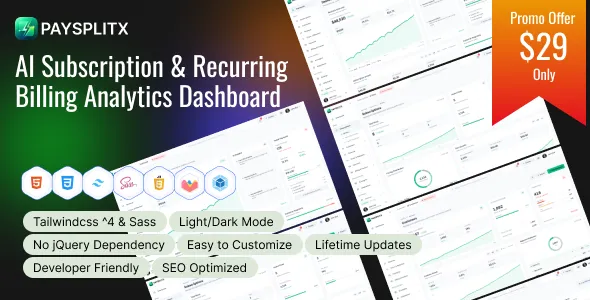
PaySplitX – AI Subscription & Recurring Billing Analytics Dashboard HTML Template
PaySplitX – AI Subscription & Recurring Billing Analytics Dashboard HTML Template is a modern HTML dashboard template designed for subscription-based businesses, SaaS companies, billing platforms, finance teams, and digital entrepreneurs who need a structured interface for understanding recurring revenue and subscription performance. With a focus on subscription analytics, billing insights, and AI-oriented dashboard experiences, PaySplitX provides a starting point for creating professional web interfaces that help users organize financial information, review recurring payment activity, and monitor important business metrics. Whether you are building a subscription management platform, a SaaS analytics portal, a recurring billing application, or a financial reporting interface, this template can help establish a consistent visual foundation for your project.
Recurring revenue has become an important part of modern digital business models. Software subscriptions, membership services, online learning platforms, digital product businesses, and other recurring-payment services rely on clear information about customer activity, payment status, revenue performance, and subscription growth. A well-organized dashboard makes it easier to present this information in a meaningful format and helps business users understand the operational details behind their subscription models.
PaySplitX is intended to support the frontend development of these experiences through an HTML-based dashboard interface. Developers can use the supplied structure as a starting point, customize its appearance, and connect appropriate components to their own application logic and data sources. Its AI-oriented positioning also makes it relevant to projects that aim to present intelligent analytics, automated insights, or data-assisted decision-making features, provided that the required functionality is implemented separately.
What Is PaySplitX – AI Subscription & Recurring Billing Analytics Dashboard HTML Template?
PaySplitX is an HTML dashboard template created for projects centered on subscription analytics, recurring billing, and financial performance monitoring. HTML templates typically provide the structural foundation of a website or web application interface, allowing developers to customize page layouts, content sections, styling, and user interactions according to their requirements.
For subscription-based businesses, an analytics dashboard can serve as a central workspace for reviewing key business information. It may be designed to present revenue summaries, subscription activity, customer information, billing records, payment statuses, or other operational data. The exact pages, components, and features available in PaySplitX depend on the supplied product version and should be verified against its documentation and live preview.
As an HTML template, PaySplitX primarily provides a frontend starting point rather than a complete subscription billing system. Developers typically need to connect the interface to backend services, databases, payment gateways, authentication systems, and analytics tools to create a fully operational application.
This separation allows teams to adapt the template to their preferred technology stack. A developer can integrate the HTML interface with a custom backend, a compatible web framework, or an existing SaaS platform, depending on the project’s architecture and the template’s implementation requirements.
Modern Dashboard Design for Subscription Analytics
A subscription analytics dashboard should present complex business information in a way that is easy to understand. Business owners and finance teams need to review revenue, customer activity, billing trends, and subscription performance without navigating through disconnected reports.
PaySplitX provides a foundation for creating a centralized dashboard experience focused on these needs. Its interface can be adapted to organize information into clearly defined sections, helping users move between high-level summaries and more detailed records.
A subscription dashboard may include revenue summaries, customer counts, recurring billing information, subscription status indicators, and recent account activity. Depending on the available components and custom implementation, it may also incorporate charts, tables, filters, and reporting panels.
A useful dashboard prioritizes information according to the needs of its audience. Executives may need a quick overview of revenue and growth, while finance professionals may require detailed transaction information and payment reconciliation. Product managers may be more interested in customer retention, plan adoption, and subscription behavior.
PaySplitX can be customized to reflect these different priorities. Developers can organize the interface around the metrics and workflows that matter most to the intended users rather than presenting every available data point on a single screen.
AI-Oriented Subscription Intelligence
Artificial intelligence is increasingly used in business analytics to identify patterns, summarize information, and support data-driven decisions. In a subscription business, AI-assisted capabilities may help analyze customer behavior, identify unusual billing activity, estimate potential churn risk, or summarize changes in recurring revenue.
PaySplitX’s AI-oriented positioning makes it suitable as a visual starting point for applications that aim to incorporate these types of analytical experiences. Developers can adapt the dashboard to display insights generated by compatible AI services, machine learning models, analytics engines, or business rules.
For example, a completed application might present a summary of revenue changes, highlight accounts that require attention, or show potential patterns in subscription cancellations. Such functionality requires appropriate data sources, analytical logic, and backend integration; it should not be assumed to operate automatically merely because an interface is described as AI-powered.
An AI-enabled subscription dashboard should also present insights responsibly. Predictions should be clearly distinguished from confirmed financial results, and users should be able to understand the context behind important recommendations wherever possible.
By providing a structured interface for analytics-related information, PaySplitX can serve as a starting point for developers who want to build an AI-oriented recurring billing experience.
Recurring Revenue Monitoring
Recurring revenue is one of the central measures used by subscription businesses to understand their financial performance. It represents revenue associated with subscriptions that renew over time, subject to the company’s accounting policies and the definitions used for reporting.
A recurring revenue dashboard can help users review revenue trends across different periods and understand whether their subscription business is growing, remaining stable, or experiencing a decline.
Common metrics that developers may choose to display include Monthly Recurring Revenue (MRR), Annual Recurring Revenue (ARR), new recurring revenue, expansion revenue, contraction revenue, and churn-related revenue changes. The availability of specific metric cards in PaySplitX should be checked in the supplied package; additional metrics can be implemented when required.
MRR is commonly used to represent normalized monthly recurring subscription revenue, while ARR often expresses a normalized annual recurring revenue figure. These metrics should be calculated consistently and should not automatically be treated as equivalent to cash received, total bookings, or recognized accounting revenue.
PaySplitX can be customized to present these measures in a readable dashboard layout. Visual summaries, trend indicators, and comparison periods can help users interpret changes in business performance, provided that the underlying calculations and data are accurate.
Subscription Management and Customer Activity
Subscription businesses need a clear understanding of their customer base. Customers may subscribe to different plans, upgrade or downgrade their services, pause subscriptions where supported, cancel memberships, or return after a period of inactivity.
An analytics dashboard can help organize this information by presenting customer records and subscription statuses in a consistent format. PaySplitX can provide a frontend foundation for this type of information architecture, depending on its included pages and components.
Developers may create subscription overview pages, customer tables, plan summaries, and account activity sections to support the needs of a particular business. These areas can be connected to backend services that maintain the actual subscription records.
For example, a subscription management application might distinguish between active subscriptions, trials, cancelled accounts, and subscriptions awaiting payment. The specific statuses and rules depend on the billing provider and business model.
A useful interface should make it easy to identify important account changes without confusing historical activity with current subscription status. Clear labels, consistent date formats, and accurate status information help administrators understand what has happened and what may require follow-up.
Recurring Billing Analytics
Recurring billing involves collecting payments at scheduled intervals according to a subscription’s pricing, renewal date, and billing configuration. Managing these processes requires accurate records and clear visibility into billing activity.
A billing analytics dashboard can provide a central place to review payment-related information, including successful charges, failed transactions, pending payments, refunds, and upcoming renewals where the underlying system supports these details.
PaySplitX can be adapted to present recurring billing data through tables, summary sections, or other suitable interface components. Developers can customize the layout according to the billing workflows and reporting requirements of their application.
For example, a finance team may need to review payments collected during a particular month, while a customer support team may need to identify accounts experiencing repeated payment failures. An administrator may also need to compare expected billing activity with actual transactions.
These capabilities require accurate integration with the relevant billing service or internal payment-processing system. The HTML template itself does not process payments, authorize transactions, or maintain authoritative financial records unless additional application functionality is built around it.
Payment Status and Failed Transaction Monitoring
Failed payments can affect recurring revenue, customer retention, and operational efficiency. Subscription businesses may experience payment failures because of expired payment methods, insufficient funds, authentication requirements, processing errors, or other circumstances.
A well-designed billing interface can help teams review failed transactions and identify accounts that may require attention. Depending on the implemented application, developers may display payment status, transaction dates, error categories, retry information, and related customer records.
PaySplitX can serve as the visual foundation for such workflows when suitable components are available or added during customization.
A completed system may connect to a payment provider’s APIs or webhooks to update payment statuses and record billing events. Retry scheduling, payment recovery, customer notifications, and dunning workflows require additional backend logic and appropriate provider integration.
Financial interfaces should clearly distinguish a failed payment from a pending payment, a successful payment, or a refunded transaction. Incorrect status labels can lead to unnecessary customer contact or inaccurate revenue reporting.
Subscription Plans and Revenue Segmentation
Subscription businesses often offer multiple plans with different pricing, billing intervals, features, and access levels. Understanding how customers are distributed across these plans can help businesses evaluate pricing strategies and product adoption.
An analytics dashboard may present information about plan popularity, recurring revenue by plan, subscription upgrades, or customer movement between tiers. These metrics can help teams understand which offerings contribute most to the business and where customers may need different options.
PaySplitX can be adapted to display subscription segmentation data in ways that support a company’s reporting needs. Developers can organize information by plan, customer segment, billing interval, region, or another meaningful dimension when the required data is available.
Segmentation is most useful when its definitions remain consistent. For instance, comparisons between plans should specify whether they are based on customer counts, subscription counts, gross billed amounts, net revenue, or another measure.
Developers should ensure that the dashboard’s filters and summary values use the same definitions throughout the application. This reduces confusion and makes reports easier to interpret.
Data Visualization and Performance Reporting
Charts and other visualizations can make subscription metrics easier to interpret than raw numbers alone. A time-series chart may help users understand revenue changes, while a comparison chart may show differences between subscription plans or customer segments.
Depending on the supplied components and additional integrations, PaySplitX may be adapted to present recurring revenue trends, subscription growth, payment outcomes, customer retention, or other business indicators.
The appropriate visualization depends on the question being answered. Line charts are often useful for trends over time, bar charts can compare categories, and tables can provide precise details for individual records. A dashboard should use visualizations to clarify information rather than add unnecessary decoration.
Developers should verify whether chart components or sample data are included in the purchased package. If charts are not included, a suitable charting library can be integrated where compatible with the template’s structure and licensing requirements.
Every visualization should use accurate labels, meaningful scales, appropriate date ranges, and reliable underlying data. When a metric is estimated or generated by an analytical model, that status should be communicated clearly.
HTML Structure and Frontend Customization
HTML provides the structural foundation for the dashboard interface. Developers can customize markup, organize content into reusable patterns, and connect interactive elements to JavaScript or other compatible frontend tools.
PaySplitX is an HTML template, making it relevant to developers who want a starting point that can be adapted to their own web development workflow. Depending on the package structure, customization may include editing page layouts, updating navigation, changing colors, refining typography, replacing placeholder content, and integrating additional interface elements.
A clear HTML structure can make an interface easier to maintain. Semantic elements, descriptive labels, and consistent component patterns help developers understand the page and support accessibility improvements.
The exact file organization, CSS framework, JavaScript dependencies, and build requirements should be verified from the product documentation. Developers should avoid assuming that a particular library, framework, or feature is included unless it is explicitly documented.
For larger applications, teams may choose to convert or integrate the HTML interface into an existing frontend architecture. This process may involve reorganizing markup, extracting reusable components, and connecting the interface to the application’s routing and data-loading patterns.
Responsive Design for Desktop, Tablet, and Mobile
Users may need to access billing information from different devices and screen sizes. Finance professionals often work on desktop computers, while managers and support teams may review important information from tablets or mobile devices.
A responsive dashboard helps ensure that essential information remains accessible as the viewport changes. Depending on the supplied implementation, PaySplitX can be customized to adjust column layouts, reorganize navigation, resize content areas, and improve the presentation of tables and summary cards.
For example, a wide billing table may need a horizontally scrollable container on smaller screens, while dashboard cards may stack vertically to preserve readability. Navigation may also need to collapse or change its presentation when the screen becomes narrow.
Responsive behavior should be tested rather than assumed. Developers should inspect the actual pages across common viewport sizes and confirm that important controls remain usable, text is readable, and data is not accidentally clipped.
A mobile-friendly dashboard does not need to display every detail at once. It should prioritize essential information and provide a practical way to access deeper records when necessary.
User Experience for Finance and SaaS Teams
A subscription analytics interface serves different types of users, including business owners, finance teams, product managers, customer support representatives, and platform administrators. Each group may need different information and levels of access.
A good user experience starts with clear information hierarchy. Important metrics should be easy to locate, labels should use familiar terminology, and related functions should be grouped logically.
PaySplitX can be customized to support these goals through consistent page layouts, recognizable navigation, readable tables, and well-organized data summaries, depending on the available components.
Interactive elements should communicate their purpose clearly. Search controls should indicate what they search, filters should show the active selection, and actions that change financial records should provide appropriate confirmation or feedback.
Empty states and error states are also important. A dashboard should explain when there is no data for a selected period, when a request has failed, or when a user lacks permission to view a particular record.
These details help make a financial dashboard easier to understand and reduce uncertainty during everyday use.
Integration with Payment Providers and Billing Platforms
A recurring billing analytics application typically relies on external payment services or internal billing infrastructure to collect transactions and maintain subscription records. A frontend dashboard can display this information, but the actual payment-processing functionality must be supplied by the connected system.
PaySplitX can be used as a starting point for an interface that integrates with suitable payment APIs, subscription management services, or internal billing endpoints. The specific integration approach depends on the chosen provider and the application’s architecture.
A typical integration may retrieve subscription records, billing events, transaction statuses, customer details, and revenue-related information from a secure backend. The backend then validates and processes this data before the frontend presents it to authorized users.
Payment provider webhooks can help a backend receive updates about events such as successful charges, failed payments, subscription cancellations, or changes in subscription status. Webhook verification, event processing, duplicate-event handling, and data consistency must be implemented appropriately.
Sensitive payment information and secret API credentials should never be exposed in public frontend code. The backend should handle privileged operations and enforce the access controls required by the application.
Developers should review the provider’s current documentation, API limitations, supported event types, and security requirements before building an integration.
Data Accuracy and Financial Reporting
Financial dashboards are useful only when their numbers are calculated and presented consistently. Subscription metrics can be affected by refunds, discounts, trials, upgrades, downgrades, cancellations, taxes, currency conversions, and differences between billing periods.
A reliable analytics implementation should define each metric before displaying it. For example, the meaning of recurring revenue should specify how the application treats discounts, paused subscriptions, cancelled accounts, and customers with outstanding payments.
PaySplitX can provide the presentation layer for such reports, but the underlying calculation logic must be implemented and tested separately. Developers should ensure that totals match the application’s authoritative records and that reporting periods use consistent time-zone rules.
When an analytics model produces estimates, those values should be distinguished from actual transactions. Historical results should remain traceable to their underlying records wherever practical.
Appropriate data validation, logging, reconciliation, and testing can help reduce reporting errors and increase confidence in the dashboard.
Potential Use Cases for PaySplitX
The PaySplitX HTML dashboard template may be suitable as a starting point for a variety of subscription-related applications.
SaaS revenue dashboards: Software companies can develop interfaces for monitoring recurring revenue, subscription activity, customer growth, and billing operations.
Subscription management platforms: Developers can create administrative views for subscription records, customer accounts, plan information, and renewal-related workflows.
Membership services: Online communities, membership businesses, and digital platforms can adapt the interface to display recurring membership payments and account statuses.
Digital product subscriptions: Businesses offering recurring access to software, resources, or digital services can build a dashboard around subscription performance and customer activity.
Billing operations portals: Finance teams can use a customized application to review transactions, failed payments, refunds, and other billing-related records.
AI analytics applications: Developers can integrate appropriate analytics services or machine learning models to present summaries, predictions, and business insights through the dashboard.
Financial reporting interfaces: Organizations can adapt the layout to display subscription-related summaries and period-based reports for internal business use.
The suitability of the template for each use case depends on the included pages, compatibility, licensing, and the additional development needed to implement the required business logic.
Customization Opportunities
A flexible dashboard foundation allows developers to align the interface with their company’s identity and workflows. PaySplitX can be customized according to the supplied code and the requirements of the intended application.
Possible customization tasks include:
- Replacing sample branding, logos, and text with company-specific content.
- Adjusting colors, typography, spacing, and layout.
- Updating navigation and organizing dashboard sections.
- Connecting summary cards to real subscription metrics.
- Integrating suitable charts and data visualization libraries.
- Building customer, plan, and transaction tables.
- Implementing search, sorting, filtering, and pagination where required.
- Connecting the frontend to secure backend APIs.
- Adding loading indicators, empty states, and error messages.
- Adapting the layout for desktop, tablet, and mobile use.
- Implementing authentication and role-based access controls.
- Integrating AI-generated summaries or analytical outputs through suitable services.
These are potential development options rather than a claim that every capability is included in the template by default. Review the current package documentation to determine which components are ready to use and which require additional development.
Performance and Maintainability
A dashboard that displays financial information should remain responsive as its data grows. Performance depends on several factors, including frontend assets, JavaScript execution, server response times, API design, database queries, and the amount of information rendered on each page.
Developers can improve performance by optimizing static assets, reducing unnecessary scripts, loading only the data needed for the current view, and implementing appropriate pagination or filtering for large datasets.
For example, loading thousands of transaction records into a single page may create unnecessary delays. A more practical implementation can request a limited set of records and allow users to navigate through additional pages or narrow the results with filters.
Maintainability also matters when subscription requirements evolve. A well-organized codebase, consistent styling, documented integrations, and clear separation between interface logic and backend services can make future updates easier to manage.
PaySplitX provides a starting point for the interface, while performance tuning and maintainability depend on how the completed application is implemented.
Security and Privacy Considerations
Subscription dashboards may display customer information, financial records, billing events, and other sensitive business data. Developers should design appropriate protections into the completed application.
Important considerations include authentication, server-side authorization, secure API access, input validation, protection against common web vulnerabilities, and safe handling of application secrets. Sensitive operations should be performed through trusted backend services rather than relying on client-side controls alone.
Financial information should be exposed only to authorized users. Access policies may differ between finance administrators, customer support representatives, business managers, and ordinary account holders.
Developers should also consider data minimization, audit logging, retention policies, and the privacy requirements applicable to their organization and customers.
An HTML dashboard template does not automatically provide a complete security system. These protections must be implemented, configured, and tested as part of the larger application.
Getting Started with PaySplitX
Before using PaySplitX in a project, inspect the supplied source files and review the documentation to understand its page structure, dependencies, styling approach, and setup requirements.
A practical implementation process can follow these steps:
Step 1: Review the template files. Identify the available HTML pages, stylesheets, scripts, assets, and documented dependencies.
Step 2: Configure the environment. Follow the instructions provided with the package to prepare the required development tools and run the initial version.
Step 3: Explore the dashboard layout. Review the available sections, identify reusable interface patterns, and determine which elements fit the intended application.
Step 4: Customize the design. Update branding, typography, colors, navigation, and page content according to the business requirements.
Step 5: Connect real data. Integrate suitable backend endpoints and replace placeholder values with verified subscription and billing information.
Step 6: Implement business logic. Add metric calculations, payment event processing, filtering, reporting, and any required AI integrations.
Step 7: Apply security controls. Implement authentication, authorization, server-side validation, and appropriate safeguards for sensitive information.
Step 8: Test the application. Verify the dashboard’s responsiveness, data accuracy, interactive controls, accessibility, error handling, and performance before deployment.
Following a structured workflow helps teams adapt the template while keeping the completed application aligned with its technical and operational requirements.
Why Choose PaySplitX – AI Subscription & Recurring Billing Analytics Dashboard HTML Template?
Choosing a suitable dashboard template can reduce the amount of initial interface work required for a web application. PaySplitX is positioned for projects that focus on recurring revenue, subscription administration, billing analytics, and AI-oriented business insights.
Its HTML-based structure can be a practical starting point for developers who want to customize a web interface and connect it to their preferred backend or application architecture. The subscription analytics focus can also help guide the organization of dashboard content around business metrics and recurring payment workflows.
Potential advantages include a dedicated dashboard concept, opportunities for custom branding, a foundation for data visualization, and the flexibility to build application-specific features around the interface. Actual benefits depend on the supplied components, code quality, browser compatibility, documentation, and the additional development required.
Before purchasing or integrating PaySplitX, review its live preview and documentation, verify its included pages and dependencies, and confirm that the licensing terms and technical requirements fit your project.
Conclusion
PaySplitX – AI Subscription & Recurring Billing Analytics Dashboard HTML Template provides a starting point for developers who want to build a professional interface for subscription analytics, recurring billing operations, and financial performance monitoring. Its focus on subscription-related information makes it relevant to SaaS businesses, membership platforms, digital service providers, and developers building billing or reporting applications.
With appropriate customization, the dashboard can be connected to backend services and adapted to present recurring revenue metrics, subscription records, payment statuses, customer activity, and other relevant business information. AI-oriented analytics can also be incorporated when supported by suitable data sources and separately implemented analytical services.
For the best results, developers should prioritize accurate financial calculations, secure backend integration, clear data visualization, responsive layouts, and reliable access controls. By combining the template’s interface foundation with well-designed application logic, PaySplitX can become part of a tailored subscription analytics solution that supports better visibility into recurring business operations.