My Account
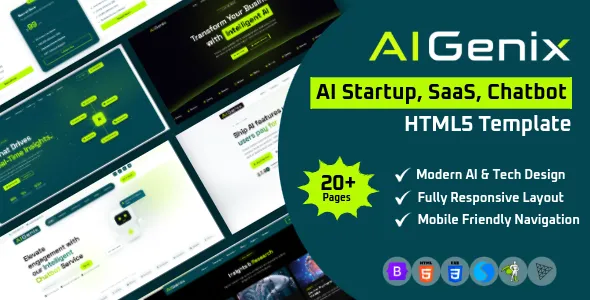
Aigenix – AI Startup, SaaS & Chatbot HTML5 Template
Aigenix – AI Startup, SaaS & Chatbot HTML5 Template is a modern website template designed for artificial intelligence startups, SaaS companies, chatbot developers, automation platforms, and technology businesses looking to establish a professional online presence. Created as a frontend foundation for AI-focused digital products, Aigenix provides a starting point for presenting innovative software solutions, explaining product capabilities, highlighting business benefits, and encouraging visitors to explore services or become customers. Whether you are launching an AI-powered startup, promoting a conversational chatbot platform, introducing a subscription-based software product, or building a website for an automation company, this HTML5 template can help you create a structured and engaging digital experience.
Artificial intelligence has become an important part of the modern technology landscape, supporting applications in customer service, content creation, workflow automation, data analysis, productivity, and business communication. As more organizations explore AI-driven products, a professional website plays an essential role in communicating what a product does, who it serves, and how it can support specific business needs.
Aigenix is intended to help developers and businesses build this type of online experience with an HTML5-based structure that can be customized for different AI and SaaS projects. Its design direction suits technology companies that want to explain complex digital solutions through clear content, organized sections, and an attractive interface. Developers can adapt the supplied pages, styling, and interactive elements to match their branding, marketing strategy, and product requirements.
As an HTML5 template, Aigenix primarily provides a frontend starting point. Features such as live chatbot conversations, AI model connections, subscription payments, user authentication, and customer dashboards require suitable backend services or third-party integrations unless explicitly included in the supplied package. This flexibility allows businesses to build an appropriate technical solution around the interface they choose.
What Is Aigenix – AI Startup, SaaS & Chatbot HTML5 Template?
Aigenix is an HTML5 website template intended for businesses operating in the artificial intelligence, software-as-a-service, chatbot, and technology sectors. It can serve as a starting point for creating a company website, software landing page, product presentation website, or marketing platform for an AI-powered application.
An effective technology website should explain its product clearly while helping visitors understand its value. Potential customers may want to know how a tool works, which problems it addresses, whether it fits their workflow, and what steps are required to get started. A well-organized website makes this information easier to find.
Aigenix can be customized to organize these messages into relevant sections, such as an introductory hero area, product explanations, feature highlights, benefits, pricing information, customer testimonials, frequently asked questions, and calls to action. The exact layouts and components included depend on the current version of the template and should be confirmed through its product preview and documentation.
Developers can adapt the website for an AI startup, a chatbot service provider, a SaaS application, an automation platform, or another technology-oriented business. Its HTML-based foundation offers flexibility for modifying page content, visual styling, navigation, and supported interactions.
Modern Website Design for AI Startups
First impressions are important for startups introducing innovative technologies. Visitors should be able to understand the company’s offering quickly, recognize its professional identity, and find relevant information without navigating through confusing layouts.
Aigenix provides a foundation for developing a contemporary website that reflects the forward-looking nature of artificial intelligence and software innovation. Developers can customize its visual presentation to suit the brand, whether the desired style is minimal and professional, bold and futuristic, or focused on enterprise technology.
A modern AI website may combine strong headlines, concise explanations, product imagery, interface previews, feature sections, and clearly defined calls to action. These elements can help communicate the product’s purpose and guide visitors through the information needed to evaluate it.
For example, an AI startup developing a business automation platform may focus on reducing repetitive work, while a chatbot company may emphasize conversational support and customer engagement. A data-focused SaaS provider might prioritize analytics, reporting, and workflow insights.
The most effective design aligns visual presentation with the actual product. Aigenix can be customized to communicate these differences while maintaining a consistent identity across the website.
SaaS Product Landing Pages
Software-as-a-Service businesses often rely on their websites to introduce a product, attract potential customers, explain subscription options, and encourage visitors to register or request a demonstration.
Aigenix can be adapted into a SaaS landing page that presents the product’s value proposition and guides visitors through its primary benefits. The page may be organized around an introductory message, product capabilities, workflow examples, pricing details, frequently asked questions, and registration prompts, depending on the available components and customization.
A strong SaaS landing page should focus on the problems a product solves rather than relying only on broad technology claims. Visitors should understand the intended audience, the main use cases, and the practical value of the software.
For example, a project management SaaS product might explain how it helps teams organize tasks, while an AI writing application may describe how users can generate and refine content. A business chatbot platform could focus on customer communication and support workflows.
Aigenix provides a starting point for presenting these messages through an organized website structure. Developers can replace placeholder content with accurate product information and connect calls to action to the appropriate registration, demo, or inquiry process.
AI Chatbot Website Development
Chatbots are used in a variety of applications, including customer support, lead qualification, information retrieval, internal assistance, and conversational experiences. A chatbot website should explain what the system can do, how users interact with it, and where its capabilities fit into a particular workflow.
Aigenix is relevant to businesses that want to promote chatbot products or AI-powered conversational services. Developers can customize the template to introduce chatbot features, explain available integrations, present example conversations, and guide potential customers toward a trial or demonstration.
A chatbot marketing website may include sections explaining supported use cases, business benefits, integration options, available plans, and frequently asked questions. The content should describe the actual functionality of the product rather than suggesting that every chatbot can perform every task.
A live conversational interface is a separate implementation concern. To provide real chatbot responses, a completed application typically needs a frontend interaction layer, a backend service, and a connection to an appropriate AI model or conversational platform. Depending on the implementation, it may also require conversation storage, authentication, usage limits, and content safety controls.
The HTML5 template can provide the presentation foundation for this experience, while the chatbot’s behavior and data processing are handled by the connected technology.
AI-Powered Business Solutions
Businesses are increasingly exploring AI tools to support tasks such as content generation, document analysis, customer communication, information retrieval, and operational automation. A professional website can help explain how these tools fit into existing business processes.
Aigenix can be customized for companies offering AI-powered business solutions. Developers can organize content around specific customer problems, explain relevant capabilities, and present examples of how the product may be used in real-world settings.
For instance, an AI productivity platform might help users organize information or draft content. An enterprise chatbot may provide access to approved internal documentation. A workflow automation solution could coordinate tasks between compatible software systems.
These examples represent possible use cases rather than guaranteed features of the template itself. The website should reflect the actual product capabilities, supported integrations, and limitations of the service being promoted.
Clear and specific messaging helps potential customers understand the value of a technology product and decide whether it is relevant to their requirements.
Feature Sections for AI and SaaS Products
Feature sections help transform a broad product description into a set of understandable capabilities. Instead of asking visitors to interpret technical terminology, a website can explain each feature in terms of what it does and why it matters.
Aigenix can be adapted to present product features through structured content blocks, illustrations, icons, screenshots, or other interface elements supported by the supplied design.
Possible feature topics for an AI or SaaS business include:
- Conversational assistance and chatbot workflows.
- Content generation and text processing.
- Workflow automation and task coordination.
- Business data organization and information retrieval.
- Reporting and analytics.
- Integration with compatible applications.
- Team collaboration and account management.
- Productivity tools for specific professional roles.
- Customizable settings and application preferences.
- Subscription options and service plans.
The relevant features depend on the product being marketed. Developers should prioritize the capabilities that make the software useful to its intended audience and avoid presenting hypothetical functions as existing product features.
Well-written feature sections can help visitors understand how a product fits their needs and provide a logical transition from the initial introduction to more detailed product information.
Clear Value Propositions and Calls to Action
A value proposition explains why a product matters to its target audience. For an AI startup, this message should describe the problem being addressed, the type of user who benefits, and the practical value the software offers.
Aigenix can serve as a foundation for presenting a concise value proposition through prominent headings, supporting text, and clearly placed calls to action. Depending on the website’s purpose, these actions may direct visitors to start a trial, request a demo, contact the sales team, view pricing, or explore product documentation.
Effective calls to action should use descriptive language and lead to a relevant destination. A button labeled for starting a trial should connect to a functioning registration or trial process, while a request-demo button should lead to an appropriate form or scheduling workflow.
Developers should also consider visitors who are not yet ready to register. Secondary links to product features, use cases, documentation, and frequently asked questions can help them learn more before making a decision.
A well-structured landing page provides a clear path through the website without overwhelming visitors with too many competing actions.
Pricing Plans and Subscription Information
Subscription pricing is an important part of many SaaS business models. Potential customers often want to understand the available plans, included usage limits, support options, and differences between subscription levels before signing up.
Aigenix can be customized to present pricing information in an organized format if the supplied template includes appropriate sections or components. Developers can create plan cards, feature comparisons, billing interval labels, and links to registration or checkout pages.
Pricing should accurately reflect the actual service. For AI products, this may include usage limits, message allowances, processing credits, model availability, storage limits, or other relevant restrictions. These details should be explained clearly so customers can compare plans without confusion.
If the website includes trial periods, discounts, or promotional offers, the conditions should be stated accurately. Pricing content should also be kept synchronized with the actual subscription system to prevent discrepancies between the marketing website and the checkout process.
The template provides the presentation layer for this information; subscription creation, payment processing, invoices, renewals, and account billing require a suitable backend or commerce integration.
Product Demonstrations and Interface Previews
Visitors often understand a software product more easily when they can see what it looks like and how it may be used. Screenshots, product mockups, workflow illustrations, and demonstration videos can help communicate the user experience.
Aigenix can be adapted to showcase an AI application through suitable visual assets and product-focused sections. Developers can replace generic imagery with genuine screenshots, relevant interface previews, and examples that accurately represent the software.
For a chatbot platform, a demonstration might show how a user asks a question and receives a response. A content-generation product could present its editing workflow, while an analytics application might highlight its reporting interface.
Demonstrations should reflect the real product and should not imply functionality that is unavailable. If examples use simulated information, they should be presented as illustrative rather than as actual customer results.
Product previews can also support different audiences. A business buyer may want to see how a solution fits into a team workflow, while a technical evaluator may look for information about integrations, customization, and implementation.
Responsive Design for Desktop, Tablet, and Mobile
A modern technology website should provide a consistent browsing experience across a variety of screen sizes. Visitors may discover an AI product from a desktop computer, a tablet, or a smartphone, and each device should offer a practical way to access essential information.
Aigenix can be customized to support responsive layouts where the supplied HTML and styling implementation provides suitable responsive behavior. Developers can adjust content widths, grid structures, typography, navigation, and spacing to suit different viewport sizes.
On desktop screens, a landing page may present multiple content columns or larger product previews. On mobile devices, these sections may need to stack vertically so visitors can read the content comfortably and interact with controls easily.
Responsive navigation is particularly important for technology websites with multiple sections. Menus should remain understandable, links should be accessible, and important calls to action should not disappear behind overlapping content.
Developers should test actual pages across common viewport sizes and browsers. Responsive behavior should be verified through practical testing rather than assumed solely because a template uses modern HTML and CSS.
HTML5 Structure and Frontend Flexibility
HTML5 provides the foundation for structuring modern websites. It supports semantic page elements, multimedia content, forms, and other building blocks used to create interactive web experiences.
As an HTML5 template, Aigenix can be a suitable starting point for developers who want direct control over their website markup and frontend presentation. Depending on the supplied source files, developers can customize page content, adjust styling, update navigation, replace images, and modify supported JavaScript interactions.
A clean structure can make the project easier to understand and maintain. Semantic elements such as headings, navigation areas, main content sections, and forms help communicate the purpose of different parts of a page.
The exact stylesheet organization, JavaScript dependencies, CSS framework, build tools, and included page layouts should be confirmed through the product documentation. Developers should avoid assuming that a particular library or integration is included unless it is explicitly listed.
For larger projects, the HTML template can potentially be adapted or integrated into an existing frontend framework, depending on compatibility and the amount of restructuring required.
Customization for Different AI Industries
Artificial intelligence is used across many industries, and different businesses need different ways to explain their software. A flexible website foundation makes it easier to tailor the presentation to the target market.
Aigenix can be customized for a variety of AI and technology use cases.
AI writing and content platforms: Present tools for drafting, editing, summarizing, and organizing written content where those capabilities are provided by the product.
Customer support chatbot services: Explain conversational support workflows, helpdesk integrations, and customer communication capabilities.
AI automation startups: Highlight supported integrations and explain how the service helps coordinate repetitive business tasks.
SaaS productivity applications: Showcase software designed to help users organize work, manage information, or complete specific tasks.
AI marketing platforms: Present campaign-related tools, content workflows, or analytics capabilities supported by the application.
Enterprise AI solutions: Explain deployment considerations, integration options, administrative controls, and business use cases relevant to organizational customers.
AI consulting companies: Introduce consulting services, implementation offerings, case studies, and technical expertise.
Technology product launches: Create a focused marketing website for a new software release, beta program, or product announcement.
These examples describe potential applications for the website template. The final design and content should be customized to the actual service, its target users, and its supported capabilities.
SEO-Friendly Website Structure
Search engine optimization can help potential customers discover an AI product when they search for relevant software, chatbot tools, SaaS solutions, or automation services. A clear website structure gives search engines and visitors a better understanding of the content on each page.
Aigenix can be customized with descriptive page titles, relevant headings, original product descriptions, useful internal links, and appropriate metadata. However, SEO performance depends on the quality of the implementation and content as well as technical and external factors; using an HTML template does not automatically guarantee rankings.
Each page should have a clear purpose. A homepage can introduce the product, a feature page can explain a specific capability, and a pricing page can describe subscription options. This structure helps visitors find information and reduces the need to place every detail on a single page.
Developers should consider the following SEO practices:
- Write unique and descriptive title tags for important pages.
- Create useful meta descriptions that accurately summarize page content.
- Use a logical heading hierarchy.
- Include relevant search terms naturally in the content.
- Add descriptive alternative text to meaningful images.
- Use readable URLs where applicable.
- Link related pages together through useful internal links.
- Configure canonical tags when necessary.
- Provide an XML sitemap for eligible pages.
- Ensure important content can be crawled and indexed.
- Optimize images and improve page loading performance.
AI-related content should be written for the intended audience rather than produced solely to repeat keywords. Specific, accurate explanations of the product and its use cases can make a website more helpful to potential customers.
Performance and Loading Speed
Website performance influences how quickly visitors can access product information and interact with important elements. A slow landing page may interrupt the visitor journey and make it harder for users to evaluate a software product.
Aigenix’s actual performance will depend on the included assets, scripts, styling, hosting configuration, and any integrations added during customization. Developers can improve performance by optimizing images, minimizing unnecessary resources, and reviewing scripts that delay the initial page display.
Large product screenshots and background images should be compressed appropriately while preserving visual clarity. Unnecessary animations and third-party scripts should be evaluated carefully because they can affect loading time and responsiveness.
If the website includes analytics tools, chat widgets, tracking scripts, or embedded media, these resources should be selected and configured thoughtfully. Each additional integration can increase the amount of code the browser needs to process.
Performance should be tested using representative pages and realistic network conditions. Developers can use browser tools and performance auditing tools to identify oversized assets, rendering delays, and other areas that may benefit from improvement.
Accessibility and User-Friendly Navigation
Accessibility helps ensure that visitors with different abilities and browsing preferences can understand and interact with the website. This is important for AI startups and SaaS companies that want their products and marketing materials to be accessible to a broad audience.
Aigenix can be customized with semantic HTML, clear navigation labels, descriptive links, accessible forms, and suitable color contrast. Interactive elements should be usable with a keyboard, and focus indicators should remain visible during navigation.
Headings should follow a meaningful hierarchy so users can understand how the page is organized. Images that communicate important information should have appropriate alternative text, while decorative images should not create unnecessary distractions for assistive technology.
Forms used for trial registration, demo requests, or contact inquiries should provide clear labels and helpful error messages. Visitors should be able to understand which fields are required and how to correct an incomplete submission.
Accessibility should be considered throughout development rather than treated as a final cosmetic adjustment. Testing the website with keyboard navigation and accessibility evaluation tools can help identify problems before launch.
Integration with AI APIs and Backend Services
A marketing website can explain an AI product, but a working AI application usually requires additional services to process user requests, manage data, and return results. Aigenix can serve as the frontend foundation for a larger application when integrated with suitable backend technologies.
Depending on the product, the backend may connect to a language model API, a chatbot platform, a document-processing service, an automation system, or another AI-related API. The frontend can then display results through the interface built around the template.
Developers should keep sensitive API credentials on the server or within an appropriate secure environment. Privileged keys should not be placed directly in public JavaScript or exposed in client-side source files.
A production AI application may also need request validation, usage limits, rate limiting, error handling, logging, authentication, and controls for managing data sent to external services. The implementation depends on the product’s purpose and the sensitivity of the information it processes.
The exact integrations available in Aigenix should be verified from the supplied documentation. API connections and AI response generation should be treated as separate development tasks unless the product explicitly includes them.
Lead Generation and Customer Conversion
For many AI startups, the website is an important channel for attracting prospective customers. A clear conversion path helps visitors move from discovering the product to taking a meaningful next step.
Aigenix can be customized to support lead generation through calls to action, contact forms, demo requests, trial-registration links, or newsletter signup sections where appropriate.
Forms should request only the information necessary for their purpose. A short demo request form may be more convenient than one that asks visitors to provide extensive details before they understand the product.
Once submitted, form information needs to be processed through an appropriate backend or service. The website should provide clear confirmation, handle errors gracefully, and protect any personal information collected from visitors.
Conversion-oriented content should remain transparent. Product claims, customer testimonials, performance comparisons, and case studies should accurately represent the underlying evidence. Avoid presenting illustrative results as verified outcomes.
A well-planned landing page can combine useful product information with straightforward next steps, making it easier for interested visitors to continue their evaluation.
Maintainability and Developer Workflow
A website template can help establish the initial visual structure of a project, but long-term maintainability depends on how developers organize and update the code.
Aigenix can provide a starting point for developers who want to customize an AI startup or SaaS website without designing every page element from scratch. After reviewing the supplied source files, developers can identify reusable patterns and determine how to organize the content for the intended product.
A practical workflow may include running the initial template, updating global styling, replacing placeholder content, connecting navigation, integrating forms, optimizing assets, and testing the final pages.
Developers should keep modifications organized, document important integrations, and avoid unnecessary duplication. Version control can help track changes and support collaboration when multiple people are working on the website.
When adding third-party scripts or libraries, check compatibility and licensing requirements. Regularly review dependencies and verify that important forms, links, and interactions continue to work after updates.
These practices can make the finished website easier to extend as the startup introduces new features, products, or marketing campaigns.
Security and Privacy Considerations
Security is important for any website that collects personal information, handles account registration, or connects to external APIs. Although a marketing template may primarily provide the frontend, the completed application should still follow appropriate security practices.
Forms should validate submitted data, and backend services should enforce authorization rules where required. API credentials and other secrets should remain outside publicly accessible frontend code.
Websites collecting contact details, trial requests, or account information should use appropriate data-handling practices and provide relevant privacy information. If the application connects to AI services, developers should understand how submitted data is transmitted, processed, stored, and retained.
A live chatbot may also require controls for abuse prevention, request limits, sensitive-data handling, and error reporting. The appropriate safeguards depend on the product’s use case and risk profile.
Aigenix does not automatically provide a complete security or privacy framework merely by supplying HTML pages. These protections must be implemented as part of the larger website or application.
Getting Started with Aigenix
Before integrating Aigenix into a project, review the product documentation, included source files, dependencies, and available layouts. Confirm that the supplied structure is compatible with the development environment and the intended use case.
A typical implementation process can include the following steps:
Step 1: Review the template package. Identify the available HTML pages, stylesheets, JavaScript files, images, fonts, and any documented dependencies.
Step 2: Run the initial website. Follow the supplied setup instructions and verify that the pages display correctly in supported browsers.
Step 3: Define the product message. Identify the target audience, main problem being solved, key capabilities, and the action visitors should take.
Step 4: Customize the design. Update the branding, colors, typography, images, headings, and page content to reflect the business.
Step 5: Connect interactive elements. Configure navigation, contact forms, registration links, and other interactions according to the website’s intended behavior.
Step 6: Integrate backend services. Add the required APIs, AI connections, account functionality, or subscription services if the project needs them.
Step 7: Optimize the website. Review SEO metadata, responsive behavior, accessibility, loading speed, and browser compatibility.
Step 8: Test before launch. Verify important user journeys, check form submissions, review error handling, and ensure that all product claims and links are accurate.
A structured development process can help turn the initial template into a polished website that supports the startup’s marketing and technical requirements.
Why Choose Aigenix – AI Startup, SaaS & Chatbot HTML5 Template?
Choosing a template focused on AI and SaaS products can provide a useful starting point for building a technology website. Aigenix is designed around the needs of AI startups, chatbot businesses, and software providers that need to communicate their offerings through a professional online presence.
Its HTML5 foundation gives developers flexibility to customize page content, refine the visual identity, and integrate suitable functionality according to the project’s requirements. The AI and SaaS focus can also help guide the organization of feature explanations, product presentations, pricing information, and conversion-oriented sections.
Potential advantages include a technology-focused design foundation, customizable content areas, opportunities for responsive layouts, and a starting point for presenting AI-related services. The actual benefits depend on the included components, documentation, source code, compatibility, and the development work required.
Before purchasing or deploying Aigenix, review its live preview, licensing terms, available pages, technical requirements, and documentation. Verify whether any desired features, such as live chatbot functionality, pricing interactions, or registration workflows, are included or require additional implementation.
Conclusion
Aigenix – AI Startup, SaaS & Chatbot HTML5 Template provides a starting point for building a modern website for artificial intelligence companies, SaaS platforms, chatbot providers, and technology startups. Its intended focus makes it relevant to businesses that need to explain digital products, highlight software capabilities, present subscription information, and guide visitors toward meaningful actions.
With thoughtful customization, Aigenix can be adapted to introduce AI tools, showcase product interfaces, describe automation workflows, and communicate the value of a software service. Developers can extend the HTML foundation with appropriate backend systems, AI APIs, account management, subscription billing, and other application features according to their requirements.
For the best results, prioritize clear messaging, accurate product information, responsive design, accessible navigation, search-friendly content, and secure integration practices. By combining a well-organized frontend with reliable application functionality, Aigenix can serve as a useful foundation for an engaging AI startup, SaaS, or chatbot website.