My Account
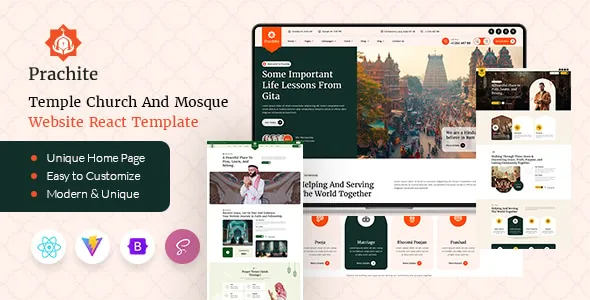
Prachite – Temple Church And Mosque Website React Template
Prachite – Temple Church And Mosque Website React Template is a versatile website template designed for religious organizations, temples, churches, mosques, spiritual centers, and faith-based communities looking to establish a professional online presence. Built around the needs of religious and community-focused websites, Prachite offers a starting point for presenting spiritual activities, sharing organizational information, publishing announcements, and helping visitors discover important services and events. Its React-based foundation makes it relevant for developers and website creators who want to build a modern religious website with a structured interface and customizable content.
A religious website serves as more than an online information page. It can help community members stay informed about worship schedules, festivals, prayer gatherings, ceremonies, educational programs, charitable initiatives, and other important activities. A well-organized website also gives newcomers a convenient way to learn about an institution, understand its traditions, explore its services, and find contact information. With appropriate customization, Prachite can be adapted to reflect the identity, values, and communication needs of different religious institutions.
Whether you are developing a website for a Hindu temple, Christian church, Islamic mosque, spiritual organization, or community service center, the template can provide a foundation for presenting information in a clear and accessible format. Its final capabilities depend on the supplied template version, included components, configuration, and any additional integrations used during development. By combining suitable layouts with authentic content, meaningful imagery, and accessible navigation, website owners can create a welcoming digital space for their communities.
What Is Prachite Temple Church And Mosque Website React Template?
Prachite is a religious website React template intended for projects related to temples, churches, mosques, and other faith-based organizations. It provides a frontend starting point for creating a website that introduces an institution, communicates its activities, and organizes information for members, visitors, and the wider community.
React is a JavaScript library used to build interactive user interfaces from reusable components. For website developers, this component-based approach can make it easier to organize page sections, maintain consistent design elements, and update the interface as project requirements evolve. Developers familiar with React can adapt supported components and layouts to suit the specific needs of a religious organization.
A temple website may focus on daily worship, religious festivals, rituals, spiritual education, and community activities. A church website may emphasize worship services, ministries, Bible study, youth groups, pastoral information, and outreach programs. A mosque website may prioritize prayer times, Friday prayers, Islamic education, Ramadan activities, community announcements, and charitable initiatives.
Prachite can serve as a starting point for these different use cases, provided the selected design and available components match the intended project. Before implementation, developers should review the included files, setup instructions, dependencies, responsive behavior, and documented features to understand the template’s actual capabilities.
Website Solutions for Temples
Temples often serve as important spiritual, cultural, and community centers. Their websites can help devotees discover worship schedules, learn about religious traditions, find festival information, and understand the services available at the temple.
Prachite can be customized for a Hindu temple or another temple-based institution that wants to share useful information online. A well-planned temple website may include an introduction to the temple, information about deities, daily darshan timings, puja services, festival announcements, special ceremonies, and directions for visitors.
The homepage can introduce the temple’s identity and highlight upcoming religious events. Dedicated pages can provide additional information about worship practices, traditional celebrations, community programs, and visitor arrangements. If the institution offers spiritual classes or cultural activities, these can be presented in separate sections for easier navigation.
Images should be selected carefully to represent the institution accurately and respectfully. Original photographs of the temple, its architecture, authorized ceremonies, and community activities can help visitors understand the environment before arriving.
Information about timings, special events, donations, and visitor guidelines should be checked regularly. Accurate details help devotees plan visits and reduce confusion during busy religious occasions.
Website Solutions for Churches
A church website provides a central place for communicating worship schedules, church activities, community programs, and information about the congregation. It can support regular members while helping newcomers understand the church’s mission, services, and opportunities to participate.
Prachite can be adapted for churches that need a professional website to present Sunday services, prayer meetings, Bible study groups, youth activities, pastoral information, and community outreach initiatives. Depending on the institution’s requirements, the website may also include sermon resources, ministry introductions, event calendars, and church news.
The homepage should make essential information easy to locate. Visitors should be able to identify service times, find the church address, explore its ministries, and learn how to contact the relevant team.
Separate pages can explain the church’s history, beliefs, leadership, community programs, and upcoming events. If the church publishes sermons or educational resources, these materials can be organized into an accessible library using suitable content-management or media tools.
A welcoming design and clear language can help visitors understand what to expect when attending a service. Contact details, accessibility information, parking guidance, and visitor instructions may also be useful additions.
Website Solutions for Mosques
A mosque website can help Muslim communities access prayer information, religious announcements, educational programs, and details about community services. It can also provide a convenient way for visitors to learn about the mosque and its activities.
Prachite can be configured as a starting point for a mosque website featuring prayer schedules, Jumu’ah information, Ramadan announcements, Islamic classes, community gatherings, and charitable initiatives. The content structure should reflect the mosque’s actual services and the information most frequently requested by its congregation.
A dedicated prayer information section can display the mosque’s published prayer timetable. If automated prayer-time calculations are required, the website may need a compatible plugin, API, or custom integration. The accuracy of the displayed schedule should be verified for the mosque’s location and local practices.
Additional sections can introduce the mosque’s leadership, educational activities, community support programs, and visitor information. During Ramadan and other important periods, the website can highlight relevant announcements and schedules.
Clear navigation is particularly useful when visitors need time-sensitive information. Important notices should be easy to find, and any schedules or announcements should be updated by authorized staff to avoid displaying outdated details.
Responsive Design for Desktop and Mobile Devices
Visitors may access a religious website using desktop computers, laptops, tablets, and smartphones. Responsive design helps content adapt to different screen sizes so that visitors can read information and navigate the website conveniently.
Prachite is positioned as a website React template for modern religious organizations, making mobile usability an important consideration during implementation. The actual responsive behavior should be tested in the supplied version rather than assumed from the template’s title alone.
On smaller screens, headings should remain readable, navigation should be easy to operate, and important information should not require excessive scrolling or horizontal movement. Buttons, contact links, event details, and form fields should remain accessible on touchscreens.
Mobile visitors may be looking for immediate information, such as a prayer schedule, worship service time, temple address, or festival announcement. Organizing these details near the top of relevant pages can improve the overall experience.
Developers should test all major page types at different viewport widths. Images, galleries, tables, navigation menus, and embedded media may need specific adjustments. Custom styles and third-party integrations should also be checked to ensure that they do not interfere with responsive layouts.
Modern Layouts for Religious Organizations
A religious website needs a design that communicates its identity while keeping essential information easy to understand. A structured layout helps visitors move from a general introduction to specific details about services, events, educational activities, and community programs.
Prachite can be used as a starting point for organizing these content areas according to the needs of a particular institution. The final layout should be guided by the available components and the organization’s communication priorities.
A temple website may emphasize spiritual imagery, festival announcements, traditional architecture, and worship information. A church may highlight service schedules, ministries, sermons, and community outreach. A mosque may place prayer information, religious education, Ramadan notices, and charitable activities near the top of its navigation structure.
Consistency across pages helps visitors understand the website. Reusable headers, footers, navigation elements, buttons, and content sections can create a cohesive interface when supported by the implementation.
Not every organization needs a large number of pages. A small place of worship may benefit from a concise website with essential information, while a larger religious center may need dedicated sections for education, events, community services, and publications.
Homepage Design and Essential Information
The homepage is often the first point of contact between a religious institution and an online visitor. It should quickly explain the institution’s identity and guide people toward the information they need most.
A Prachite-based website can be organized around an introductory banner, a short institutional overview, featured activities, upcoming events, service information, community initiatives, and contact details. The precise sections should be selected according to the available template structure and the institution’s objectives.
A clear introductory headline can identify the temple, church, mosque, or spiritual center. Supporting text can explain its purpose, location, and role in the community.
Important information should be easy to find without requiring visitors to navigate through several unrelated sections. For example, service schedules, prayer details, upcoming festivals, and contact information may deserve prominent placement.
Featured announcements can direct visitors toward special gatherings, educational programs, charity activities, or seasonal celebrations. Each announcement should provide accurate dates and any relevant participation details.
A useful homepage prioritizes clarity over unnecessary decoration. Every section should help visitors understand the institution, find important information, or take a relevant next step.
Religious Events and Festival Announcements
Religious institutions often organize recurring worship services, annual festivals, seasonal celebrations, ceremonies, educational sessions, and community gatherings. A website can help communicate these activities to both regular members and new visitors.
Prachite can provide a frontend starting point for displaying event-related information. Depending on the included components, developers may be able to create event cards, announcement sections, or dedicated event pages. More advanced scheduling and registration features may require additional development or compatible integrations.
Each event listing should include the event name, date, time, location, and a concise description. Where appropriate, the page can also explain registration requirements, visitor arrangements, dress guidelines, or other relevant information.
A temple might publish festival schedules, special puja arrangements, and cultural programs. A church could announce worship services, retreats, study sessions, and outreach events. A mosque might share Ramadan timetables, lectures, community gatherings, and charitable activities.
For institutions that hold frequent events, a calendar interface may improve organization. Before adding a calendar or registration system, developers should confirm compatibility with the React project and determine whether event information will be maintained manually or managed through a backend service.
Keeping event details current is essential. Past events should be archived or clearly marked as completed so visitors do not mistake old announcements for upcoming activities.
Spiritual Education and Learning Resources
Many religious organizations provide educational opportunities for children, young people, adults, and families. These may include scripture study, religious instruction, cultural learning, lectures, discussion groups, and introductory sessions for newcomers.
A Prachite website can be customized to present educational programs in a structured format. Separate pages can explain the purpose of each program, its intended audience, schedule, location, and registration process where applicable.
A temple may publish information about spiritual classes, cultural education, or traditional practices. A church may provide Bible study schedules, youth ministry information, and sermon resources. A mosque may share Quran learning programs, Islamic lectures, and religious education opportunities.
Educational resources can also be presented through articles, downloadable documents, recordings, or links to approved external materials. The specific delivery method depends on the organization’s needs and the technical capabilities of the completed website.
If online classes or member-only learning areas are required, additional functionality may be necessary. Developers should assess authentication, content permissions, media hosting, privacy, and maintenance requirements before implementing these features.
Well-organized educational content helps visitors identify relevant opportunities and understand how to participate.
Community Services and Charitable Activities
Religious organizations frequently support their communities through charitable initiatives, volunteer activities, food distribution, counseling referrals, social programs, and assistance for people in need. A website can help explain these initiatives and communicate ways to participate.
Prachite can be adapted to introduce community services through dedicated content sections. These pages can describe the purpose of each initiative, the people it serves, how volunteers can contribute, and whom visitors should contact for further information.
A temple may organize community meals, cultural programs, or local support activities. A church might coordinate food assistance, volunteer outreach, or family support programs. A mosque may provide community aid, educational support, or charitable distribution during religious occasions.
Information should be presented respectfully and accurately, particularly when programs involve vulnerable individuals or sensitive personal circumstances. Avoid publishing private details or identifiable photographs without appropriate permission.
If the organization accepts donations online, the website may require a secure payment provider or a dedicated donation integration. Such functionality should not be assumed to be included in the frontend template. Payment processing, donor records, receipts, privacy, and applicable legal requirements should be reviewed before launch.
Donation Information and Support Options
Donations can help religious institutions maintain their facilities, organize community programs, support charitable work, and fund educational or cultural activities. A clear donation page can explain how contributions support the institution and how people can use approved payment methods.
Prachite can serve as a visual foundation for presenting donation information, subject to the included layout options. A basic information page may explain the institution’s needs and provide verified payment instructions, while a more advanced donation experience may require a payment gateway or fundraising service.
Donation information should be transparent and easy to understand. Explain the intended purpose of contributions and provide appropriate contact details for questions about donations, receipts, or payment issues.
If online payments are integrated, developers should use reputable payment providers and follow their security and compliance requirements. Sensitive payment information should be handled by the payment provider rather than stored unnecessarily by the website.
Religious organizations should verify local rules concerning charitable fundraising, tax documentation, financial reporting, and donation receipts before publishing claims about tax benefits or eligibility.
A carefully designed donation experience can make support options easier to understand while protecting the trust of community members.
About Us and Institutional History
An About page helps visitors understand a religious institution’s identity, history, beliefs, leadership, and role in the community. It can also provide useful background for newcomers who want to learn more before visiting.
A Prachite-based website can include an institutional introduction tailored to the organization. The page may describe the institution’s founding, its mission, the activities it supports, and its relationship with the local community.
A temple may explain its history, traditions, architectural significance, and religious activities. A church may introduce its congregation, statement of faith, pastoral leadership, and ministries. A mosque may provide information about its community, educational services, leadership, and religious activities.
The content should be written in clear, respectful language appropriate to the institution and its audience. If historical details, religious statements, or leadership information are included, they should be reviewed by authorized representatives.
Photographs and supporting media can make the page more informative, provided the organization has permission to publish them. A thoughtful About page gives visitors a clearer understanding of the institution without overwhelming them with unnecessary details.
Contact Information and Visitor Guidance
A religious website should make it easy for people to contact the institution and find its physical location. Visitors may need directions, service details, accessibility information, event guidance, or help identifying the correct department.
Prachite can be customized to present contact information through a dedicated page, footer section, or other available layout. Useful details may include the institution’s address, telephone number, official email address, office hours, and links to verified social media profiles.
A map embed or directions link can help visitors navigate to the location. Developers should use a suitable mapping service and check its privacy implications, loading behavior, and mobile usability.
Contact forms can collect questions or general inquiries, but their fields should be kept practical. A simple form may request a name, email address, subject, and message. Sensitive religious, financial, or personal information should not be requested unless there is a clear need and appropriate protection.
All forms should be tested for validation, successful submission, error handling, spam prevention, and email delivery. If a form requires a backend service, that functionality must be configured separately where it is not already provided.
Accurate contact details and useful visitor guidance help make the website more welcoming and practical.
React Component-Based Development
React provides a component-based approach to building user interfaces. Instead of maintaining every page as one large block of code, developers can organize repeated elements into smaller components that can be reused across the application.
For a religious website, reusable components might include navigation menus, page headers, event cards, information panels, service summaries, contact sections, and footers. The exact component structure depends on the supplied Prachite codebase.
A modular structure can make it easier to update shared design elements and maintain consistency across multiple pages. For example, updating a common navigation component may allow the change to appear across all pages that use it.
Developers can also organize content according to the institution’s requirements. A reusable event component could display different festival announcements, while a common information section could introduce multiple community programs using a consistent layout.
Before making changes, review the project’s directory structure, component conventions, dependencies, and setup documentation. The available build tools, routing approach, styling system, and supported React version should be confirmed from the supplied files rather than assumed.
This preparation helps developers customize the template more efficiently and reduces the risk of introducing unnecessary complexity.
Customization and Visual Branding
Every religious organization has its own identity, traditions, audience, and communication style. Customization helps the completed website reflect those characteristics instead of appearing like an unmodified template.
Depending on the supplied version and its styling approach, Prachite may be adaptable through changes to colors, typography, images, content sections, spacing, navigation, and other visual elements. Developers should check the included source files to determine how these settings are organized.
A temple may use imagery that reflects its architecture and cultural traditions. A church may prefer photographs of its building, congregation, worship spaces, and community activities. A mosque may use appropriate architectural photography, geometric design elements, and clear presentation of prayer information.
Visual choices should remain respectful and consistent with the institution’s identity. Decorative elements should not make important content difficult to read, and imagery should support the message rather than distract from it.
Use a consistent typography system for headings, body text, buttons, and captions. Maintain readable contrast between text and background colors, and ensure that important links are easy to identify.
Before publishing, replace all placeholder text and sample images with authorized content. Review every page to confirm that the final design represents the institution accurately.
SEO-Friendly Website Structure
Search engine optimization can help people discover a religious organization when searching for worship schedules, community programs, educational activities, or information about a place of worship.
Prachite can provide a frontend starting point for an SEO-conscious website, but search visibility depends on many factors beyond the template. Content quality, technical configuration, local competition, website performance, indexing, and external signals can all influence results.
Create descriptive page titles and headings that reflect each page’s purpose. A temple might have separate pages for visitor information, festivals, worship services, and educational programs. A church could organize content around service schedules, ministries, sermons, and community outreach. A mosque might create dedicated pages for prayer information, religious education, Ramadan activities, and charitable services.
Use clear URLs and connect related pages through internal links. For example, an event announcement can link to visitor information, while a community program page can link to the appropriate contact details.
Images should have descriptive alternative text when they convey meaningful information. Image dimensions and file sizes should also be optimized to support efficient loading.
Developers should review React-specific SEO requirements, including how page metadata is generated and whether important content is available to search engines. Depending on the implementation, server-side rendering, static generation, or other rendering strategies may need to be configured separately.
An SEO plugin or external service should not be assumed to work automatically with every React project. Review the actual architecture and choose compatible tools where required. No template can guarantee a specific ranking or volume of organic traffic.
Website Performance and Loading Speed
Performance affects how quickly visitors can access important information. A fast and responsive website is particularly useful for people checking service times, event schedules, directions, and announcements from mobile devices.
The performance of a Prachite website depends on the source code, hosting environment, image assets, JavaScript bundles, external integrations, and any custom features added during development.
Start by optimizing images and using appropriate dimensions for the spaces in which they appear. Large photographs can often be compressed without noticeably reducing visual quality. Where suitable, modern image formats and responsive image techniques can help reduce unnecessary downloads.
Review JavaScript dependencies and avoid adding packages that provide little practical value. Unnecessary animation, oversized media, and multiple third-party widgets can increase loading time and complicate maintenance.
Developers should test the homepage and important internal pages rather than evaluating performance from a single screen. Event sections, image galleries, maps, and embedded video may have different performance characteristics.
Caching, hosting improvements, code splitting, and other optimization techniques may be appropriate depending on the project’s implementation. Use performance measurements to identify the main problems before introducing additional tools.
Accessibility and User-Friendly Navigation
A religious website should make its information accessible to visitors with different devices, abilities, and levels of technical experience. Clear navigation and readable content help people find the information they need without unnecessary difficulty.
Use descriptive menu labels, logical heading structures, sufficient color contrast, and readable text sizes. Buttons and links should have clear purposes, while form fields should include appropriate labels and understandable validation messages.
Images that convey information should include meaningful alternative text. Decorative images can be handled appropriately so they do not create unnecessary interruptions for screen-reader users.
Interactive elements should be usable with a keyboard where applicable. Visible focus indicators help users understand which element is currently selected, and navigation menus should not depend exclusively on hover interactions.
Keep important information, such as worship times, prayer schedules, event dates, and contact details, easy to locate. Avoid presenting essential information only through an image when it can also be provided as readable text.
Accessibility depends on the completed implementation and the content entered into the template. Conduct practical testing across devices and input methods, and review automated accessibility results as part of the development process.
Integrations and Additional Website Features
A religious website may need functionality beyond its basic frontend layout. Depending on the institution’s objectives, additional integrations could support event management, online donations, prayer-time information, contact forms, newsletters, video resources, or content publishing.
Prachite should be evaluated against these requirements before development begins. A React template primarily provides a starting point for the user interface unless the supplied package explicitly includes a backend or other functional services.
A contact form may need an API or form-handling service to deliver messages. Online donations require a compatible payment provider. Dynamic prayer schedules may need a data source or calculation service. An event registration system may require a backend, database, or third-party event platform.
Developers should also review authentication, permissions, privacy, and data-retention requirements before adding features that collect personal information.
Avoid assuming that a visual button automatically performs a real action. Every form, registration link, payment workflow, and interactive component should be connected to its intended service and tested thoroughly.
A well-planned integration strategy keeps the website useful without adding unnecessary dependencies.
Security and Website Maintenance
Regular maintenance helps keep a religious organization’s website reliable, accurate, and secure. Even a well-designed frontend requires attention when dependencies, content, integrations, and hosting settings change.
Developers should follow the project’s documented installation and update process. Review dependency versions, security advisories, and compatibility before upgrading packages. Test changes in a development or staging environment before deploying them to a live website.
If the website connects to a backend or external API, protect credentials and secret keys. Private credentials should not be embedded in publicly accessible frontend code. Use appropriate server-side configuration and access controls where required.
Contact forms and donation integrations should be configured with suitable validation and security measures. Limit the collection of personal information to what the institution genuinely needs, and publish clear privacy information where applicable.
Regular backups should cover the data and services that require recovery, including website files and any connected content database. The backup and restoration process should be tested periodically.
Content maintenance is equally important. Review worship schedules, prayer times, contact details, event announcements, leadership information, and donation instructions to ensure they remain accurate.
Who Should Use Prachite Temple Church And Mosque Website React Template?
Prachite may be suitable for a range of religious and community-focused website projects, depending on the supplied design, supported components, and customization requirements.
Hindu temples: Create a website for temple information, darshan timings, puja services, festivals, ceremonies, and community activities.
Christian churches: Present worship schedules, ministries, Bible study groups, sermons, church announcements, and outreach programs.
Islamic mosques: Share prayer schedules, Jumu’ah details, Ramadan announcements, educational programs, and community information.
Spiritual centers: Introduce meditation sessions, spiritual education, workshops, gatherings, and related activities.
Religious trusts: Organize information about institutional activities, charitable programs, community initiatives, and public announcements.
Faith-based educational organizations: Present classes, lectures, learning resources, schedules, and registration information.
Community service organizations: Explain volunteer opportunities, charitable projects, support programs, and ways to participate.
Religious event organizers: Publish event information, ceremony schedules, festival announcements, and visitor guidance.
Before selecting the template for a live project, review the actual demo, source code, documentation, included pages, dependencies, and responsive behavior. This helps determine whether the template meets the organization’s technical and design requirements.
Tips for Building a Successful Religious Website
Start by identifying the primary purpose of the website. Decide whether the institution mainly needs to share worship schedules, announce events, introduce its services, publish educational content, support donations, or provide several of these functions.
Plan the navigation around the information visitors need most. A simple structure might include Home, About, Services, Events, Community, and Contact, with additional pages introduced only when they provide clear value.
Prepare accurate content before customizing every section. Confirm institutional details, schedules, contact information, event dates, and visitor guidance with authorized representatives. Replace placeholder content and sample imagery before launch.
Use original or properly licensed images that represent the institution respectfully. Maintain consistent typography, colors, spacing, and heading styles throughout the website.
Test the complete experience on desktop and mobile devices. Check navigation, buttons, forms, links, image display, accessibility, loading speed, and any third-party integrations.
If the website includes dynamic schedules, online donations, or registration tools, verify that the underlying services are configured correctly. Do not publish features until they have been tested with realistic scenarios.
Finally, establish a maintenance routine for software updates, backups, security checks, and content reviews. A religious website is most useful when its information remains accurate and its important features continue to work.
Final Thoughts on Prachite Temple Church And Mosque Website React Template
Prachite – Temple Church And Mosque Website React Template is a potential starting point for developers and organizations seeking to establish a digital presence for a temple, church, mosque, spiritual center, or faith-based community. Its religious website focus makes it relevant to projects that need to communicate institutional information, worship schedules, community activities, events, and educational resources.
With thoughtful customization, the website can present essential information in a clear structure while reflecting the organization’s identity and traditions. Temples can emphasize festivals and worship information, churches can highlight services and ministries, and mosques can prioritize prayer schedules, religious education, and community announcements.
The final result depends on the supplied template version, available components, React implementation, and any additional integrations required. Developers should review the documentation and test the actual source code before relying on specific features.
A successful religious website also requires accurate content, accessible navigation, responsive testing, appropriate security practices, and regular maintenance. The template alone cannot guarantee search rankings, visitor engagement, or particular business outcomes, but it can provide a useful foundation for building a well-organized and welcoming online resource.
For religious institutions looking to improve communication with their communities, Prachite can be evaluated as part of a broader website development strategy focused on usability, trust, accessibility, and reliable information.