My Account
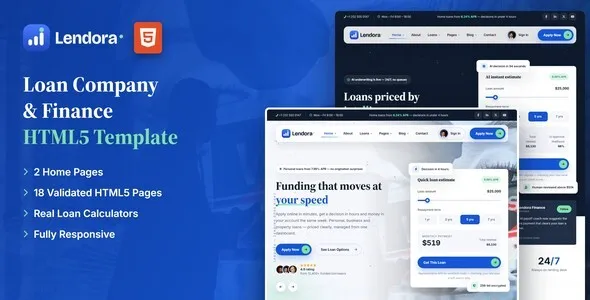
Lendora – Loan & Finance HTML5 Template
Lendora – Loan & Finance HTML5 Template is a website design solution for financial service providers, lending companies, loan consultants, credit service businesses, and finance-focused organizations looking to establish a professional online presence. Designed for loan and finance-related website projects, this HTML5 template can provide a structured starting point for presenting financial services, explaining loan options, sharing business information, and helping visitors understand how to contact a provider. With suitable customization, Lendora can support a website that communicates professionalism, clarity, and trust in a field where visitors often need straightforward information before making important financial decisions.
A well-organized financial website should make it easy for users to explore available services, understand the general application process, review relevant information, and find answers to common questions. Whether you operate a personal loan consultancy, a business lending service, a mortgage advisory firm, a credit assistance company, or a financial consulting organization, a suitable website layout can help present your services in an accessible format. Lendora can be evaluated as a foundation for building a finance-oriented website that reflects your brand identity and communicates your business offerings.
HTML5 provides a familiar foundation for developing structured web pages, while customization through CSS, JavaScript, and compatible integrations can help adapt the presentation to specific business requirements. The final functionality depends on the template version, included files, and any additional development work. By combining a suitable layout with accurate financial information, clear navigation, and responsible communication, businesses can create a website that supports customer engagement and provides a convenient starting point for online inquiries.
What Is Lendora – Loan & Finance HTML5 Template?
Lendora is a loan and finance website template intended for businesses that need a digital platform to introduce their services and share financial information. An industry-focused template can help reduce the initial design work involved in creating a website by providing a starting structure that developers can customize to match their requirements.
Financial service providers often need to communicate several types of information, including company details, loan categories, eligibility considerations, application steps, contact information, and frequently asked questions. A dedicated website structure can organize these details into clearly defined sections, helping visitors navigate the content without unnecessary confusion.
Lendora may be considered for websites serving personal lending, business financing, loan advisory, mortgage consulting, credit services, financial planning, or related professional activities. The exact page layouts and included components should be checked against the current template demo and documentation before purchase or implementation.
As an HTML5 template, Lendora is a front-end website foundation rather than a complete financial management platform by default. A working loan application system, customer account area, payment gateway, eligibility calculator, or loan management dashboard may require additional programming, server-side development, and third-party integrations.
Website Design for Loan and Financial Services
Financial websites need to balance professional presentation with clear communication. Visitors may be comparing service providers, researching lending options, or trying to understand the general steps involved in requesting financial assistance. A well-structured website helps them locate relevant information and make more informed decisions about whether to contact the business.
Lendora can provide a starting point for organizing a finance-focused website around the services a business actually offers. Depending on the available layout, the site may be customized to introduce the company, highlight its services, explain the inquiry process, provide educational resources, and present convenient contact options.
A financial business should avoid overwhelming visitors with complicated terminology or lengthy blocks of unexplained text. Short sections, descriptive headings, consistent spacing, and clear navigation can make important information easier to understand.
Visual elements should support the message rather than distract from it. Professional imagery, restrained colors, readable typography, and a consistent visual hierarchy can help create a dependable presentation. The design should also reflect the business’s actual identity and avoid implying regulatory approval, financial guarantees, or affiliations that do not exist.
Suitable for Different Loan Businesses
Lendora can be evaluated for a range of loan-related and finance-oriented business websites. Its suitability depends on the actual template features, available page structures, and the level of customization required.
Personal loan service providers: A personal lending business may need pages describing its services, general eligibility requirements, application steps, and contact options. Any published interest rates, fees, and terms should be accurate and clearly explained.
Business loan consultants: Organizations supporting small businesses and entrepreneurs can use a finance-oriented website to introduce funding consultation services, explain the information clients may need to prepare, and describe the consultation process.
Mortgage advisory firms: Mortgage consultants can organize information about their advisory services, common home-financing questions, documentation requirements, and consultation appointments. Actual lending terms should be presented only when verified and applicable.
Credit assistance services: Businesses offering credit-related guidance can explain their services, outline their process, and provide educational resources. Claims about improving credit scores or obtaining approvals should be realistic and supported by evidence.
Financial consulting companies: Consultants can introduce their expertise, explain their professional services, publish educational articles, and offer contact options for prospective clients.
Loan comparison services: A business that helps customers compare lending options may use the template as a visual foundation, while the comparison engine, live financial data, and lender connections would require appropriate development and data sources.
Before selecting Lendora for a particular business, confirm that the template’s actual layouts and licensing terms align with the intended project.
Homepage Layout and Content Organization
The homepage is an important introduction to a financial services business. It should help visitors understand what the organization offers, who its services are intended for, and where to find more information.
A Lendora-based website can be organized around a clear introductory section, a summary of services, information about the company, an explanation of the inquiry process, educational content, and contact details, depending on the available template components.
The opening section should communicate the main offering in straightforward language. A heading might introduce the type of financial service provided, while supporting text explains the audience served and directs visitors toward the appropriate information.
A service overview can help users navigate to dedicated pages for different offerings. Each service page should explain the service’s purpose, important conditions, and the steps involved in requesting further information.
Additional homepage sections may include company credentials, genuine client feedback, frequently asked questions, or recent articles. These sections should be included only when the business can provide accurate information. Testimonials must be authentic and published with appropriate permission.
A clear contact section can help interested visitors find the correct communication channel. Contact forms, telephone details, business addresses, and operating hours should be maintained carefully so that inquiries reach the right destination.
Present Financial Services Clearly
Loan and finance websites should explain their offerings in a way that helps visitors understand the differences between available services. Clear descriptions can reduce uncertainty and help users identify the information they need before making an inquiry.
With Lendora, service descriptions can be organized into dedicated pages or clearly separated content sections, depending on the available layouts. Each page should focus on one main service and answer the questions a prospective customer is most likely to have.
For example, a business financing page could explain the types of businesses served, the general purpose of the service, the documents that may be requested, and how an initial consultation works. A personal finance consultation page might describe the guidance available and clarify that the outcome depends on the individual’s circumstances.
Avoid presenting all services with identical descriptions. Each offering should have relevant details, appropriate terminology, and a clear explanation of its purpose.
Financial claims must be handled carefully. Do not advertise guaranteed approval, guaranteed savings, fixed rates, or specific funding outcomes unless the claims are accurate, properly substantiated, and compliant with applicable requirements. When terms vary by lender or customer circumstances, explain that clearly.
Responsive Website Experience
A responsive website adapts its layout to the screen size and device being used. This matters for financial businesses because visitors may browse services on a desktop computer, research loan information on a tablet, or use a smartphone to contact a consultant.
Lendora is presented as an HTML5 website template for loan and finance services, but its exact responsive behavior should be verified through the current demo and documentation. Developers should test the installed version across multiple screen sizes before launching the website.
On smaller displays, headings should remain readable, paragraphs should fit comfortably within the viewport, and navigation should be easy to operate. Buttons and form controls should have sufficient space for touch interaction, while essential contact details should remain easy to locate.
Responsive testing should include more than the homepage. Service pages, article layouts, inquiry forms, tables, and any calculator interfaces can behave differently on narrow screens.
Custom CSS, JavaScript plugins, third-party widgets, and embedded content may affect responsive behavior. Testing after significant design changes helps identify layout problems before they affect visitors.
Customization and Brand Identity
A finance website should look consistent with the organization it represents. Customization makes it possible to adapt a template’s appearance to the company’s brand, audience, and communication style.
Depending on the included files and implementation, developers may be able to modify colors, typography, spacing, images, page layouts, buttons, icons, and navigation elements using HTML, CSS, and JavaScript. The exact customization options should be confirmed in the template documentation.
A lending company may prefer a clean and structured visual identity, while a financial consultancy may emphasize informative content and professional credentials. The chosen design should remain consistent throughout the website and should not sacrifice readability for decorative effects.
Use genuine business information and relevant imagery wherever possible. Replace demonstration text, placeholder logos, sample contact details, and stock testimonials before publishing the site.
Developers should keep customizations organized so that later updates and maintenance remain manageable. Maintaining a backup of the original template files is also useful before making extensive modifications.
HTML5, CSS, and JavaScript Foundation
HTML5 provides the markup used to structure website content, including headings, paragraphs, navigation, forms, images, and other page elements. CSS controls the presentation, such as colors, typography, spacing, and layout. JavaScript can support interactive behavior where it is included or added by the developer.
Together, these technologies provide a flexible foundation for creating and customizing a loan and finance website. Developers can adapt page content, adjust the visual presentation, and implement front-end interactions according to the project’s needs.
However, the presence of HTML5 does not automatically mean that a template includes a complete backend system. Features that store customer data, process applications, authenticate users, calculate lending eligibility, or communicate with financial institutions require additional implementation where not already supplied.
Before development begins, review the included directory structure, stylesheet files, scripts, documentation, and licensing conditions. Understanding how the template is organized can make customization more efficient and reduce unnecessary changes.
For websites that handle sensitive financial information, backend architecture, access controls, secure data transmission, and appropriate testing should be treated as essential parts of the project rather than optional design enhancements.
Loan Application Forms and Customer Inquiries
A website can help a financial service provider receive inquiries and guide prospective customers toward the next step. A simple contact form may be sufficient for an initial consultation, while a detailed loan application requires a more carefully designed process.
Lendora can be customized with inquiry forms or application interfaces if the available markup supports them or if developers add the necessary components. A functional form requires more than a visual layout: it must validate submissions, handle errors, deliver or securely store information, and provide appropriate confirmation to the user.
For an initial inquiry, collect only the information needed to respond. This might include a name, preferred contact method, type of service, and a brief message. Avoid collecting sensitive financial documents or unnecessary personal details through an ordinary contact form.
A full application workflow may require server-side validation, secure storage, access permissions, audit records, and appropriate privacy notices. Where relevant, the system should also explain how submitted information will be used and retained.
Before launch, test successful submissions, missing required fields, invalid input, spam protection, error messages, and notification delivery. Confirm that inquiries reach an authorized person and that customer data is handled appropriately.
Financial Calculators and Interactive Tools
Financial calculators can help visitors understand illustrative repayment scenarios or estimate costs using information they provide. For some finance websites, tools such as loan repayment estimators, interest calculators, or affordability guides can make the content more practical.
Whether Lendora includes a calculator should be confirmed from its current demo and documentation. If the required component is not included, a developer can create an appropriate calculator using JavaScript or a compatible service.
A calculator should clearly state its assumptions and explain the values used in its calculations. For example, an estimate may depend on the principal amount, interest rate, repayment period, payment frequency, and calculation method.
Results should be presented as estimates rather than promises. Actual loan terms may differ because of fees, taxes, lender policies, customer eligibility, changing interest rates, or other conditions.
Calculators should be tested against independently verified examples, including edge cases such as zero values, invalid entries, and unusually large amounts. The interface should also remain usable on mobile devices.
A calculator alone does not constitute a loan approval system or replace professional financial advice. Any tool used for actual lending decisions requires appropriate validation, security, and compliance review.
Search Engine Optimization for Finance Websites
Search engine optimization can help prospective customers discover relevant pages through search engines. A suitable template provides only part of the foundation; effective SEO also depends on useful content, technical implementation, competition, site reputation, and the needs of the intended audience.
When customizing Lendora, create a logical website structure with descriptive page titles, meaningful headings, clear URLs, and content focused on the questions visitors are likely to ask. Each important service should have its own page when that separation provides genuine value.
A personal lending business could publish educational content about application steps or commonly used financial terms. A business finance consultancy might explain funding considerations for small businesses. Such content should be accurate, current, and written to help readers rather than merely repeat keywords.
Images should use suitable dimensions and descriptive alternative text where appropriate. Internal links can connect related service pages, articles, and contact information.
Developers may configure metadata, XML sitemaps, canonical URLs, structured data, and other technical SEO elements as needed. The implementation depends on the actual template and any tools added to the project.
Financial content requires particular care because readers may rely on it when making consequential decisions. Avoid misleading promises, unsupported statistics, and outdated information. No HTML template can guarantee a specific search ranking or amount of traffic.
Website Speed and Performance
A responsive and well-organized website should also load efficiently. Slow pages can make it harder for visitors to compare services, read important information, or complete an inquiry form.
The performance of a Lendora website depends on its implementation, hosting environment, image sizes, fonts, JavaScript, external services, and any additional features. Performance should therefore be measured after customization rather than assumed from the template name.
Optimize images for their intended display dimensions and compress files without reducing quality excessively. Review unnecessary scripts, animations, and external integrations that may delay page rendering.
Use suitable caching and hosting configurations where appropriate. Avoid adding multiple libraries that provide overlapping functionality, particularly when they introduce extra page weight or maintenance requirements.
Test the homepage, service pages, articles, and form pages on both desktop and mobile connections. Performance tools can help identify oversized images, render-blocking resources, and other technical issues.
Regular monitoring is useful as new content and integrations are added. Keeping the implementation lightweight can help maintain a smoother experience for visitors and support the website’s broader usability goals.
Accessibility and User-Friendly Navigation
Accessibility helps ensure that visitors with different abilities and browsing preferences can use the website effectively. Clear navigation and readable content are especially important for financial information, where misunderstandings can have significant consequences.
When adapting Lendora, use meaningful heading structures, descriptive link text, visible keyboard focus, sufficient color contrast, and clear labels for form fields. Important information should not rely on color alone.
Menus should use familiar wording and organize the most important pages logically. Visitors should be able to locate services, company information, privacy details, and contact options without navigating through unnecessary layers.
Forms should explain required information and display understandable validation messages. If an error occurs, the interface should help the user identify and correct it.
Images that communicate important information should have suitable alternative text. Decorative images can be handled appropriately so that assistive technologies are not burdened with unnecessary descriptions.
Accessibility depends on the template, its customization, and the behavior of additional components. Test the complete website using keyboard navigation and practical accessibility checks before launch.
Security, Privacy, and Responsible Financial Information
Financial websites may handle personal information, contact details, and potentially sensitive documents. Security and privacy should therefore be considered from the planning stage.
An HTML5 template does not automatically provide secure data storage, account management, encryption at every layer, or regulatory compliance. These requirements depend on the wider application architecture and the services integrated into the website.
Use HTTPS, trusted hosting, appropriate server-side validation, and secure access controls. If the website collects personal information, publish a clear privacy notice that explains the purpose of collection, how the information is handled, and the applicable rights and procedures.
Restrict access to customer information to authorized personnel. Keep software and dependencies maintained, use appropriate backups, and review any third-party integrations that process user data.
Loan terms, interest rates, fees, eligibility criteria, and disclosures should be accurate and presented in accordance with applicable laws and regulations. If the website operates in a regulated financial sector, obtain suitable professional or legal guidance before publishing claims or collecting applications.
Avoid implying that a website is operated by a licensed lender or authorized institution unless that is true. Clear, responsible communication helps users understand the service without creating unrealistic expectations.
Integration with Backend Systems and Third-Party Services
Some finance businesses need more than static informational pages. They may require application processing, appointment scheduling, customer accounts, document uploads, analytics, email notifications, or connections to external financial systems.
Lendora can serve as a front-end starting point for such projects, but each integration must be evaluated according to the template’s structure and the requirements of the chosen service.
A contact form may need a server-side handler or a trusted form service. A customer portal may require authentication, database design, role-based access, and secure session management. A live loan comparison feature may need reliable data from participating lenders or other authorized sources.
Third-party tools should be selected carefully. Review their documentation, security practices, compatibility, privacy implications, costs, and maintenance requirements before integrating them.
Test the complete workflow after integration. A form that appears correctly on the page may still fail to deliver notifications, while a connected service may introduce layout or performance problems.
Documenting custom functionality can also help future developers understand how the website works and maintain it more effectively.
Who Should Use Lendora – Loan & Finance HTML5 Template?
Lendora may be worth evaluating for several types of finance-related projects, depending on its available layouts and the customization required.
Loan consultants: Professionals can introduce their services, describe the consultation process, and provide ways for prospective clients to request further information.
Financial service businesses: Organizations can create pages explaining their offerings, business background, and customer communication channels.
Small business finance advisors: Consultants can publish information about business financing support and explain the general steps involved in an initial consultation.
Mortgage advisory companies: Advisors can organize resources about home financing, documentation, and consultation services without implying that every visitor will qualify for a particular loan.
Credit guidance providers: Businesses can describe their legitimate services, publish educational content, and clarify what clients can expect from the process.
Financial education websites: Publishers can share articles, glossaries, and general explanations about borrowing, repayment, and personal finance.
Fintech startups: A startup may use the template as an informational front end while building the secure backend and product functionality separately.
Web developers and agencies: Developers can evaluate the template as a starting point for client projects that need a finance-oriented design and customized implementation.
Before using the template commercially, confirm the license, included assets, browser support, documentation, and any third-party dependency requirements.
Best Practices for Building a Professional Finance Website
A successful finance website starts with a clear purpose. Decide whether the primary objective is to explain services, receive consultation requests, publish educational resources, or direct users to an existing application system.
Prepare accurate content before completing the design. Service descriptions, contact information, company credentials, eligibility explanations, and financial disclosures should be reviewed for clarity and correctness.
Use a consistent visual identity and remove demonstration content that does not apply to the business. Keep the navigation straightforward, and ensure that each page has a useful purpose.
Prioritize transparent communication. Explain when rates or eligibility depend on individual circumstances, distinguish illustrative examples from actual offers, and avoid claims that suggest guaranteed outcomes.
Test every important interaction, including forms, navigation, telephone links, and any calculator or account features added during development. Check the website on different screen sizes and browsers.
Finally, plan for ongoing maintenance. Keep backups, update dependencies carefully, review content periodically, monitor performance, and verify that privacy and security practices remain appropriate as the website evolves.
Final Thoughts on Lendora – Loan & Finance HTML5 Template
Lendora – Loan & Finance HTML5 Template is a potential starting point for developers, lending businesses, finance consultants, and organizations that need a website focused on loan-related services. A finance-oriented template can help organize company information, service descriptions, educational resources, and contact opportunities into a consistent online presentation.
Its usefulness for a particular project depends on the actual layouts, included components, licensing terms, and documentation available with the current version. Features such as loan applications, calculators, customer portals, and backend processing should be verified rather than assumed, as they may require additional development.
A professional financial website should combine a clear design with accurate information, responsive behavior, accessible navigation, suitable performance, and careful handling of customer data. Responsible financial communication is particularly important because visitors may use the information when considering significant financial decisions.
For businesses seeking a customizable front-end foundation, Lendora can be evaluated as part of a broader website development plan. With thoughtful customization, reliable technical implementation, and regular maintenance, a well-built finance website can help explain services, support customer inquiries, and establish a more accessible digital presence.