My Account
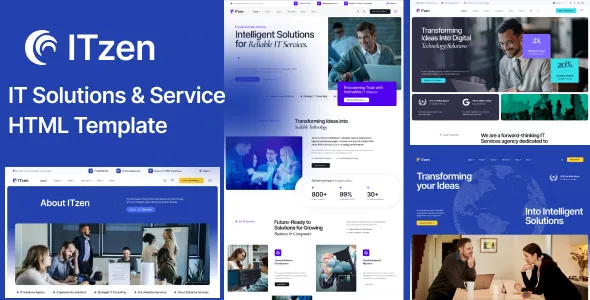
ITzen – IT Solutions & Service HTML Template
ITzen – IT Solutions & Service HTML Template is a modern website design solution for IT companies, technology consultants, software development firms, digital transformation specialists, and managed service providers looking to establish a professional online presence. Designed as a frontend foundation for technology-focused businesses, this HTML template can help organizations present their services, communicate technical expertise, showcase projects, and provide clear contact opportunities for prospective clients. Its business-oriented purpose makes it suitable for companies that want to explain complex technology solutions through an organized, accessible, and visually consistent website.
Technology businesses need websites that do more than introduce their company. Visitors often want to understand available services, evaluate industry experience, explore previous projects, and determine whether a provider can address their technical challenges. ITzen offers a starting point for structuring this information into meaningful website sections, allowing businesses to develop a digital presence that supports brand awareness, client communication, and lead generation.
Whether you operate an IT consulting company, software development agency, cybersecurity service, cloud solutions provider, or technical support business, ITzen can be evaluated as a foundation for presenting your offerings. As an HTML template, it primarily provides frontend structure and styling rather than a complete backend application. The available pages, design components, and technical requirements should be confirmed through the current product demo and documentation before implementation.
What Is ITzen – IT Solutions & Service HTML Template?
ITzen is an HTML website template intended for businesses operating in the information technology and professional services industries. It provides a starting point for building a business website that introduces company capabilities, explains technical services, highlights project experience, and guides visitors toward relevant actions.
Developing a website from scratch requires decisions about page structure, typography, spacing, navigation, responsive behavior, and reusable interface elements. A prepared HTML template can help simplify this initial design process by providing an existing framework that developers can customize for a specific brand and audience.
An IT solutions website may include pages for company information, IT consulting, software development, infrastructure management, cybersecurity, cloud computing, case studies, blog articles, and contact details. The actual pages available in ITzen depend on the supplied package, while additional sections can be developed according to project requirements.
Because the template is primarily a frontend resource, dynamic features such as customer portals, service request management, automated ticket handling, and database-driven content require suitable backend development or third-party integrations. Reviewing the package before starting work helps clarify which elements are already available and which need additional implementation.
Modern Design for Technology Businesses
A professional technology website should communicate competence, reliability, and clarity. Visitors may not understand every technical term a company uses, so the design should help them find relevant information without unnecessary complexity.
ITzen can serve as a visual foundation for presenting IT services in a structured business-oriented layout. Depending on the included design, developers can adapt headings, colors, typography, imagery, content blocks, and calls to action to match the company’s brand identity.
A technology company might introduce its core expertise through a prominent homepage message, followed by service summaries and project highlights. Supporting sections can explain the organization’s approach, introduce its team, and provide evidence of relevant experience.
Visual consistency is particularly important for businesses serving other organizations. Consistent heading styles, spacing, colors, and buttons help create a cohesive experience across different pages. Technical diagrams, relevant illustrations, and authentic project screenshots can also help explain services more effectively than generic decorative images.
The final presentation should reflect the intended audience. A cybersecurity consultancy may prefer a precise and professional visual style, while a creative software agency might use more expressive layouts and product-focused imagery.
Homepage Layout and Business Introduction
The homepage provides an opportunity to explain what the company does, whom it serves, and why its services may be relevant. Visitors should be able to understand the primary offering without navigating through multiple pages.
An ITzen-based website can be organized around an introductory banner, service summaries, company information, selected projects, client feedback, and contact opportunities where supported by the available layouts. Each section should have a clear purpose and contribute to the overall business message.
A strong opening headline might explain the company’s main service, such as managed IT support, custom software development, cloud infrastructure, or technology consulting. Supporting text can describe the business’s approach and the problems it helps clients address.
Service summaries can direct visitors toward dedicated pages with more detailed explanations. Project examples can demonstrate practical experience, while a company introduction can provide context about the team’s expertise and working methods.
Calls to action should use specific, understandable wording. Options such as requesting a consultation, discussing a project, or contacting the team can help visitors identify the next step.
The homepage should not attempt to explain every service in full. A concise overview supported by clear navigation gives visitors a reason to explore the website further.
IT Solutions and Service Pages
Technology companies often provide several related services, each addressing a different business need. Dedicated service pages help explain these offerings without overwhelming visitors with a single lengthy description.
ITzen can be customized to present service categories according to the actual capabilities of the business. Depending on the company’s portfolio, these categories may include IT consulting, network support, software engineering, cloud migration, cybersecurity, technical maintenance, or digital transformation.
Each service page should explain the problem being addressed, the intended audience, the proposed approach, and the expected deliverables. For example, a cloud consulting page might discuss infrastructure assessment, migration planning, deployment, and ongoing optimization.
A managed IT services page could describe support arrangements, infrastructure monitoring, maintenance processes, and the scope of assistance offered. A software development page might explain discovery, planning, implementation, testing, and maintenance.
Avoid using identical descriptions for every service. Each page should provide specific information that helps prospective clients understand the offering and determine whether it matches their requirements.
Clear service descriptions improve the user experience and create opportunities to target relevant search queries naturally.
Software Development and Technology Consulting
Software development companies need websites that demonstrate their technical capabilities while explaining how their services support business objectives. Prospective clients may be interested in custom applications, web development, mobile solutions, system integrations, or the modernization of existing software.
ITzen can provide a starting point for presenting these services through organized descriptions, project showcases, and contact sections. The actual content should reflect the technologies, industries, and project types the business can support.
A software development page might describe how the team gathers requirements, plans application architecture, builds the solution, tests functionality, and supports deployment. This helps visitors understand the process rather than relying on broad claims about innovation.
Technology consultants can use similar structures to explain infrastructure assessments, technical planning, system integration, process improvement, or digital transformation services.
Where appropriate, project examples can illustrate the challenges addressed and the work performed. Developers should avoid publishing confidential client information or unsupported performance claims.
A well-organized website helps potential clients evaluate the company’s expertise and provides a practical starting point for discussing their project requirements.
IT Infrastructure, Networking, and Managed Services
Reliable technology infrastructure supports everyday business operations. Companies may need help with network configuration, hardware planning, system administration, cloud environments, or ongoing technical support.
ITzen can be adapted to explain these services in a way that connects technical capabilities with practical business needs. For example, an infrastructure services page might describe network planning, server configuration, system maintenance, and infrastructure upgrades.
A managed services provider could explain the scope of its support, its communication process, and how service requests are handled. If the business offers defined service levels or support hours, these details should be presented accurately.
A networking services page might cover connectivity planning, network administration, infrastructure assessment, and troubleshooting. A cloud services page could explain how the company helps clients evaluate hosting options, manage migration projects, or improve their existing environments.
Specific descriptions are more useful than vague promises about complete technology transformation. Businesses should communicate what is included, which requirements must be met, and where external platforms or third-party providers are involved.
The website itself should not imply that ITzen automatically provides monitoring, remote support, or infrastructure management. These are business services that need to be delivered through the company’s actual operations and supporting systems.
Cybersecurity and Data Protection Services
Cybersecurity is an important consideration for organizations that depend on digital systems, online services, and business data. Technology companies offering security services need to communicate their expertise carefully and avoid exaggerated guarantees.
ITzen can serve as a starting point for presenting cybersecurity consulting, security assessments, risk management, security awareness training, or related services when these offerings are part of the business.
A cybersecurity page should explain the scope of the service, the types of risks it addresses, and the process used to assess or improve security. Where relevant, the company can describe vulnerability assessment, access control reviews, security policy development, or incident response planning.
Clear language helps prospective clients understand the purpose of each service without requiring advanced technical knowledge. Relevant qualifications, documented experience, and genuine case studies may provide further context.
Avoid absolute claims that a service can eliminate every security risk. Effective security depends on technology, configuration, user behavior, operational procedures, and ongoing review.
If the company publishes security-related content, it should be accurate, responsible, and regularly reviewed. Trust is especially important when visitors are evaluating providers that may eventually handle sensitive systems or information.
Project Portfolio and Case Studies
A project portfolio helps IT companies demonstrate practical experience and explain how their services are applied to real business challenges. Instead of simply listing technologies, a well-prepared portfolio can show the context behind completed work.
An ITzen website can include project highlights or case study sections where supported by the available layouts or added during customization. These sections may cover software implementations, infrastructure improvements, website development, cloud projects, or other relevant work.
A useful case study generally explains the client’s challenge, the scope of the engagement, the approach taken, and the outcome. If measurable results are available and approved for publication, they can help illustrate the project’s impact.
For example, a case study might describe how a team modernized an outdated application or helped an organization consolidate its digital systems. The explanation should distinguish verified outcomes from general benefits.
Images, interface screenshots, diagrams, and project summaries can make technical work easier to understand. However, confidential information, credentials, customer data, and proprietary details should never be published without appropriate authorization.
A focused selection of relevant projects is often more persuasive than a large gallery of unrelated examples. Choose work that reflects the services the company wants to promote.
Responsive Design for Desktop and Mobile Devices
Visitors may access a technology company’s website from desktop computers, tablets, and smartphones. Responsive design helps keep information accessible across different screen sizes.
ITzen is positioned as an HTML website template for IT businesses, and responsive behavior should be evaluated as part of the implementation process. The exact experience depends on the included styles, scripts, page structures, and any custom modifications.
On smaller screens, navigation should remain easy to operate, headings should be readable, and service information should fit naturally within the available space. Buttons and contact links should be convenient to select without excessive zooming or scrolling.
Developers should test all important pages rather than checking only the homepage. Service descriptions, project galleries, contact forms, and blog layouts can behave differently when viewed on mobile devices.
Custom CSS, embedded content, third-party widgets, and large tables may introduce responsive issues. These should be checked at several viewport widths before the website is published.
A consistent responsive experience helps visitors explore services and contact the business regardless of which device they use.
Customization and Brand Identity
A business website should reflect the organization’s identity and communicate a consistent message. Customization helps transform a general template into a website that feels relevant to the company’s audience and services.
With ITzen, developers can adapt the available HTML, CSS, JavaScript, images, typography, colors, and content according to the package structure and project requirements. The exact customization process depends on the supplied files and documented conventions.
A managed IT company may choose a restrained visual style that emphasizes reliability and service clarity. A software development agency might use product screenshots and project-focused layouts, while a technology consultancy may prioritize case studies and professional expertise.
Establishing a consistent design system helps maintain a unified appearance across the website. Use a defined palette, a small set of typography styles, consistent button treatments, and predictable spacing.
Replace placeholder content with original business information and relevant imagery. Generic statements and unrelated visuals can weaken the website’s message, even when the underlying design is attractive.
Before making substantial changes, maintain a backup of the original files and test customized pages locally or in a staging environment. This makes it easier to identify problems and restore the previous version if needed.
SEO-Friendly Structure for IT Companies
Search engine optimization can help prospective clients discover an IT company’s services through relevant search queries. A well-structured HTML template provides a starting point, but search visibility depends on content quality, technical implementation, competition, and other factors.
Each page should have a clear topic, a descriptive title, a relevant meta description, and an appropriate heading hierarchy. Service pages should focus on specific offerings rather than repeating the same general description across the entire website.
For example, a company offering cloud consulting, managed IT support, and custom software development can create distinct pages explaining each service. This helps visitors find information relevant to their needs and gives search engines clearer context about the website’s content.
Use descriptive URLs, meaningful internal links, and accurate image alternative text. Ensure that important pages are accessible to search engines and avoid unnecessary duplication.
An HTML template does not automatically guarantee strong search rankings. Developers may need to configure metadata, redirects, canonical URLs, XML sitemaps, structured data, and other technical elements according to the final website architecture.
Content should prioritize usefulness and clarity. Natural keyword usage, original explanations, and relevant project examples are more effective foundations than excessive repetition of search terms.
Content Marketing and Technology Blogging
Publishing useful technology content can help a business demonstrate expertise and answer questions that prospective clients commonly ask. A blog can also provide a place to share company updates, technical guidance, industry observations, and service-related information.
ITzen can be extended with blog or article pages if they are included in the package or created during development. Since a static HTML template does not automatically provide a content management system, frequently updated articles may require a CMS, backend application, or another publishing workflow.
An IT consulting company might publish articles about infrastructure planning, cybersecurity practices, or cloud adoption. A software agency could share development insights, application maintenance guidance, or explanations of different technology approaches.
Useful articles should address a clear audience need. They might explain a process, compare alternatives, clarify a technical concept, or help business owners prepare for a technology project.
Internal links can connect educational articles with relevant service pages and case studies. This allows interested readers to explore the company’s offerings naturally.
Maintain accuracy and update content when technical guidance changes. A smaller collection of useful, well-maintained articles is often more valuable than a large archive of shallow or outdated posts.
Lead Generation and Contact Forms
For many IT businesses, the website’s primary purpose is to encourage relevant inquiries. Prospective clients may want to request a consultation, discuss a software project, ask about managed services, or obtain additional information.
ITzen can provide a frontend foundation for contact sections, inquiry buttons, and form layouts where available. Functional form submission requires a suitable backend handler, form service, or third-party integration unless the supplied package explicitly includes one.
A project inquiry form might request a name, business email, company name, service of interest, and a short description of the requirement. The form should collect enough information to support an initial response without creating unnecessary barriers.
Use clear field labels and provide helpful validation messages. After submission, visitors should receive an understandable confirmation or error message.
Test the complete process, including delivery to the intended destination, spam protection, required-field validation, and mobile usability. Avoid collecting sensitive information that is not necessary for an initial inquiry.
Calls to action should match the page’s purpose. A service page may invite visitors to discuss a technical requirement, while a case study may encourage them to explore a similar project with the company.
Website Performance and Asset Optimization
Website performance affects how easily visitors can explore services and access business information. Slow-loading pages may create frustration, particularly for visitors using mobile devices or limited network connections.
The actual performance of an ITzen website depends on its HTML structure, CSS, JavaScript, images, hosting environment, fonts, and third-party integrations.
Start by optimizing images and using appropriate file dimensions. Compress visual assets while retaining sufficient quality, and avoid loading large resources that are not necessary for a page.
Review JavaScript and CSS usage to identify unnecessary files or scripts. If the template includes animation effects or external libraries, evaluate whether each element contributes meaningfully to the user experience.
Browser caching, compression, and suitable hosting configuration may also improve loading performance. These settings should be selected and tested according to the website’s deployment environment.
Measure important pages using performance testing tools and address issues identified through actual results. Check the homepage, service pages, project galleries, and contact pages because their resource requirements may differ.
Regular testing after customization helps ensure that new scripts, images, and embedded components do not introduce avoidable performance problems.
Accessibility and User-Friendly Navigation
An accessible website helps a wider range of visitors understand information and interact with its content. IT service websites should be easy to navigate, with readable text, meaningful headings, and clear interactive elements.
When customizing ITzen, use semantic HTML elements, descriptive link text, appropriate image alternative text, and sufficient color contrast. Form fields should have clear labels, and errors should explain what needs to be corrected.
Navigation should use familiar wording and group related pages logically. Visitors should be able to move between the homepage, services, company information, projects, and contact details without confusion.
Interactive components should be tested with keyboard navigation and visible focus indicators. Avoid using color alone to communicate status or importance, and ensure that important information remains understandable when styles are not available.
Accessibility should be checked across the full website, including menus, forms, galleries, and embedded third-party components. Automated tools can identify some problems, but manual testing is also useful for evaluating practical usability.
Integration with Backend Systems and Third-Party Services
An IT company’s website may eventually need additional capabilities such as customer portals, support ticket submission, appointment requests, analytics, or CRM integration. These features should be planned separately from the template’s visual presentation.
ITzen provides an HTML-oriented foundation, so backend functionality depends on the technologies and services selected for the finished project. Developers may connect forms to an application server, integrate an appropriate content management system, or use third-party services where suitable.
A customer portal may require authentication, account management, access controls, and database operations. A support request workflow may need ticket storage, notifications, and administrative tools. These capabilities should not be assumed to exist merely because a frontend page has been designed.
When integrating external services, review compatibility, privacy implications, authentication requirements, and error handling. Ensure that any customer information is processed according to applicable obligations and the organization’s privacy policies.
Keep integrations focused on genuine business needs. Each additional service can introduce maintenance requirements and should be tested as part of the complete website.
Security and Website Maintenance
A professional website should be maintained after launch to preserve reliability, accuracy, and security. Although static HTML files have a different risk profile from a full application, their hosting environment, scripts, forms, and integrations still require attention.
Use reputable hosting, enable HTTPS, and keep any server-side software or third-party libraries updated. If the website includes backend forms or dynamic functionality, validate submitted data and apply appropriate security controls.
Remove unused scripts and dependencies where practical. Review external embeds and integrations to understand what data they collect and how they affect the website.
Keep backups of website files and configuration settings, particularly before significant redesigns or deployment changes. Test updates in a staging environment when possible, and confirm that navigation, forms, and responsive layouts continue to work after changes.
Content maintenance is equally important. Update service descriptions, team information, project examples, contact details, and published articles whenever the business changes.
A simple maintenance routine helps prevent outdated information, broken links, and avoidable technical issues from undermining the visitor experience.
Who Should Use ITzen – IT Solutions & Service HTML Template?
ITzen may be suitable for different organizations that need a professional website focused on technology services and business solutions.
IT service providers: Companies offering technical support, infrastructure management, or managed IT services can organize their offerings and contact information.
Software development agencies: Development teams can introduce their expertise, describe their processes, and showcase selected application projects.
IT consulting firms: Consultants can explain their services, professional approach, and experience in helping businesses make technology decisions.
Cloud service providers: Businesses working with cloud infrastructure, migration, hosting, or optimization can use dedicated pages to describe their offerings.
Cybersecurity companies: Security specialists can present assessments, consulting services, and other relevant capabilities using clear and responsible descriptions.
Technology startups: New businesses can establish a digital presence that introduces their products, services, mission, and contact channels.
Digital transformation consultants: Organizations helping clients modernize business systems can explain their approach and present relevant project examples.
Freelance technology professionals: Independent developers and technical consultants can adapt the template to highlight skills, experience, services, and professional contact details.
The best fit depends on the included page layouts, customization requirements, technical compatibility, and the company’s goals. Review the current demo and documentation before selecting the template for a project.
Tips for Building a Successful Website with ITzen
A successful IT company website begins with a clear understanding of its audience and objectives. Before customizing the template, identify the services that matter most, the types of clients the company wants to reach, and the actions visitors should be encouraged to take.
Prepare accurate content for each important page. Write service descriptions that explain real capabilities, use case studies where available, and include clear contact information.
Establish a consistent brand identity through typography, colors, imagery, and page structure. Replace demonstration text and placeholder images with relevant business content rather than publishing the template without meaningful customization.
Keep navigation straightforward and give every page a clear purpose. Service pages should answer practical questions, project pages should demonstrate relevant experience, and contact sections should make inquiries convenient.
Test the website on desktop and mobile devices before launch. Check page loading, navigation links, form behavior, accessibility, and the accuracy of all published information.
Finally, plan for ongoing maintenance. Review content regularly, monitor website performance, maintain backups, and test changes before deploying them to the live environment.
Final Thoughts on ITzen – IT Solutions & Service HTML Template
ITzen – IT Solutions & Service HTML Template is a potential starting point for technology companies that want to create a professional website for IT services, software development, consulting, infrastructure solutions, and related business offerings. Its intended focus makes it relevant to organizations that need a structured way to explain their expertise, present project experience, and encourage prospective clients to make contact.
A well-customized website can combine clear service pages, a focused homepage, relevant case studies, responsive layouts, and useful contact opportunities. Strong content and consistent branding help visitors understand the company’s capabilities and decide whether its services match their requirements.
The final website’s features depend on the actual HTML package, included layouts, scripts, and any additional development or integrations. Dynamic forms, customer portals, support systems, and content management features require appropriate implementation unless they are explicitly included in the supplied package.
With careful customization, performance optimization, accessible design, accurate content, and regular maintenance, ITzen can serve as a useful frontend foundation for building a technology-focused business website that supports professional communication and long-term digital growth.