My Account
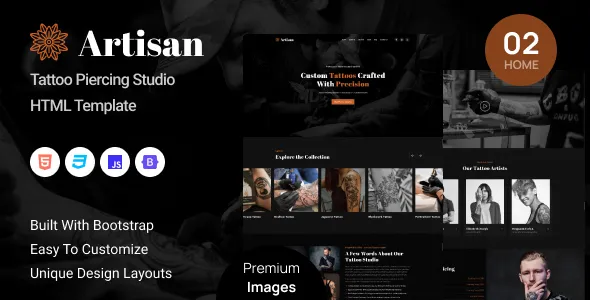
Artisan – Tattoo Piercing Studio HTML Template
Artisan – Tattoo Piercing Studio HTML Template is a modern website template designed for tattoo artists, piercing studios, body art professionals, and creative businesses that want to establish a distinctive online presence. Combining an artistic presentation with a professional website structure, this HTML template provides a foundation for showcasing tattoo designs, piercing services, artist portfolios, studio information, and appointment inquiries. Whether you operate an independent tattoo studio, a professional piercing salon, a body art business, or a creative tattoo collective, Artisan can help you build a website that reflects your visual identity and communicates your services to potential clients.
A tattoo or piercing studio needs a website that communicates creativity, professionalism, and trust. Visitors often want to explore an artist’s work, learn about available services, review studio policies, and understand how to arrange an appointment before visiting in person. Artisan provides a starting point for organizing these essential details into a visually engaging digital experience. With appropriate customization, you can adapt the template to your brand colors, imagery, typography, service offerings, and business requirements.
Built around HTML-based website development, Artisan is intended for developers, designers, studio owners, and creative professionals who want control over their website’s presentation. The template can be customized with relevant content, portfolio images, service descriptions, and contact information to create a website suited to a particular studio. Its final appearance and functionality depend on the supplied template files, available page layouts, and any additional development work or integrations you choose to implement.
What Is Artisan – Tattoo Piercing Studio HTML Template?
Artisan – Tattoo Piercing Studio HTML Template is a website design solution for businesses in the tattoo, piercing, and body art industries. It offers a foundation for creating a website that introduces a studio, highlights creative work, explains services, and helps visitors discover how to get in touch.
Tattoo and piercing businesses often depend on strong visual presentation. Customers may want to examine different artistic styles, compare portfolio examples, understand the studio’s approach, and review practical information before deciding which artist or service is right for them. A dedicated website allows studios to present these details in one convenient location.
Artisan can be adapted for a variety of body art businesses, including traditional tattoo studios, contemporary tattoo parlors, fine-line tattoo artists, blackwork specialists, piercing salons, and multidisciplinary creative studios. The content and design can be adjusted according to the studio’s audience and professional identity.
As an HTML template, it provides a front-end foundation that developers can customize using HTML, CSS, JavaScript, and any supported libraries included with the package. Unlike a ready-to-use content management system, an HTML template generally requires suitable hosting and some technical knowledge to modify and maintain. Additional functionality, such as appointment booking, online payments, or advanced content management, may require separate development or compatible third-party services.
Before implementation, review the current product demo and documentation to confirm the included pages, assets, responsive behavior, browser support, and technical requirements.
Creative Design for Tattoo and Piercing Studios
Visual identity plays an important role in the body art industry. A website should communicate the studio’s artistic personality while helping visitors navigate its services and information without unnecessary confusion.
Artisan provides a starting point for building a distinctive digital presentation around tattoo culture, piercing services, and creative expression. Studio owners can customize the design to reflect a particular aesthetic, whether that means bold and expressive visuals, minimalist fine-line artwork, traditional tattoo imagery, contemporary body art, or an alternative creative atmosphere.
High-quality portfolio images can help introduce the studio’s work and demonstrate its artistic direction. Carefully selected photographs of completed tattoos, piercing jewelry, studio interiors, and creative projects can make the website more informative and visually engaging.
Typography, colors, spacing, and image selection should work together to support the brand. A studio specializing in traditional tattoos might prefer a bold visual identity, while a fine-line artist may choose a cleaner and more understated presentation. A piercing studio could emphasize jewelry, precision, and service information.
The goal is to create a website that feels authentic to the business. Instead of relying entirely on decorative elements, prioritize a clear message, well-organized content, and relevant visuals that help visitors understand the studio’s identity and offerings.
Responsive Website Experience Across Devices
Many potential customers discover tattoo artists and piercing studios through mobile searches and social media links. A website that is easy to navigate on smartphones, tablets, laptops, and desktop computers can make it more convenient for visitors to explore the studio.
Artisan is positioned as an HTML website template for this type of business, but its precise responsive behavior should be verified against the current demo and supplied files. Responsive layouts typically adjust content widths, image sizes, navigation, and spacing according to the available screen space.
For a tattoo studio website, mobile usability is particularly important for portfolio galleries, service descriptions, contact information, and appointment inquiries. Visitors should be able to view artwork clearly, read essential details, and find contact options without excessive scrolling or difficult navigation.
Developers should test the website at multiple screen sizes and check how menus, buttons, forms, images, and content sections behave. Large portfolio photographs may need optimization to preserve visual quality without slowing down mobile browsing.
Custom CSS, embedded booking tools, third-party scripts, and other modifications can affect the final responsive experience. Testing after each significant design change helps maintain a consistent presentation across devices.
Tattoo Artist Portfolio and Gallery
A portfolio is one of the most important elements of a tattoo artist’s online presence. It allows prospective clients to examine completed work, discover artistic styles, and identify artists whose skills match their preferences.
Artisan can serve as a foundation for presenting tattoo photography and creative projects in an organized portfolio. Depending on the available page layouts, the gallery can be customized to showcase different categories of work and help visitors explore the studio’s artistic range.
A tattoo artist may organize portfolio content into categories such as:
- Traditional and neo-traditional tattoos
- Fine-line and minimalist tattoos
- Blackwork and geometric designs
- Realism and portrait tattoos
- Floral, botanical, and ornamental artwork
- Lettering and typography tattoos
- Custom illustrations and original concepts
These categories should reflect the actual services and artistic capabilities of the studio. Each portfolio image should be selected carefully, with sufficient resolution and suitable cropping for the intended layout.
Where appropriate, captions can explain the tattoo style, project concept, or artist responsible for the work. Client images should be published only with suitable permission, and the website should avoid implying that example artwork is available for reproduction when it is not.
A focused portfolio gives visitors a clearer understanding of the studio’s strengths and helps them make informed decisions before requesting a consultation.
Professional Piercing Services Presentation
Piercing studios need to communicate their available services clearly while helping customers understand the process of making an inquiry or arranging a visit. A dedicated service section can explain the studio’s offerings and direct visitors toward relevant information.
Artisan can be customized to present piercing services alongside other body art offerings. Depending on the business, service categories may include ear piercings, nose piercings, cartilage piercings, and other piercing procedures offered by qualified professionals.
Each service description should provide accurate information about what the studio offers. Where relevant, visitors may also benefit from information about jewelry options, appointment requirements, age restrictions, identification requirements, and aftercare guidance.
Safety and hygiene information should be especially clear. Studios should communicate their actual sterilization procedures, equipment standards, and professional practices without making unsupported claims. Detailed medical or aftercare guidance should be reviewed by an appropriately qualified professional and should not replace individualized advice when needed.
The website can also explain how customers should prepare for a visit and whom to contact if they have questions. Clear service information helps visitors understand their options before contacting the studio.
Studio Information and Brand Story
A studio’s background can help visitors understand its identity, creative approach, and professional values. An About section provides space to introduce the business, its artists, and the experience customers can expect.
Artisan can be adapted to include information about the studio’s history, artistic philosophy, team members, and approach to customer service. The content should be based on genuine details rather than generic claims about experience or reputation.
For example, a studio may explain its focus on custom tattoo design, its interest in particular artistic traditions, or its commitment to providing clear consultations before beginning a project. A piercing business might introduce its team, explain its jewelry selection, and outline its approach to customer communication.
Artist profiles can include professional biographies, specialties, selected work, and links to relevant portfolios. This allows visitors to explore the people behind the studio and determine which artist may be appropriate for their project.
Authentic photography can further support the presentation. Images of the actual studio, workspaces, team, and creative process can help the website feel more personal and informative.
Keep all published information accurate and current. Artist availability, opening hours, service offerings, and studio policies should be reviewed regularly so visitors can rely on the details presented online.
Service Pages for Different Tattoo Styles
A well-organized website can make it easier for visitors to find information about the specific services they are interested in. Instead of placing every offering into a single general description, a studio can create dedicated sections or pages for its main tattoo styles.
Artisan can be customized to support a structured presentation of services, depending on the layouts included in the template. Each page can explain the relevant style, provide representative portfolio images, and describe how customers can discuss a potential design with the artist.
A fine-line tattoo page might focus on delicate linework and minimalist designs. A traditional tattoo section could feature bold outlines and classic motifs, while a realism portfolio might showcase detailed portraits or lifelike imagery.
Custom tattoo design can also be explained as a separate service when the studio offers consultations and original artwork. Visitors should understand how to submit an idea, what information to include, and how the artist handles the design discussion.
Clear service descriptions help prospective clients identify relevant work and prepare useful questions before making contact. They also create opportunities to develop original website content around the studio’s actual specialties.
Avoid promising identical results for every client. Tattoo outcomes depend on the design, placement, individual skin characteristics, artist technique, and other factors. Accurate descriptions and realistic expectations support better communication between the studio and its customers.
Appointment Inquiries and Contact Information
A clear contact process helps turn website visitors into potential clients. People interested in a tattoo or piercing often need to ask about availability, discuss a design, confirm pricing, or learn more about the studio’s policies.
Artisan can provide a front-end foundation for displaying contact information and, where supported by the supplied files or additional development, presenting inquiry forms or appointment-related interface elements. A functional booking system should not be assumed unless it is explicitly included or integrated.
A contact page can include the studio’s business email, telephone number, location, opening hours, and relevant social media profiles. If the business accepts appointment requests online, the website can explain what information customers should provide.
For tattoo inquiries, a form may ask for the desired style, approximate placement, estimated size, reference images, and a brief description of the concept. For piercing inquiries, visitors may need to identify the service they are interested in and ask questions about jewelry or appointment requirements.
Only collect information that is genuinely necessary. Forms should clearly identify required fields and explain what happens after submission. If a form collects personal details or reference images, the business should handle them responsibly and provide appropriate privacy information.
Before publishing the website, test every contact link, form, confirmation message, and email delivery process. A well-designed contact section is only useful when its functionality works as expected.
Customization Options and Visual Branding
A consistent brand identity helps a tattoo or piercing studio distinguish itself from other businesses. Customization allows website owners to align the website’s visual presentation with the studio’s logo, atmosphere, artistic specialties, and audience.
With Artisan, developers can adapt the available HTML and styling files to suit the intended design. The exact editing process depends on the structure of the template and the tools or libraries supplied with the product.
Customization may involve adjusting:
- Brand colors and background treatments
- Heading and body typography
- Portfolio images and gallery arrangements
- Service descriptions and content sections
- Navigation labels and page organization
- Buttons, links, and contact information
- Studio photographs and artist profiles
- Spacing and layout details
A cohesive visual system makes the website easier to recognize and use. Consistent headings, button styles, spacing, and image treatments help create a more polished experience across the site.
When customizing the template, preserve readable contrast and avoid excessive decorative effects that interfere with navigation or content. Large photographs and expressive typography can strengthen the visual identity, but they should not make the website difficult to use.
Developers should keep original files backed up and test changes before deploying them to a live website. Reviewing the template documentation can help identify the appropriate files and dependencies for making updates.
SEO-Friendly Structure for Tattoo Studio Websites
Search engine optimization can help a tattoo or piercing studio make its website more discoverable to people searching for relevant services. Artisan can serve as a starting point for an organized website, but search performance depends on content quality, technical implementation, competition, location relevance, and many other factors.
Each important page should have a clear topic and useful information. A studio might create separate pages for tattoo services, piercing services, artist portfolios, custom tattoo consultations, and contact details, provided those pages accurately reflect the business.
Page titles and headings should describe the content naturally. If the studio serves a specific city or region, relevant location information can be included where useful and accurate. Avoid inserting unrelated locations or repeating keywords unnaturally.
Image optimization also matters for a visually focused website. Use descriptive filenames and appropriate alternative text that explains meaningful images. Compress image files and use suitable dimensions to help maintain reasonable loading performance.
Developers should review technical elements such as page metadata, canonical URLs, indexing directives, XML sitemaps, and structured data where applicable. Some features may require manual implementation or supporting tools because a static HTML template does not automatically provide a complete SEO management system.
Internal links can connect service pages, artist portfolios, studio information, and contact details. This helps visitors move naturally through the website and gives search engines a clearer understanding of its structure.
No HTML template can guarantee a particular ranking position, traffic level, or number of appointments. Consistent optimization and useful, original content provide a more sustainable foundation for search visibility.
Local SEO for Tattoo and Piercing Businesses
Many tattoo and piercing customers search for studios within a convenient travel distance. Local search optimization can help businesses present accurate information to potential customers in their service area.
A studio website can display its genuine business name, address, telephone number, opening hours, and service area where appropriate. These details should match the information published on relevant business listings and social profiles.
If the studio operates from a physical location, a map or directions link can make it easier for visitors to find the premises. The implementation may require an embedded map or an external mapping service, depending on the website setup.
Location-specific service pages can be useful when the business genuinely serves different areas or has multiple locations. However, creating many nearly identical pages for places the business does not serve can reduce content quality and confuse visitors.
Customer reviews may also support local visibility and trust when collected and displayed appropriately. Reviews should be authentic and presented without misleading edits or unsupported claims.
Artisan’s design can be customized to make local business details easy to find. A clear contact section, useful service information, and accurate location data help visitors determine whether the studio is suitable for their needs.
Performance Optimization for Image-Rich Websites
Tattoo and piercing websites often rely on photography to communicate artistic quality. However, large images, unnecessary scripts, and unoptimized page assets can slow down loading, particularly on mobile networks.
The actual performance of an Artisan website depends on its supplied code, image assets, hosting environment, scripts, fonts, and customizations. Developers should evaluate the finished website rather than assume that the template will be fast under every configuration.
Image optimization is a useful starting point. Resize photographs to appropriate display dimensions, compress files, and choose modern image formats where supported. Preserve enough detail for visitors to appreciate the artwork while avoiding unnecessarily large downloads.
Loading behavior can also be improved by reviewing scripts, external libraries, font requests, and decorative animations. Features that do not support the website’s main purpose can often be simplified or removed.
Caching, content delivery networks, and other hosting or performance tools may be useful depending on the website’s traffic and technical setup. Their configuration should be based on testing and actual performance requirements.
Check important pages on both mobile and desktop devices. Pay particular attention to portfolio galleries, large banners, navigation menus, and any embedded booking or contact tools.
Regular performance reviews help ensure that new content and design changes do not gradually reduce the website’s usability.
Accessibility and User-Friendly Navigation
A professional tattoo studio website should make its information easy to navigate and understand. Clear menus, readable text, useful image descriptions, and properly labeled forms can improve the experience for a broad range of visitors.
When customizing Artisan, use a logical heading hierarchy and descriptive link text. Navigation labels should explain where each link leads, while buttons should communicate the action they perform.
Portfolio images should include appropriate alternative text when they convey meaningful information. Decorative images can use empty alternative text where suitable, preventing unnecessary screen-reader announcements.
Text and background colors should provide sufficient contrast. Interactive elements should have visible focus indicators, and important information should not be communicated through color alone.
Contact forms should use clear labels and helpful validation messages. Menus, galleries, and other interactive components should be tested with keyboard navigation where applicable.
Accessibility is influenced by the original template, the content, and all later customizations. Developers should combine automated checks with manual testing to identify issues that could make the website difficult to use.
HTML Template Flexibility for Developers
An HTML template provides developers with direct access to the front-end structure and styling of a website. This can be useful for studios that want to tailor their online presentation without relying entirely on a visual content management system.
Artisan can be adapted according to the structure of its supplied HTML, CSS, JavaScript, images, and other assets. Developers can review the existing code, replace placeholder content, adjust the styling, and connect suitable external services as required.
The template may be suitable for a standalone studio website or as a starting point for a larger custom project. If the business later needs dynamic content, staff-managed portfolio updates, customer accounts, online payments, or appointment scheduling, those requirements may involve additional programming or integration with a back-end system.
A static HTML website generally does not include a database-driven administration panel by default. This means that routine content updates may require editing files unless a content management system or custom editing interface is added.
Before development begins, identify the website’s essential requirements and determine which functions are available in the template. This helps avoid assuming that visual elements such as booking buttons or contact forms automatically include working back-end behavior.
Well-planned customization allows developers to create a website that fits the studio’s workflow while maintaining a manageable technical structure.
Social Media Integration and Portfolio Promotion
Social media can be an important discovery channel for tattoo artists and piercing studios. Many customers first encounter artwork through visual platforms before visiting a studio website to learn more or make an inquiry.
Artisan can be customized to include links to the studio’s active social media profiles. Depending on the available layouts and additional integrations, developers may also be able to incorporate selected social content or other external media.
The website should remain useful even when visitors do not use social media. Important service information, artist portfolios, contact details, and business policies should be available directly on the website rather than existing only on external platforms.
Social links should lead to the correct official accounts and be tested regularly. If embedded feeds are added, review their effect on page speed, privacy, and mobile usability.
A portfolio website also provides a stable place to direct visitors from social media campaigns. Rather than relying on a single platform, the studio can use its website to organize its best work, explain its services, and provide a consistent contact pathway.
Security and Website Maintenance
Ongoing maintenance helps keep a studio website accurate, reliable, and secure. Although an HTML template does not have the same update process as every content management system, it still requires attention to hosting, dependencies, forms, and published content.
Use a reputable hosting provider and enable HTTPS. Keep backups of the website files and any custom code so the site can be restored if a change causes problems.
Review third-party libraries and scripts for compatibility and updates. If the website includes inquiry forms, booking integrations, analytics, or external services, check their security requirements and privacy implications.
Forms that send information to a server require appropriate validation and spam protection. Sensitive customer information should not be collected unnecessarily or exposed through insecure handling.
Regular content reviews are equally important. Update opening hours, service descriptions, artist information, contact details, pricing guidance, and studio policies when changes occur.
Before deploying significant modifications, test the website in a staging environment where practical. Verify navigation, images, forms, responsive layouts, and external links before publishing the updated version.
Who Can Benefit from Artisan – Tattoo Piercing Studio HTML Template?
Artisan can be considered by different professionals and businesses working in the body art industry.
Tattoo studios: Establish an online presence that introduces services, showcases artwork, and provides clear contact information.
Independent tattoo artists: Create a portfolio focused on individual artistic styles, selected projects, and consultation inquiries.
Piercing studios: Present available piercing services, jewelry information, studio details, and relevant customer guidance.
Body art businesses: Combine tattooing and piercing information within a single website tailored to the business’s actual offerings.
Creative tattoo collectives: Introduce multiple artists, organize portfolios, and help visitors explore different specialties.
Alternative lifestyle brands: Adapt the visual presentation for a creative business connected to tattoo culture and artistic expression.
Web designers and developers: Use the HTML foundation as a starting point for a customized website project for a client in the body art industry.
Freelance web development professionals: Customize the design, integrate suitable services, and deliver a website aligned with a studio’s branding and operational requirements.
The suitability of Artisan depends on the project’s needs and the template’s current capabilities. Review the available demo, documentation, page structure, and technical requirements before choosing it for a production website.
Tips for Building a Successful Tattoo Studio Website
A successful website should communicate the studio’s identity while helping visitors find the information they need. The following practices can support a more effective implementation of Artisan.
Define the website’s main objective. Decide whether the priority is showcasing artwork, attracting appointment inquiries, explaining piercing services, or introducing the studio’s team and facilities.
Use authentic portfolio content. Choose high-quality images that represent the studio’s real work. Obtain permission before publishing client photographs and ensure that each image accurately reflects the artist’s capabilities.
Organize services clearly. Present tattoo styles and piercing services in understandable categories. Provide accurate descriptions and direct visitors to the relevant contact pathway.
Maintain a consistent visual identity. Use a coordinated set of colors, typography, image treatments, and spacing. Replace generic placeholder content with details that reflect the studio’s personality.
Make contact information easy to find. Display the correct business details and test every inquiry form, email link, and appointment-related feature.
Prioritize mobile usability. Review navigation, gallery images, text, buttons, and forms on a range of screen sizes.
Optimize images and performance. Compress large photographs, remove unnecessary scripts, and test the website after significant changes.
Create useful SEO content. Write original service descriptions, descriptive page titles, relevant headings, and accurate local business information.
Review safety and privacy information. Publish genuine studio policies and explain how customer inquiries or personal information are handled.
Plan for ongoing maintenance. Keep website content current, back up files, check external integrations, and resolve broken links or technical problems.
These practices help turn a basic template into a useful business website that supports communication, portfolio presentation, and customer discovery.
Final Thoughts on Artisan – Tattoo Piercing Studio HTML Template
Artisan – Tattoo Piercing Studio HTML Template is a potential starting point for tattoo artists, piercing professionals, body art studios, and developers who need a website foundation tailored to a creative industry. Its intended application makes it relevant to projects that combine visual portfolios, service information, studio branding, and customer contact opportunities.
A carefully customized website can help visitors explore tattoo styles, learn about piercing services, discover individual artists, and understand how to contact the business. A consistent visual identity and well-organized content can also communicate the studio’s creative personality while keeping essential information accessible.
As an HTML template, Artisan offers a front-end foundation that can be adapted to specific branding and content requirements. Advanced features such as dynamic portfolio management, online payments, and functional appointment booking may require additional development or third-party integrations unless explicitly included in the current package.
Before implementation, check the official demo and documentation for the included layouts, supported technologies, assets, responsiveness, and licensing terms. Testing the finished website across devices and reviewing its performance, accessibility, and contact functionality will help ensure that it meets the needs of the business.
For tattoo and piercing professionals seeking a customizable online presentation, Artisan can be evaluated as part of a broader website development plan. With original portfolio content, clear service descriptions, thoughtful customization, and regular maintenance, a studio website can support brand awareness, customer communication, and long-term digital growth.