My Account
Infratex | Home Builder & Remodeling Service HTML Template
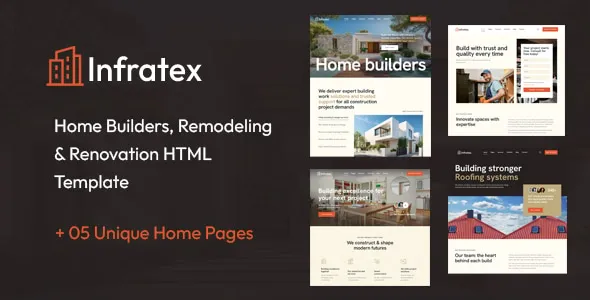
Infratex | Home Builder & Remodeling Service HTML Template is a professional website design solution for construction companies, home builders, renovation contractors, remodeling specialists, and residential improvement businesses looking to establish a strong online presence. Designed around the needs of the home construction and renovation industry, Infratex can serve as a starting point for creating a website that introduces building services, presents completed projects, communicates business expertise, and helps potential customers connect with a service provider. Its industry-focused positioning makes it suitable for businesses that want to showcase their work and explain their offerings through a structured online experience.
In the competitive construction and home improvement market, a professional website can help homeowners understand available services, evaluate previous projects, and learn how to request a consultation or estimate. A well-organized website can present information about home construction, remodeling, kitchen renovation, bathroom upgrades, interior improvements, exterior repairs, and other residential projects. With suitable customization, Infratex can help businesses organize these services into clear sections while maintaining a consistent visual identity across their online presence.
As an HTML template, Infratex provides a frontend starting point that developers can customize according to a company’s branding, service areas, content, and business objectives. HTML templates are useful for creating structured web pages using technologies such as HTML, CSS, and JavaScript, depending on the included implementation. Before selecting the template, review its current demo, documentation, supported components, and included page layouts to confirm that it matches your project requirements.
What Is Infratex Home Builder and Remodeling Service HTML Template?
Infratex is an industry-focused HTML website template intended for home builders, remodeling contractors, construction businesses, and residential improvement service providers. Rather than starting with a completely blank design, developers can use an existing template structure as a foundation and adapt it to a company’s services, portfolio, contact information, and branding.
A home construction or remodeling website has several important objectives. It should explain what the business does, help visitors understand the services available, demonstrate the quality of previous work, and provide a convenient way to make inquiries. Infratex can be evaluated for projects that need a professional presentation of these elements.
A home builder might use the website to introduce residential construction services and explain the general building process. A remodeling contractor may focus on kitchen renovations, bathroom upgrades, room additions, and whole-home improvements. A renovation company could emphasize before-and-after project photography, service details, and customer testimonials where genuine feedback is available.
The exact features and page layouts included with Infratex depend on its current release. Businesses should verify whether the template includes particular pages, forms, galleries, sliders, navigation options, or other interactive components before planning a final website around them.
Professional Website Design for Construction Businesses
A construction company website should communicate reliability, experience, and the practical value of its services. Potential customers may be comparing several contractors before deciding whom to contact, so the website needs to make essential information easy to find.
Infratex can provide a starting point for presenting a company’s identity through its homepage, service sections, project galleries, company information, and contact details. Developers can adapt these sections to reflect the business’s actual capabilities and the needs of its target audience.
For example, a residential construction company may introduce its experience in new-home building, structural improvements, extensions, and renovation projects. A remodeling specialist may highlight kitchen redesigns, bathroom upgrades, flooring, painting, and interior improvements. Each service can be supported by descriptive content and relevant project images.
A professional design should support the information rather than distract from it. Clear headings, readable text, consistent spacing, and recognizable calls to action help visitors navigate the website. Real photographs of completed projects can provide a more useful impression of the company’s work than generic stock images.
When customizing Infratex, businesses should prioritize accurate service descriptions, current contact information, and a straightforward path to requesting further details. These practical elements can make the website more useful for prospective customers.
Responsive Layout for Desktop and Mobile Devices
Homeowners may search for construction or remodeling services using smartphones, tablets, laptops, and desktop computers. A website should remain easy to use across these devices so that visitors can explore services, review project images, and find contact details without unnecessary difficulty.
Responsive web design adjusts page layouts to the available screen size. A desktop layout may display multiple content columns, while a mobile layout may stack sections vertically to preserve readability. Navigation, images, buttons, and forms should also adapt to different screen dimensions.
Infratex should be tested across a range of screen sizes before launch. Developers should check that text remains readable, project photographs fit the viewport, navigation works correctly, and buttons are easy to tap. Contact forms should remain usable without excessive zooming or horizontal scrolling.
Responsive behavior should be evaluated on all important page types, not only the homepage. Service pages, project galleries, company profiles, and contact pages may contain different elements that require additional testing.
The final mobile experience also depends on customization. Custom CSS, embedded maps, third-party scripts, and added plugins or widgets can affect the layout. Testing the completed website on real devices and common browsers helps identify issues before visitors encounter them.
Website Solutions for Home Builders
Home builders need a website that explains their construction services and helps potential clients understand how the company approaches residential projects. Visitors may want information about new-home construction, custom homes, structural work, extensions, or other building services.
Infratex can be adapted to introduce these services through dedicated pages or clearly organized homepage sections, depending on its available layouts. Each service description should explain the work provided, the types of projects the company handles, and the next steps a potential customer can take.
For instance, a custom home builder may describe the process of planning a new residence, coordinating construction stages, and communicating with clients. A company specializing in home extensions may explain how it approaches additional rooms, expanded living spaces, or other permitted structural improvements.
Useful website content should avoid vague claims and unrealistic promises. Instead, it should give homeowners practical information about the company’s experience, project types, service coverage, and consultation process.
Builders can also present selected completed projects to demonstrate the variety of work they undertake. Project descriptions should explain the scope of the work and include relevant photographs, with client permission where necessary.
Remodeling and Home Renovation Services
Home remodeling businesses often offer several related services, making it important to organize their website content clearly. Visitors may be interested in updating one room, improving the layout of their home, modernizing older interiors, or coordinating a larger renovation project.
Infratex can serve as a starting point for presenting these services in a way that helps visitors understand the company’s capabilities. Depending on the business, relevant service sections may include kitchen remodeling, bathroom renovation, flooring installation, painting, interior upgrades, room additions, and general home improvements.
Each service page should explain what the work involves and what customers can expect when discussing a project with the contractor. For example, a kitchen remodeling page might describe cabinetry updates, countertop replacement, lighting improvements, storage solutions, and layout changes if these services are actually offered.
A bathroom renovation page may focus on fixtures, tiling, ventilation, waterproofing, and accessible design options where applicable. A whole-home remodeling page could explain how different improvements may be coordinated within a broader renovation plan.
Clear service descriptions can help visitors determine whether a business is suitable for their requirements. Businesses should publish only services they can provide and explain any limitations, licensing requirements, or geographical restrictions that apply.
Showcase Completed Projects with a Portfolio Gallery
A portfolio is an important part of a construction or remodeling website because it allows prospective customers to review examples of previous work. Photographs and project descriptions can help communicate the company’s style, capabilities, and attention to detail.
Infratex can be evaluated for displaying construction and renovation projects through suitable gallery or portfolio layouts, depending on the included components. A project section may organize examples by category, such as new homes, kitchen renovations, bathroom upgrades, exterior improvements, or complete home transformations.
A useful portfolio should contain more than photographs. Each project can include a short description of the original requirement, the work completed, the materials or design approach used where relevant, and the outcome. This information helps visitors understand the context behind the images.
Before-and-after photography can be especially useful for remodeling businesses when both images are authentic and accurately represent the same project. Images should be presented with appropriate permission and should not imply that a contractor completed work performed by another company.
Image optimization is also important. Large photographs can slow down a website, particularly on mobile connections. Use suitable dimensions, compressed formats, and descriptive alternative text to balance visual quality, performance, and accessibility.
Service Pages That Explain Your Offerings
Dedicated service pages can help a construction company explain its work in greater detail than a short homepage summary allows. They also provide useful destinations for visitors who arrive through search engines looking for a particular service.
With Infratex, developers can adapt available page layouts to create separate pages for the business’s main offerings. The exact number and type of layouts should be confirmed from the template documentation.
A strong service page typically includes a clear heading, an explanation of the service, relevant project images, information about the process, and a suitable call to action. Depending on the service, it may also address common customer questions about preparation, scheduling, materials, or project scope.
For example, a home extension page could explain the kinds of additions the company handles and invite customers to discuss their property and requirements. A flooring page might describe the types of flooring the contractor installs, provided these match the business’s actual capabilities.
Avoid publishing nearly identical pages that differ only by location or a few keywords. Each page should provide useful, specific information that helps potential customers make a decision.
Build Trust with Company Information and Testimonials
Home improvement projects often involve significant financial commitments and require customers to allow contractors into their homes. A website should therefore provide enough information for visitors to assess the business and decide whether to make contact.
An About Us page can introduce the company, its background, its approach to projects, and the types of customers it serves. It may also describe relevant qualifications, insurance, licenses, certifications, or professional memberships where these are genuine and applicable.
Infratex can be customized to present this information through company profile sections and other suitable page layouts. Photographs of the team, workshop, equipment, or completed projects can add context when they accurately represent the business.
Customer testimonials may also help visitors understand the experience of working with the company. Reviews should be authentic, used with appropriate permission, and presented without changing their meaning. Avoid inventing testimonials or implying that every project produces the same result.
Clear policies and practical information can further strengthen credibility. Depending on the business, visitors may benefit from information about consultation requests, estimates, project communication, and service coverage.
Trust is built through accurate information and consistent service, not design alone. The website should reflect the company’s real capabilities and provide clear ways for customers to ask questions.
Homepage Structure and Calls to Action
The homepage introduces the business and helps visitors decide where to go next. For a construction or remodeling company, it should quickly communicate the main services, the intended audience, and how to request more information.
An Infratex-based homepage can be customized around a prominent introduction, service summaries, featured projects, company information, customer feedback, and contact details, depending on the available layout options.
The opening section should communicate the business’s main offering in straightforward language. A heading such as “Home Construction and Remodeling Services” can be supported by a short description explaining the company’s service area and approach.
A service overview can then guide visitors toward dedicated pages. A featured project section can demonstrate previous work, while an About section provides additional background. Contact information and calls to action should appear where visitors naturally need them.
Calls to action should be specific and appropriate. Examples include “Request an Estimate,” “Discuss Your Project,” or “View Our Projects.” These labels help users understand what will happen when they select an action.
Avoid filling the homepage with unnecessary sections. The strongest structure is one that gives visitors enough information to make an informed next step without overwhelming them with repetitive content.
Customization and Brand Identity
A construction company’s website should reflect its brand and target audience. While a template provides a visual foundation, customization helps create a recognizable presentation that fits the business.
Depending on Infratex’s included structure and styling, developers may be able to adjust colors, typography, imagery, spacing, navigation, and content sections. The available options should be confirmed by reviewing the source files and documentation.
A residential builder may choose a clean, professional design with project photography and straightforward service information. A premium remodeling company may prefer larger images, refined typography, and more detailed project presentations. A local contractor may prioritize contact details, service areas, and clear descriptions of its main offerings.
Consistency across the website is important. Use a coordinated color palette, readable heading styles, consistent buttons, and similar layouts for related service pages. Images should also reflect the company’s real work and visual identity.
Before making extensive modifications, maintain a backup of the original template and use version control where practical. This makes it easier to track changes, correct mistakes, and maintain the website as the business develops.
SEO-Friendly Structure for Construction Websites
Search engine optimization can help potential customers discover construction and remodeling services through relevant searches. An HTML template can provide the frontend foundation, but search visibility also depends on useful content, technical configuration, competition, location relevance, and ongoing optimization.
Infratex can be customized with descriptive page titles, clear headings, useful service descriptions, relevant internal links, and properly optimized images. Each page should focus on a distinct purpose and address the questions visitors may have about the service.
A construction company may create individual pages for home building, kitchen remodeling, bathroom renovation, extensions, or other genuine services. These pages should contain original explanations rather than repeated paragraphs with only the service name changed.
Local SEO is especially relevant to contractors who serve specific cities or regions. Business contact details, service areas, accurate business listings, and useful location-specific information can help prospective customers understand where the company operates. Location pages should provide genuine value and should not be created simply to repeat keywords across many nearly identical pages.
Image optimization can also support usability and discoverability. Use descriptive filenames and meaningful alternative text, and compress images to improve loading speed.
If the website includes a blog, publish helpful articles about renovation planning, material selection, project preparation, maintenance, and other relevant topics. Avoid guaranteeing rankings or traffic, since SEO outcomes depend on many factors beyond the template.
Local SEO for Home Builders and Contractors
Many home construction and remodeling businesses rely on customers within a defined service area. Local SEO helps make the business’s location and service coverage clearer to both potential customers and search engines.
An Infratex website can include a contact page with the business’s accurate address, phone number, email address, and service area where appropriate. If the company operates from a service-area location rather than a customer-facing office, the website should represent that arrangement accurately.
Create useful descriptions of the communities served when the business genuinely provides services in those locations. Include relevant project examples or explain local service considerations where appropriate, rather than publishing repetitive location pages with little useful information.
A properly maintained business profile on relevant search platforms can complement the website. Keep operating details, contact information, and service descriptions consistent across online listings.
Customer reviews should be requested and managed honestly. Responding professionally to feedback can demonstrate that the business takes customer experiences seriously, but reviews should never be fabricated or manipulated.
Local search optimization is an ongoing process. Monitor the inquiries received, review website analytics, and update business information when services or service areas change.
Website Performance and Image Optimization
Construction websites often rely on high-resolution photographs to showcase homes, interiors, renovations, and completed projects. Although strong imagery is useful, oversized files can slow down page loading and make browsing less convenient.
Performance depends on the HTML structure, CSS, JavaScript, image sizes, hosting environment, third-party integrations, and any additional features added during customization. The template itself does not guarantee a particular loading speed.
Developers should optimize project images for their intended display dimensions and use modern image formats where appropriate. Avoid uploading large original photographs when smaller files can provide sufficient visual quality. Lazy loading can also help reduce the initial loading cost of pages with many images when implemented appropriately.
Review unused scripts, unnecessary animations, and external integrations that may affect performance. Caching and other optimization techniques may help depending on the hosting setup and website architecture.
Test the homepage, service pages, project galleries, and contact page rather than relying on a single performance score. Pages with many images or interactive elements may need additional attention.
A fast website helps visitors browse projects more comfortably and can support a better overall user experience, especially for customers using mobile devices.
Contact Forms and Customer Inquiries
A construction website should make it easy for potential customers to ask questions and discuss their projects. A clear inquiry process can help the business understand a customer’s needs before arranging a consultation or preparing an estimate.
Depending on the included components, Infratex may be adaptable to a contact form or project inquiry form. If a working form is not included, developers can integrate an appropriate form solution or implement server-side form processing.
A project inquiry form might request a name, email address, phone number, service required, project location, and a brief description. Only collect information that is genuinely needed for the initial inquiry, and explain how submitted information will be used where required.
Forms should have clear labels, suitable validation, helpful error messages, and confirmation after a successful submission. Developers should test email delivery, spam prevention, and mobile usability before publishing the website.
Alternative contact options, such as a business phone number or email address, can be displayed for visitors who prefer not to use a form.
If the template includes a visual form without functional submission processing, additional backend configuration will be required. A form should never be treated as operational until submissions have been tested end to end.
Accessibility and User-Friendly Navigation
An accessible construction website helps visitors find information and interact with its features more easily. Clear navigation, readable text, sufficient contrast, and understandable form controls benefit a broad range of users.
When customizing Infratex, use logical heading structures and descriptive link text. Navigation labels should be familiar and consistent, while interactive elements should be usable with a keyboard as well as a mouse or touchscreen.
Images of completed projects should have meaningful alternative text when they communicate relevant information. Decorative images can use appropriate empty alternative text so that assistive technologies do not announce unnecessary descriptions.
Buttons and links should be visually distinguishable, and color should not be the only method used to communicate important information. Contact forms should provide clear instructions and explain how to correct errors.
Test the website at different screen sizes and with keyboard navigation. Automated accessibility tools can identify common issues, but manual checks are important for evaluating the complete user experience.
Accessibility should be reviewed after major content or design changes because new components can introduce problems that were not present in the original template.
Security and Website Maintenance
A professional website requires ongoing maintenance to remain reliable and secure. An HTML template may reduce the amount of initial frontend work, but the finished website still needs appropriate hosting, secure form handling, and regular technical checks.
Use HTTPS, keep hosting software and server components updated, and obtain third-party scripts or libraries from trustworthy sources. If the website uses a content management system or backend service, keep its software and dependencies updated according to their maintenance guidance.
Forms should be protected against spam and inappropriate input. Any data submitted by visitors should be handled securely, and sensitive information should not be exposed in frontend code.
Create backups of website files, configuration, and relevant data. Confirm that backups can be restored before relying on them as a recovery strategy. Maintain records of important customizations and deployment settings so that future updates can be completed more safely.
Routine maintenance should also include checking broken links, reviewing service descriptions, updating project galleries, and verifying contact information. A website that accurately reflects the company’s current services provides a more dependable experience for prospective customers.
Who Should Use Infratex HTML Template?
Infratex | Home Builder & Remodeling Service HTML Template may be suitable for businesses and developers creating websites for the residential construction and home improvement industry.
Home builders: Companies specializing in new-home construction can present their services, building experience, project examples, and contact information.
Remodeling contractors: Businesses offering kitchen, bathroom, and whole-home renovation services can organize their offerings and showcase completed work.
Renovation specialists: Contractors focused on interior upgrades, flooring, painting, or room improvements can create dedicated service pages.
Construction companies: Residential construction businesses can introduce their capabilities and explain the types of projects they undertake.
Interior improvement services: Businesses involved in home upgrades can use a suitable customized layout to present their services and portfolio.
Web developers and agencies: Developers can evaluate the template as a starting point for client projects requiring a construction-focused design.
Freelance designers: Designers can adapt the frontend structure for clients who need a professional website tailored to residential building or remodeling services.
Before choosing the template, confirm that its layouts, documentation, licensing, browser support, and technical requirements match the intended project. Additional work may be required for features such as appointment scheduling, payment processing, customer accounts, or advanced project management.
Best Practices for Launching an Infratex Website
A successful website launch begins with a clear plan. Determine which services the company offers, which customers it wants to reach, and what visitors should do after exploring the website.
Prepare accurate business information before customizing the pages. This includes service descriptions, company background, contact details, service areas, project photographs, and any qualifications or certifications the business can substantiate.
Replace placeholder content with original material that reflects the company. Use genuine project photographs and provide meaningful descriptions rather than relying on generic images and broad marketing claims.
Organize the navigation around the most important visitor needs. Make services, project examples, company information, and contact details easy to locate. Use clear calls to action that guide visitors toward a relevant next step.
Before launch, test the website on desktop and mobile devices. Check navigation, image loading, form submissions, links, responsive layouts, page titles, and contact details. Review spelling and grammar throughout the site.
After launch, monitor website performance and visitor behavior. Update project examples, improve content where necessary, and fix technical issues promptly. Regular maintenance helps the website remain useful as the business grows.
Final Thoughts on Infratex | Home Builder & Remodeling Service HTML Template
Infratex | Home Builder & Remodeling Service HTML Template is a potential frontend solution for construction companies, home builders, remodeling contractors, and residential improvement businesses that want to establish a professional online presence. Its industry-specific focus makes it relevant to projects that need to introduce services, display completed work, communicate business information, and encourage customer inquiries.
With appropriate customization, the template can serve as a starting point for a website featuring service descriptions, project galleries, company information, contact details, and other content relevant to residential construction and renovation. Responsive design, optimized photography, accessible navigation, and clear calls to action can further improve the experience for visitors using different devices.
The final result depends on the template’s actual included components, the developer’s customization, hosting configuration, and any additional integrations. Features such as working contact forms, advanced galleries, scheduling systems, or dynamic content should be verified in the current product documentation before being treated as included functionality.
Long-term website success also depends on useful content, local SEO, performance optimization, security, and consistent maintenance. No template can guarantee search rankings or customer inquiries, but a well-organized website can provide a valuable foundation for presenting a construction or remodeling business online.
For businesses seeking an HTML template focused on home building and renovation services, Infratex is worth evaluating against their branding, content, and technical requirements. With authentic project examples, clear service information, and regular improvements, a customized website can help communicate the company’s expertise and make it easier for prospective customers to take the next step.