My Account
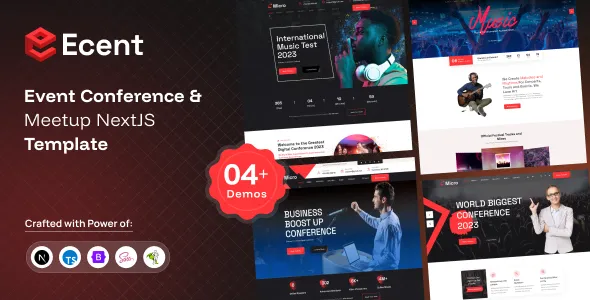
Ecent – Event Conference & Meetup NextJS Template
Ecent – Event Conference & Meetup NextJS Template is a modern website template designed for event organizers, conference planners, meetup communities, business networks, and organizations looking to promote events through a professional online presence. Built around the Next.js development framework, Ecent provides a potential starting point for creating event-focused websites that communicate essential details, introduce speakers, present schedules, and encourage visitors to participate in upcoming gatherings. Whether you are planning a corporate conference, technology summit, startup meetup, business seminar, educational workshop, networking event, or community gathering, this template can help organize event information into an engaging digital experience.
A successful event website needs to do more than announce a date and location. Visitors should be able to understand the purpose of the event, explore its program, discover the speakers, review attendance information, and find a clear way to register or contact the organizers. Ecent can be customized to support these objectives through relevant event content, structured page layouts, promotional sections, and calls to action, depending on the features included in the supplied version. Its final capabilities will depend on the template’s components, available pages, integrations, and implementation requirements.
Next.js provides a React-based framework for building modern web applications and websites. For developers, a Next.js template can offer a foundation for creating structured pages, reusable interface components, and a development workflow suited to customized event platforms. Before implementation, review the current demo and documentation to confirm the available layouts, dependencies, setup process, and supported functionality.
What Is Ecent – Event Conference & Meetup NextJS Template?
Ecent is an event-oriented Next.js website template intended for projects that need to communicate event information in a clear and professional format. It can be evaluated for conferences, seminars, networking sessions, professional meetups, industry gatherings, workshops, and similar occasions where visitors need quick access to event details.
An event website serves as an information hub for prospective attendees. It can introduce the event theme, explain its benefits, present the organizers, and guide visitors toward the next step. For a multi-session conference, this may include a program overview, speaker profiles, session times, and venue information. A smaller meetup may require a simpler page that focuses on the topic, date, location, and registration instructions.
Using a Next.js-based template gives developers a foundation for customizing the front-end presentation. Depending on the supplied source code, developers may adapt page sections, components, typography, colors, imagery, navigation, and other interface elements.
However, a front-end template does not automatically include every function associated with a complete event management system. Features such as attendee accounts, payment processing, ticket inventory, automated confirmations, and administrative dashboards may require additional services or development unless they are explicitly included in the product.
Ecent should therefore be evaluated against the specific needs of the planned event website before it is selected for production.
Modern Design for Conference and Meetup Websites
The visual design of an event website influences how visitors understand the event and whether they feel encouraged to participate. A clear and consistent interface can make information easier to scan while establishing a professional identity for the organizers.
Ecent is positioned for conference and meetup websites, making it a potential starting point for event pages that require a contemporary presentation. The actual design characteristics should be verified through the available demo and included source files.
An effective event homepage usually gives priority to the event name, theme, date, venue or online format, and primary registration action. Supporting sections can introduce speakers, explain the program, highlight key topics, and provide practical information for attendees.
Visual elements should support the event’s identity. A technology conference might use a modern digital aesthetic, while a business summit may benefit from a more formal presentation. A creative meetup could use expressive imagery and a distinctive color palette.
Consistency is important across the entire website. Headings, buttons, content sections, images, and navigation should work together to create a coherent experience. Visitors should be able to move from the introduction to the schedule or registration information without unnecessary confusion.
When customizing Ecent, focus on readability and clarity rather than adding decorative elements that compete with the essential event information.
Responsive Design for Desktop, Tablet, and Mobile
Many attendees discover events through mobile searches, social media links, email invitations, and messaging applications. A responsive website helps ensure that event information remains accessible across different screen sizes.
Ecent should be tested for responsive behavior before being used on a live event website. Depending on the supplied implementation, its layouts may adapt to different viewport widths by adjusting content columns, navigation, typography, images, and spacing.
On mobile devices, event dates, venue details, and registration links should be easy to find. Speaker photographs should remain clear, schedules should be readable, and interactive controls should be convenient to use on touchscreens.
Conference schedules require particular attention because they may contain multiple sessions, speakers, rooms, and time slots. A layout that looks organized on a desktop can become difficult to use on a narrow screen if the content is not adapted carefully.
Responsive testing should include the homepage, speaker sections, schedule pages, venue information, and registration interfaces where available. Developers can use browser tools and real devices to identify layout issues at different widths.
Custom styling and third-party integrations may affect the final responsive experience, so test the complete website after making significant changes.
Ideal for Corporate Conferences and Business Summits
Corporate conferences and business summits bring together professionals to discuss industry developments, exchange ideas, and build valuable connections. Their websites need to communicate the event’s purpose while presenting information in a structured and credible format.
Ecent can be considered for business events covering management, entrepreneurship, finance, marketing, technology, innovation, leadership, and other professional topics. Its suitability will depend on the page structures and customization options available in the selected version.
A corporate conference website may include an event overview, a list of speakers, the agenda, venue information, sponsor details, and registration instructions. Each section should answer a specific question that prospective attendees are likely to have.
The introduction should explain the event’s subject and intended audience. Speaker profiles can highlight relevant professional experience, while the agenda helps visitors understand the sessions and activities planned throughout the day.
If the conference includes networking opportunities, panel discussions, workshops, or exhibitions, these activities should be explained clearly. Visitors should understand what participation involves before making a registration decision.
For recurring conferences, organizers can use the website as a central source of information for each edition. Dates, speakers, schedules, and venue details should be updated carefully so that visitors do not rely on outdated announcements.
Create Technology Events and Startup Meetups
Technology events and startup meetups provide opportunities for developers, founders, investors, designers, and other professionals to share knowledge and build relationships. Their websites often need to communicate technical topics without making the information difficult for newcomers to understand.
Ecent can be adapted for events focused on software development, artificial intelligence, cloud computing, cybersecurity, product management, entrepreneurship, startup funding, and digital innovation.
A technology event homepage can introduce the main theme, explain who should attend, and highlight important sessions. Speaker sections can introduce engineers, researchers, founders, product leaders, or industry specialists, depending on the program.
Startup meetups may require a different emphasis. Organizers might highlight networking opportunities, founder presentations, product demonstrations, panel discussions, and community activities.
A clear agenda helps attendees decide which sessions are relevant to their interests. Where the event includes multiple tracks, rooms, or workshops, the schedule should present the information in an organized and easy-to-follow format.
Developers can adapt the template’s visual style to match the event’s identity, provided the necessary changes are supported by the source code. Logos, event graphics, speaker photographs, and other media should be optimized for performance and used with appropriate permissions.
Speaker Profiles and Presenter Information
Speakers are often an important part of a conference or professional meetup. Visitors may evaluate an event based on the expertise, experience, and relevance of the people presenting its sessions.
A well-organized speaker section can introduce presenters and help attendees understand what they will learn. Ecent may be customized to include speaker profiles if the supplied layouts support them or if the necessary sections are added during development.
Each profile can include the speaker’s name, professional role, organization, photograph, biography, and session topic. Additional information should be included only when it helps visitors understand the speaker’s contribution to the event.
Biographies should be concise and accurate. Focus on experience and expertise that relate to the event rather than publishing lengthy professional histories that are difficult to scan.
For conferences with several presenters, consistent formatting helps attendees compare sessions and identify topics of interest. If the event includes panel discussions, moderators and panelists should be identified clearly.
Speaker information must be maintained as the event approaches. If a presenter changes or a session is rescheduled, update the website promptly so that attendees receive accurate information.
Event Schedules and Conference Agendas
A conference schedule helps visitors plan their attendance and understand how the event will unfold. It can also reduce confusion by making session times, locations, and topics available before the event begins.
Ecent can serve as a starting point for presenting an event agenda, depending on the available page layouts and the customizations required. A schedule may organize sessions by time, topic, speaker, room, or event track.
For a one-day seminar, a simple chronological agenda may be sufficient. A larger conference may require separate tracks for workshops, keynote sessions, panel discussions, demonstrations, and networking activities.
Each schedule entry should provide the essential information. This may include the session title, start and end time, speaker, location, and a short description of the topic.
Organizers should make time zones clear when the event is online or includes international participants. For in-person events, room names and venue directions should be accurate and easy to locate.
If the program changes, update all relevant pages and communicate significant changes through the appropriate channels. An accurate schedule helps attendees prepare and reduces the likelihood of misunderstandings.
For events with complex agendas, an interactive schedule may be useful, but additional development could be required if it is not included with the template.
Registration and Attendee Conversion
A key purpose of an event website is to encourage interested visitors to register or take another appropriate action. The registration process should be clear, trustworthy, and convenient.
Ecent can be customized to include registration calls to action and links to an external booking or ticketing service, depending on the available implementation. A complete registration workflow may require a separate platform or backend integration.
Registration buttons should use clear wording that tells visitors what happens next. If attendees must select a ticket type, provide personal information, or complete a payment, explain the process before sending them to another service.
Keep the path from event discovery to registration as straightforward as possible. Visitors should not have to search through multiple pages to find the registration link or determine whether places are still available.
When using an external ticketing platform, verify that the link works on desktop and mobile devices. Make sure the event name, date, location, ticket information, and payment details are consistent across the website and registration provider.
If registration requires a form, test validation, confirmation messages, error handling, and data delivery. A visual form alone does not guarantee that submitted information will be stored securely or processed correctly.
Organizers should also explain relevant registration terms, cancellation conditions, and privacy information where applicable.
Venue Information and Event Logistics
For in-person conferences and meetups, practical venue information is essential. Attendees need to know where the event takes place, how to arrive, and what arrangements are available.
Ecent can be adapted to present venue details such as the location name, street address, arrival instructions, parking information, public transport guidance, accessibility details, and nearby accommodation recommendations.
The venue section should be easy to locate from the main navigation or event overview. If the event takes place at a large facility, include building names, room numbers, or entrance instructions when relevant.
A map link can help visitors plan their journey. Embedded maps or route-planning integrations may require additional configuration and should be tested before launch.
Online and hybrid events have different logistical needs. Their websites may need to explain how attendees will receive access links, whether sessions will be recorded, and what equipment or software is required.
Avoid publishing unconfirmed details. If parking, refreshments, accessibility arrangements, or accommodation discounts have not been finalized, communicate that clearly rather than creating inaccurate expectations.
A well-organized logistics section reduces repetitive questions and helps participants prepare for the event.
Sponsor and Partner Presentation
Sponsors and partners can play an important role in conferences, exhibitions, and industry gatherings. A dedicated sponsor section can acknowledge their support and provide visibility for participating organizations.
Depending on the available page layouts, Ecent can be customized to present sponsor logos, partner names, short descriptions, and links to official websites. The arrangement should reflect the actual sponsorship agreements and approved branding requirements.
If the event has different sponsorship levels, such as headline sponsor, supporting sponsor, or community partner, organize the presentation accordingly. Use only categories that accurately represent the event’s agreements.
Logo files should be prepared at appropriate dimensions and displayed without distortion. Ensure that contrast and spacing remain consistent across different logo shapes and colors.
Sponsor links should lead to the intended destinations, and any required disclosures should be included where appropriate.
A well-planned sponsor section can improve the completeness of the event website while helping partners understand how their participation is represented.
Customization and Event Branding
Every event has its own identity, audience, and objectives. Customization helps the website communicate these characteristics while maintaining a consistent presentation.
Ecent’s front-end styling and content can be reviewed and adjusted according to the structure of the supplied Next.js project. Depending on the implementation, developers may customize colors, typography, imagery, section layouts, navigation, and reusable components.
A corporate leadership summit may require a restrained visual identity, while a creative technology meetup might benefit from a more energetic style. A university conference may emphasize academic topics, research presentations, and institutional branding.
Start by defining the event’s core message and target audience. Select visual elements that support the theme without making essential information difficult to read.
Use consistent styling for buttons, headings, speaker profiles, agenda sections, and registration prompts. This makes the website easier to navigate and gives the event a recognizable identity.
Replace all placeholder content with accurate information, including event names, dates, venue details, presenter biographies, and sponsor information. Review the website on multiple devices after making design changes.
Keep the source code organized and preserve a backup of the original project so that customizations can be maintained or reversed when needed.
Next.js Development Framework
Next.js is a React-based framework used to build websites and web applications. It provides a development structure for organizing pages, components, assets, and other parts of a modern front-end project.
For developers working with Ecent, the framework can provide a foundation for adapting the template to a specific event website. The exact architecture, routing setup, rendering strategy, and component organization depend on the version and implementation supplied with the product.
Reusable components can help maintain consistency across event pages. For example, common navigation, footer elements, speaker cards, and calls to action may be shared where the codebase supports that approach.
Developers should review the package configuration, dependency versions, setup instructions, and documentation before making changes. This helps identify required tools and avoid compatibility issues.
Next.js can support more advanced website requirements, but those capabilities should not be confused with functionality automatically included in the template. Database connections, ticketing systems, attendee authentication, payments, and event administration may require separate development or external services.
A clear understanding of the supplied source code makes it easier to estimate customization work and plan a reliable deployment.
SEO-Friendly Event Website Structure
Search engine optimization can help potential attendees discover an event through searches related to its topic, location, speakers, or industry. The website should provide useful information and a clear structure rather than relying only on visual presentation.
Ecent can be configured with descriptive page titles, relevant headings, meaningful page content, and appropriate metadata. The actual SEO implementation should be reviewed after installation.
The event’s name, topic, date, and location should be presented clearly where relevant. For example, a local technology conference may benefit from a page that explains its subject, intended audience, location, and program.
If the event includes several sessions or speakers, separate pages or sections can provide more detailed information when appropriate. Internal links should connect the event overview with the agenda, speaker profiles, venue information, and registration page.
Use descriptive URLs where the project’s routing setup allows them. Optimize images and provide appropriate alternative text for meaningful visuals. Ensure that important pages can be crawled and indexed, subject to the site’s intended publication settings.
For events that qualify, developers may consider suitable event structured data using current search engine documentation. The information must match the visible page content and comply with the relevant guidelines.
SEO does not guarantee a particular ranking or number of registrations. Search performance depends on many factors, including competition, content relevance, technical quality, and how early the event information becomes available.
Website Performance and Loading Speed
Fast loading is particularly important for event websites because visitors may arrive from advertisements, social media, email campaigns, and mobile searches. A slow page can make it harder for attendees to find important information.
The performance of an Ecent website depends on the supplied code, image assets, fonts, JavaScript, hosting environment, and external services. Developers should measure performance before launch and after major customizations.
Speaker photographs, event banners, sponsor logos, and promotional graphics should be optimized for their intended display sizes. Large files can increase loading times, especially on mobile networks.
Review the use of external libraries and scripts. Keep dependencies appropriate to the project and avoid adding unnecessary functionality that increases complexity.
Depending on the Next.js implementation, developers may be able to use framework-supported image optimization and rendering features. Confirm the correct configuration in the project documentation rather than assuming that every optimization is already enabled.
Test the homepage, agenda, speaker pages, and registration journey using suitable performance tools. Check both mobile and desktop experiences, and investigate any significant loading delays or layout shifts.
Regular performance checks help keep the event website useful as new content and promotional material are added.
Accessibility and User-Friendly Navigation
An event website should make information accessible to visitors with different devices, browsing preferences, and abilities. Clear navigation and readable content can improve the experience for everyone.
When customizing Ecent, use a logical heading hierarchy, descriptive link text, sufficient color contrast, and readable typography. Buttons should have clear labels, and form fields should explain what information is required.
Navigation should prioritize essential pages such as Event Overview, Schedule, Speakers, Venue, and Registration where these sections are included. Visitors should be able to find important details without unnecessary clicks.
Do not rely exclusively on color to distinguish event categories or status information. Provide appropriate text labels and ensure interactive elements have visible focus indicators for keyboard users.
Speaker photographs and event graphics that communicate information should have suitable alternative text. Decorative images can be handled according to accessibility best practices.
Test the website using keyboard navigation, mobile devices, and browser zoom. Automated accessibility tools can identify some problems, but manual testing is also valuable.
The final accessibility level depends on the template, its customization, content, and third-party components. Reviewing these elements before launch helps create a more inclusive event experience.
Integrations and Additional Event Functionality
Some events require functionality beyond displaying information. Depending on the event’s complexity, organizers may need registration systems, payment services, email notifications, calendar links, maps, analytics, or attendee management tools.
Ecent can be evaluated as the front-end foundation for these workflows, but the available integrations should be confirmed in the current product documentation.
An external ticketing service can handle ticket selection and payment processing, while the website provides event information and directs visitors to the registration process. Calendar links can help attendees save event dates, and email services may support announcements or reminders.
More advanced requirements, such as attendee dashboards, personalized agendas, check-in systems, and ticket validation, generally require compatible services or additional development unless specifically included.
Before adding integrations, check their documentation, pricing, compatibility, data requirements, and privacy implications. Test each workflow from the visitor’s perspective, including unsuccessful submissions and error scenarios.
Avoid connecting unnecessary services simply because they are available. Every integration adds maintenance considerations and may affect performance or the handling of attendee information.
A carefully selected set of tools can extend the website’s usefulness while keeping the attendee journey manageable.
Security and Attendee Data Protection
Event websites may collect personal information during registration, contact requests, newsletter subscriptions, or other interactions. Protecting that information should be part of the implementation plan.
A front-end template alone does not provide a complete security framework for data collection. Any form or registration workflow should use an appropriate backend or trusted service that handles submissions securely.
Use HTTPS for the live website and follow the security recommendations of the chosen hosting provider and integrations. Keep dependencies updated, restrict access to administrative systems, and avoid exposing private credentials in client-side code.
Collect only the information required for the stated purpose. Explain how attendee data will be used, stored, and managed, and provide suitable privacy information in line with applicable requirements.
If the event uses a third-party ticketing or email platform, review its data handling practices and configuration. Test that sensitive information is not inadvertently exposed in page source, logs, public URLs, or analytics events.
Security requirements depend on the website’s architecture and the services it uses. For projects that process payments or sensitive attendee information, use appropriate professional review before launch.
Who Should Use Ecent – Event Conference & Meetup NextJS Template?
Ecent may be suitable for a range of event-focused website projects, depending on the available layouts and the degree of customization required.
Corporate event organizers: Present business conferences, leadership summits, professional seminars, and industry gatherings.
Technology communities: Promote developer conferences, software workshops, innovation events, and technical meetups.
Startup networks: Introduce founder meetups, pitch events, entrepreneurship sessions, and investor networking gatherings.
Educational institutions: Share information about academic conferences, training sessions, workshops, and professional development events.
Marketing agencies: Build event pages for brand activations, marketing seminars, product presentations, and industry networking activities.
Community organizers: Communicate details about local meetups, interest groups, public gatherings, and community learning sessions.
Professional associations: Present industry meetings, member events, annual conferences, and specialized training programs.
Event management companies: Create a digital presentation for selected events and guide visitors toward registration or inquiry channels.
Before selecting the template, confirm that its included pages and implementation suit the event format, branding requirements, and technical environment.
Tips for Building a Successful Event Website
A successful event website combines useful information, clear navigation, trustworthy details, and a straightforward path to participation. The template should support these goals rather than dictate the event’s entire content strategy.
Begin by defining the event’s audience and purpose. Determine what attendees need to know before registering and which information is most likely to influence their decision.
Prepare accurate event content before customizing the design. This may include the event description, date, venue, agenda, speaker biographies, registration instructions, organizer details, and sponsor information.
Place essential details where visitors can find them quickly. Keep the primary call to action visible, and make sure that registration links lead to the correct destination.
Use original or properly licensed imagery and maintain consistent event branding across the website. Replace placeholder text and confirm that all public information is accurate.
Test the site on desktop and mobile devices. Check the agenda, speaker profiles, forms, navigation, external links, and any ticketing or calendar integrations.
Finally, create a maintenance plan for updating schedules, announcing speaker changes, reviewing registration information, and removing outdated content after the event. This is particularly important for recurring conferences and events with evolving programs.
Final Thoughts on Ecent – Event Conference & Meetup NextJS Template
Ecent – Event Conference & Meetup NextJS Template is a potential starting point for organizers and developers who want to create a professional website for conferences, meetups, seminars, networking sessions, and other organized gatherings. Its event-focused positioning makes it relevant to projects that need to present essential event details, introduce speakers, communicate schedules, and direct visitors toward registration.
Built around the Next.js development framework, the template can provide a foundation for front-end customization and the development of a structured event website. Depending on the supplied implementation, developers may adapt its presentation to different event brands, audiences, and program requirements.
The final capabilities depend on the included source files, layouts, dependencies, and any additional services or integrations. Features such as ticket payments, attendee management, automated email confirmations, and administrative tools should be verified rather than assumed to be part of the template.
Long-term effectiveness also depends on accurate content, responsive testing, performance optimization, accessibility, SEO configuration, and appropriate security practices. A well-planned event website helps prospective attendees find the information they need and understand how to participate.
For organizers seeking a customizable front-end foundation for a conference or meetup website, Ecent is worth evaluating against the project’s specific requirements. By combining a suitable template with clear event information and careful implementation, developers can build an online experience that supports event promotion, attendee engagement, and a smoother registration journey.