My Account
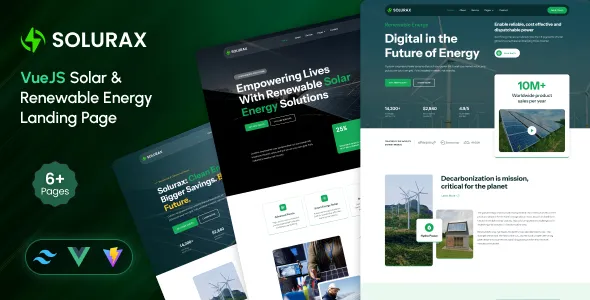
Solurax – VueJS Renewable & Solar Energy Landing Page Template
Solurax – VueJS Renewable & Solar Energy Landing Page Template is a modern website template designed for renewable energy companies, solar power providers, clean energy startups, environmental organizations, and businesses working toward a more sustainable future. Built around Vue.js, Solurax offers a potential starting point for creating a professional landing page that introduces renewable energy solutions, communicates business services, showcases solar projects, and encourages visitors to explore clean energy opportunities. Its industry-focused concept makes it suitable for organizations that want to establish a credible online presence while presenting their commitment to energy efficiency and environmental responsibility.
As businesses and households increasingly explore renewable energy options, having a clear and informative website can help energy providers communicate their services to prospective customers. A well-structured landing page can explain solar installation services, introduce renewable energy technologies, highlight completed projects, and provide convenient ways for visitors to request information. Solurax can be customized to support these objectives through relevant content, consistent branding, and a layout tailored to the needs of the target audience.
Vue.js is a JavaScript framework used to build interactive user interfaces and web applications. Its component-based approach can help developers organize page sections and maintain a consistent design as a website evolves. When combined with suitable styling and responsive layouts, a Vue.js landing page template can provide a useful foundation for presenting business information across desktop computers, tablets, and mobile devices. The exact layouts, components, animations, and interactive elements available with Solurax depend on the supplied template package and its current documentation.
Whether you operate a solar installation company, manufacture renewable energy equipment, provide energy consulting, or promote sustainable technology, Solurax can be evaluated as a starting point for building an industry-specific website. The final website should be customized with accurate service information, original project images, clear contact options, and content that reflects the organization’s actual capabilities.
What Is Solurax VueJS Renewable and Solar Energy Landing Page Template?
Solurax is a Vue.js landing page template intended for websites in the renewable energy and solar power sector. A landing page focuses on communicating a business’s main offering and guiding visitors toward relevant information or actions. For an energy company, this may involve introducing solar installation services, explaining renewable energy solutions, presenting project examples, or inviting potential customers to request a consultation.
The renewable energy industry serves a broad audience, including homeowners, commercial property owners, industrial facilities, real estate developers, and organizations seeking to understand alternative energy solutions. Each audience may have different questions about installation, system capacity, project planning, equipment, maintenance, and expected costs. A focused landing page can organize these details so visitors can quickly understand the services available.
Solurax can serve as a visual foundation for communicating these offerings. Depending on the included sections, developers may adapt the template to feature a business introduction, service summaries, project showcases, company information, customer testimonials, and contact opportunities. The precise page structure should be confirmed by reviewing the current demo and documentation.
It is important to distinguish between a landing page template and a complete solar business management system. The template may provide frontend layouts and interface elements, but features such as quotation calculations, customer account management, installation scheduling, payment processing, and project monitoring may require separate development or third-party integrations.
Designed for Renewable Energy and Solar Power Businesses
Renewable energy businesses need websites that explain their services clearly while helping customers understand the value of clean energy solutions. A specialized landing page can provide a focused introduction to these services without requiring visitors to navigate through unrelated information.
Solurax can be considered for solar panel installation companies, renewable energy consultants, clean technology providers, solar equipment suppliers, energy efficiency businesses, and organizations involved in sustainable infrastructure. The final website can be structured around the services and audiences that matter most to the business.
A residential solar provider might prioritize rooftop solar installations, site assessments, system planning, and maintenance services. A commercial energy company could focus on installations for offices, warehouses, factories, schools, and other large facilities. A renewable energy consultancy may instead emphasize energy assessments, project planning, and technical guidance.
The website should explain each offering in language that customers can understand. Technical information may be useful, but it should be supported by clear descriptions of the service, the intended audience, and the process involved. This approach helps visitors determine whether the business is relevant to their needs.
By replacing generic demonstration content with accurate service information and genuine project examples, Solurax can be adapted to reflect the identity and expertise of a specific renewable energy organization.
Vue.js Framework for Modern Website Development
Vue.js provides a component-oriented approach to building interactive web interfaces. It allows developers to organize application elements into reusable components and manage interface behavior in a structured way.
For a renewable energy landing page, reusable components can help maintain consistency across service sections, project cards, navigation elements, contact forms, and other repeated interface patterns, depending on the template’s implementation. Developers can adapt these components to match the business’s content and design requirements.
The Vue.js ecosystem can also support further development if the website needs to grow beyond a simple landing page. For example, a company may eventually want to add service-area pages, project directories, customer inquiry workflows, or additional informational sections. The suitability of these changes depends on the supplied source code and the architecture selected for the project.
Before starting development, review the package structure, required Node.js version, dependency list, installation instructions, and build process. Some templates may require a development server and production build, while others may provide prepared assets or a particular project configuration.
Vue.js does not automatically provide every business function required by a solar company. Dynamic pricing, customer data storage, lead management, and external service integrations need appropriate implementation. Understanding the template’s included features helps developers plan the work and avoid assuming that all functionality is already available.
Responsive Design for Desktop, Tablet, and Mobile
Potential solar customers may discover a business through search engines, online advertisements, social media, or referrals. Many visitors use mobile devices to browse service information, compare providers, and contact companies. A responsive website helps ensure that essential content remains accessible across different screen sizes.
Solurax can be evaluated for projects that require an adaptable presentation on desktop computers, laptops, tablets, and smartphones. A responsive layout should keep headings readable, images properly scaled, navigation understandable, and important actions easy to select.
On larger screens, a landing page may present a broad introductory section with supporting imagery and clearly organized service information. On smaller devices, the same content may need a simpler column structure, more compact spacing, and navigation that works comfortably with touch input.
Solar websites often include project photographs, equipment images, diagrams, and other visual material. These assets should be sized appropriately to avoid overflowing the layout or making mobile pages difficult to load. Contact forms and buttons should also remain usable without excessive zooming or horizontal scrolling.
Responsive behavior should be tested across the complete website rather than only on the main banner. Service sections, project galleries, testimonials, inquiry forms, and footer navigation may each need individual review. Custom scripts and third-party components can also affect how the page behaves on smaller screens.
Homepage and Landing Page Structure
The landing page is often the first substantial introduction visitors receive to a renewable energy business. It should explain what the company does, who it serves, and how visitors can learn more about its services.
Solurax can be customized around a logical page structure that introduces the business before presenting supporting details. Depending on the available sections, the layout might include a hero area, company introduction, service overview, project highlights, key business information, customer feedback, frequently asked questions, and a contact section.
The opening section should communicate the company’s primary offering in clear language. For example, a residential solar provider might explain its installation services, while a commercial energy business may emphasize solutions for business premises and industrial facilities.
The service overview can help visitors identify relevant offerings without reading every section. Project examples can then provide context about the company’s work, while company information can explain its experience, approach, and service coverage.
Not every landing page needs the same number of sections. A small local installer may benefit from a concise presentation, while a larger renewable energy provider may need more detailed information about its service categories and project experience.
The most effective structure is the one that helps visitors find answers and understand the next step. Every section should contribute to that purpose rather than simply adding length to the page.
Showcase Solar Installation and Renewable Energy Services
Service presentation is an important part of a solar company website. Visitors need to understand what the business offers and whether its services are appropriate for their property or project.
Solurax can be adapted to present services such as residential solar installation, commercial solar systems, rooftop solar solutions, solar equipment consultation, energy assessments, maintenance support, and renewable energy project planning, depending on the actual services provided by the business.
Each service section should explain the offering in practical terms. A residential installation page might describe the initial assessment, system design, equipment selection, installation process, and available maintenance options. A commercial service section could explain how a provider evaluates site requirements, electricity consumption, installation constraints, and project objectives.
Businesses should avoid presenting services they do not actually provide. Clear descriptions help potential customers understand the scope of the work and reduce confusion during the inquiry process.
Where appropriate, service sections can include links to dedicated pages with more detailed explanations. This can be useful for businesses serving multiple customer groups or offering several types of renewable energy solutions.
A consistent presentation of services makes the website easier to scan and helps visitors compare available options. Combined with clear contact opportunities, it can support a more useful path from initial interest to a business inquiry.
Highlight Renewable Energy Projects and Case Studies
Project showcases can help renewable energy businesses demonstrate their experience and explain the types of installations or initiatives they have completed. For customers considering a solar project, real examples may provide useful context about the company’s work.
Solurax can be evaluated for project-focused layouts that present photographs, project descriptions, and other relevant information supported by the template. A company may showcase residential rooftops, commercial installations, industrial facilities, or renewable energy initiatives, provided it has permission to publish the material.
A useful project entry should explain the general context, the customer’s requirements where disclosure is authorized, the work performed, and any verified outcomes. Technical details may include system capacity, equipment specifications, installation scope, or project duration when accurate information is available and suitable for publication.
For example, a commercial case study could describe the facility’s energy objectives and explain the installation approach. A residential example might outline the property type and the general process used to develop a suitable system.
Avoid using fabricated statistics or presenting estimated outcomes as guaranteed results. Energy generation, savings, and payback periods depend on several factors, including system design, local conditions, electricity tariffs, usage patterns, and applicable policies.
Authentic project examples can make a website more informative while helping visitors understand the company’s practical experience.
Communicate the Benefits of Solar Energy Clearly
Visitors often explore solar energy because they want to understand its practical, financial, and environmental implications. A website can help them make informed decisions by presenting these topics clearly and avoiding exaggerated promises.
Solurax can be customized to explain general benefits associated with appropriately designed solar energy systems. These may include generating electricity from sunlight, reducing reliance on grid-supplied electricity during suitable operating periods, supporting energy diversification, and contributing to lower operational emissions depending on the system and energy sources being displaced.
Financial outcomes vary between projects. Installation costs, system capacity, local electricity rates, available incentives, maintenance requirements, and actual energy generation can influence the overall economics. Website content should therefore avoid promising identical savings for every customer.
A useful benefits section can explain what a customer should consider before investing in solar energy. This may include the property’s available roof area, shading, electricity consumption, equipment selection, installation requirements, and local regulations.
Businesses can also provide educational resources that explain the difference between system capacity and actual energy production. Clear explanations help visitors develop realistic expectations and prepare more informed questions for a consultation.
The aim should be to communicate genuine value rather than rely on broad environmental claims. Accurate information can support trust and help prospective customers decide whether to explore the business’s services further.
Customization and Renewable Energy Branding
A professional website should reflect the identity of the business it represents. For a renewable energy company, branding can communicate reliability, technical competence, environmental awareness, and a commitment to practical energy solutions.
Solurax can be customized to align with a company’s visual identity, depending on the styling options and source-code structure provided. Developers may adapt the logo, colors, typography, imagery, spacing, and other visual details to match the brand.
Some businesses may prefer a clean, minimal design with restrained colors and technical project imagery. Others may use a more vibrant visual identity that emphasizes innovation, sustainability, and modern energy technology.
Consistency is important across the entire landing page. Headings should follow a recognizable hierarchy, buttons should use predictable styles, and service cards should present information in a uniform format. Project photography should also be relevant to the company’s work rather than relying entirely on generic stock images.
Before launch, replace demonstration logos, placeholder text, and sample contact details. Confirm that all images, icons, and fonts are licensed for the intended use.
Thoughtful customization can help turn a general template into a website that reflects the company’s services, market positioning, and communication style.
Lead Generation and Customer Inquiry Forms
For many solar energy businesses, one of the main purposes of a website is to generate qualified inquiries. Potential customers may want to request a quotation, arrange a site assessment, discuss a commercial project, or ask questions about available services.
Solurax can serve as a starting point for a landing page that guides visitors toward these actions. Depending on the supplied components, developers may adapt buttons, contact sections, or inquiry forms to suit the business’s workflow.
A residential solar inquiry form might request a name, contact details, property location, property type, and a short description of the customer’s requirements. A commercial project form may need additional information about the facility, project scope, or estimated electricity consumption.
Forms should remain straightforward. Request only the information needed for an initial response, and explain why any important details are being collected. Clear field labels and helpful validation messages can make the process easier to complete.
A form’s visual appearance does not guarantee that submissions will be delivered. Developers must configure the appropriate backend, email service, customer relationship management platform, or other lead-handling system. They should test successful submissions, invalid entries, spam protection, and confirmation messages before launch.
Businesses should also provide accurate contact details and ensure that submitted inquiries are handled appropriately. A well-planned contact workflow can help turn website visits into meaningful conversations with prospective customers.
SEO-Friendly Website Structure
Search engine optimization can help renewable energy businesses reach people searching for solar installation services and related information. A well-organized landing page provides a useful starting point, but search visibility also depends on content quality, technical implementation, competition, and ongoing maintenance.
Solurax can be customized with clear headings, descriptive page titles, useful service descriptions, relevant internal links, and properly optimized images. The content should focus on the actual services and locations served by the business rather than repeating the same keywords throughout the page.
For example, a company serving a specific region may explain its residential and commercial solar installation services on dedicated pages. A business offering several renewable energy solutions may benefit from separate pages for major service categories rather than placing every topic into one long landing page.
Local SEO can be particularly relevant for installation businesses. Accurate business details, consistent contact information, genuine customer reviews, and useful service-area content can help customers understand where the company operates. Service locations should be stated truthfully and should not be added solely to create repetitive pages.
Image optimization also matters. Use appropriate image dimensions, compress files where possible, and provide descriptive alternative text for meaningful images. Avoid placing important service information only inside images.
Developers should verify metadata, canonical URLs, sitemap configuration, robots directives, and the way page content is rendered. The appropriate technical setup depends on the Vue.js implementation and hosting environment.
No template can guarantee rankings or traffic. Original content, relevant service information, a good user experience, and technically sound implementation provide a more sustainable foundation for SEO.
Website Performance and Loading Speed
A fast website helps visitors access service information without unnecessary delays. Performance is especially important for mobile users who may be browsing over slower connections or accessing the website while comparing local providers.
The performance of a Solurax website depends on its source code, images, stylesheets, JavaScript, fonts, hosting, and third-party integrations. A modern framework does not automatically guarantee that every page will load quickly.
Renewable energy websites often rely on large photographs, project galleries, and promotional visuals. These assets should be compressed appropriately and displayed at suitable dimensions. Modern image formats can be considered where supported by the deployment environment.
Developers should review unnecessary scripts, decorative animations, and external widgets that add loading costs without providing meaningful value. If the template uses a build process, follow the recommended production build instructions and check that the deployed assets are optimized.
Performance testing should cover the main landing page, project sections, contact forms, and any additional pages added during customization. Testing only the development environment may not reveal issues caused by production configuration or third-party services.
Regular performance reviews can identify oversized images, inefficient scripts, and layout problems introduced by new content. Maintaining efficient loading behavior supports a more convenient experience for potential customers.
Accessibility and User-Friendly Navigation
A renewable energy website should make its information easy to locate and understand. Clear navigation, readable text, suitable contrast, and accessible interactive elements help visitors explore services without unnecessary difficulty.
When customizing Solurax, developers should use logical heading structures, descriptive links, meaningful image alternative text, and clear form labels. Navigation elements should have understandable names, while buttons should communicate their actions.
Color should not be the only way to convey important information. Text and background combinations should provide suitable contrast, and interactive controls should have visible focus indicators for keyboard users.
Contact forms should explain which fields are required and provide understandable messages when an entry needs correction. If a page includes accordions, menus, sliders, or dialogs, those components should be tested for keyboard accessibility and appropriate behavior.
Mobile usability also contributes to accessibility. Buttons should be easy to select, content should not require unnecessary horizontal scrolling, and navigation should remain predictable across different screen sizes.
Accessibility depends on the original template, the content added, and the quality of any custom components. Automated checks can identify some issues, but manual testing is also important for evaluating the complete user experience.
Integration with Business Tools and External Services
A renewable energy website may need to connect with services that help manage customer inquiries, schedule consultations, measure traffic, or support other business activities. The appropriate integrations depend on the organization’s workflows and the functionality included in the template.
Solurax can be considered as a frontend foundation for a website that connects to compatible services. For example, inquiry forms may be linked to an email delivery system or customer relationship management platform, while analytics tools can help businesses understand how visitors use the website.
A company that manages many projects may also connect its website to an existing content management system or internal data source. More advanced features, such as appointment booking, quotation requests, or customer portals, may require backend development.
Developers should review each integration’s documentation, security requirements, data handling practices, and compatibility with the supplied Vue.js version. API credentials and private keys should be stored securely rather than exposed in client-side code.
Only necessary integrations should be added. Excessive third-party scripts can increase maintenance requirements and affect website performance.
After implementing an integration, test the complete workflow. Confirm that forms submit correctly, data reaches the intended destination, error states are handled appropriately, and the user receives clear feedback.
Security and Ongoing Website Maintenance
A professional business website requires regular maintenance to remain reliable and secure. Although a landing page may be simpler than a full web application, it can still depend on third-party packages, contact forms, external services, and deployment configuration.
Developers should follow the template’s installation instructions and review its dependencies before deployment. Supported packages should be updated carefully, with compatibility testing performed before significant changes are released.
If the website collects customer information, the form and backend should handle that data responsibly. Validation, spam protection, access controls, and appropriate data-handling practices should be implemented according to the site’s requirements.
HTTPS should be enabled, and hosting and deployment settings should be reviewed. Backups are useful for preserving website files and configuration, particularly before major updates or redesigns.
Maintenance should also include reviewing the published content. Service descriptions, contact details, project information, and any references to incentives or regulations should remain accurate. Renewable energy policies and market conditions can change, so time-sensitive information should be checked regularly.
A planned maintenance routine helps keep the website dependable while allowing the business to update its services and project portfolio as it grows.
Who Should Use Solurax Renewable and Solar Energy Landing Page Template?
Solurax may be suitable for several types of organizations working in renewable energy and related industries.
Solar installation companies: Businesses can create a landing page that introduces residential or commercial solar installation services and provides a clear way to request information.
Renewable energy startups: New businesses can establish an online presence focused on clean energy technologies, sustainable solutions, and their specific market offering.
Solar equipment suppliers: Companies can present their products, equipment categories, and related services, subject to the layout and functionality available in the template.
Energy consultants: Consultants can introduce energy assessments, project planning, technical guidance, and other services they actually provide.
Commercial solar providers: Businesses serving offices, warehouses, factories, and other facilities can organize their website around commercial energy requirements and relevant project examples.
Environmental organizations: Organizations focused on renewable energy awareness can present educational information, initiatives, and sustainability projects.
Clean technology businesses: Companies working on energy efficiency and related technologies can adapt the template to communicate their offerings and business objectives.
Freelance web developers and digital agencies: Professionals can evaluate the template as a starting point for client websites, subject to its license and customization requirements.
Before selecting Solurax, review the current demo, documentation, included sections, supported dependencies, license terms, and responsive behavior to ensure that it matches the project’s requirements.
Tips for Building a Successful Renewable Energy Website
Start by identifying the website’s primary audience. A residential solar company needs different information from a commercial installation provider or a renewable energy consultancy. Understanding the audience helps determine which services, project examples, and calls to action deserve the most attention.
Prepare accurate business information before customizing the layout. This may include service descriptions, company background, service locations, contact details, project photographs, and relevant technical information. Real content makes it easier to determine how the template should be organized.
Use clear language to explain the services offered. Avoid exaggerated environmental claims, guaranteed savings, or unsupported technical statements. Where financial or performance estimates are included, explain the assumptions and factors that can influence the results.
Create a consistent visual identity using suitable colors, typography, logos, and original imagery. Ensure that the main message and contact options remain easy to find across desktop and mobile layouts.
Before launch, test every important interaction. Review navigation links, contact forms, responsive layouts, page loading, accessibility, and any external integrations. Check the accuracy of all published information and replace any remaining demonstration content.
Finally, establish a maintenance plan that includes dependency updates, backups, performance reviews, and periodic content checks. A website that remains accurate and easy to use can continue supporting the business as its services and customer base develop.
Final Thoughts on Solurax – VueJS Renewable & Solar Energy Landing Page Template
Solurax – VueJS Renewable & Solar Energy Landing Page Template is a potential starting point for solar companies, renewable energy providers, clean technology startups, consultants, and organizations that want to build a professional online presence. Its industry-focused concept and Vue.js foundation make it relevant to projects that need a structured presentation for renewable energy services, project examples, business information, and customer inquiries.
A successful renewable energy website should combine responsive design, clear service descriptions, authentic project information, consistent branding, accessible navigation, and a convenient contact process. Solurax can provide the visual foundation, while developers customize the interface to reflect the organization’s actual services and business objectives.
The final capabilities depend on the supplied template version, its documentation, the included components, and any additional development or integrations. Features such as quotation tools, appointment booking, customer portals, and advanced lead management should be verified before being treated as available.
By reviewing the current demo, replacing placeholder content with accurate information, optimizing the website for performance and search engines, and maintaining its technical components, businesses can adapt Solurax to support their digital marketing efforts. With careful customization and useful content, it can serve as a foundation for communicating renewable energy solutions and helping prospective customers take the next step.