My Account
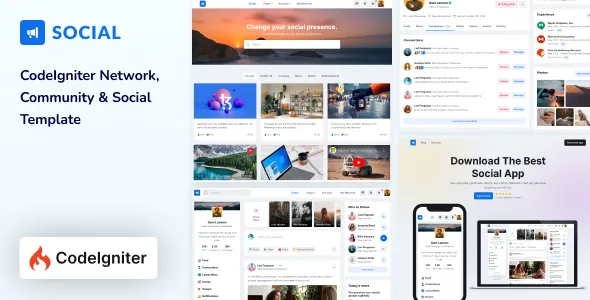
Social – CodeIgniter Network & Community Template
Social – CodeIgniter Network & Community Template is a versatile web development solution designed for building social networking platforms, online communities, membership-based websites, and interactive networking portals. Developed for projects using the CodeIgniter framework, this template provides a frontend foundation for creating digital environments where users can connect, communicate, share content, and participate in community activities. Whether you are planning a social networking website, a professional community platform, an interest-based discussion portal, or a membership-oriented web application, Social offers a starting point for developing a structured and engaging online experience.
Online communities have become an important part of digital communication, enabling people to exchange ideas, discover shared interests, establish connections, and participate in discussions. A well-designed community website needs an organized interface that allows visitors to navigate profiles, explore content, interact with other members, and access relevant features conveniently. Social is intended to support the development of such platforms through a community-focused design approach and a framework-oriented development structure.
CodeIgniter provides a PHP framework for building dynamic web applications, organizing application code, and developing backend functionality. When combined with a suitable frontend template, developers can create a foundation for a customized social platform. The actual functionality depends on the supplied package, framework version, configuration, and additional development work. Features such as authentication, messaging, notifications, database-driven profiles, and social interactions require appropriate implementation unless explicitly included in the product.
What Is Social CodeIgniter Network & Community Template?
Social is a CodeIgniter-based website template intended for developers who want to create online networking and community platforms. It can be considered for projects where the website experience revolves around user participation, profile-based interaction, shared content, and community engagement.
A community platform generally needs a consistent structure for presenting member information, organizing discussions, displaying updates, and providing access to relevant interaction features. Social can serve as a starting point for developing these frontend experiences while allowing developers to customize the website according to their project requirements.
The template may be suitable for different types of community-oriented projects, including social networking websites, professional networking platforms, interest-based communities, online discussion portals, and membership websites.
CodeIgniter provides a PHP-based application framework that developers can use to build dynamic web applications. Its architecture and development tools can support the creation of application components, routing, controllers, database interactions, and other backend features, depending on the framework version and configuration.
Before implementation, developers should review the product documentation, demo, package contents, and supported framework version to understand the actual features and technical requirements included.
Build a Modern Social Networking Website
A social networking website needs an interface that makes it convenient for users to discover content, connect with others, and participate in community activities. The overall experience should prioritize clear navigation, organized information, and accessible interaction elements.
Social can provide a foundation for developing a networking website with customized sections for member profiles, community updates, activity feeds, discussions, and other relevant content. The actual pages and components available depend on the purchased version.
A social platform might be designed around personal connections, shared interests, professional networking, educational communities, or specialized groups. Each type of website has different audience expectations and content requirements.
For example, a professional networking platform may emphasize career information, skills, and industry discussions. An interest-based community might prioritize group participation, shared posts, and discussion topics. A general social website may focus on profile presentation and community interaction.
The design should support the intended purpose of the platform rather than include unnecessary elements. By customizing the interface around specific user needs, developers can create a more focused and intuitive networking experience.
CodeIgniter Framework for Web Application Development
CodeIgniter is a PHP framework used to develop web applications with a structured programming approach. It provides development tools and application components that can help developers organize code and implement dynamic website functionality.
Social is intended for projects that use the CodeIgniter development environment, making it relevant to PHP developers who want to build community-oriented web applications. The framework can serve as the foundation for implementing backend logic, database connections, application routing, and other necessary functionality.
Depending on the CodeIgniter version, developers may work with different application structures, configuration requirements, and supported libraries. Reviewing the documentation is important before beginning customization to ensure compatibility with the intended environment.
The frontend resources can be adapted to work with the application’s views and other presentation components, depending on the package structure. Developers can connect the interface to suitable controllers, models, and database-backed application features as needed.
The actual backend capabilities depend on the included code, development configuration, and additional implementation work. A template should not be assumed to provide a fully operational social network without verifying its contents.
Responsive Design for Community Platforms
Responsive design is important for social networking websites because users may access the platform from desktop computers, laptops, tablets, and smartphones. A consistent interface across different screen sizes helps make community content more accessible.
Social can be evaluated as a starting point for developing responsive networking interfaces. Depending on the included layouts, developers can customize navigation, content sections, profile presentations, and interaction areas to fit different screen dimensions.
On smaller screens, community feeds should remain readable, profile information should be organized clearly, and navigation should be convenient to use. Buttons, menus, and forms should be appropriately sized for touch interaction.
Responsive behavior should also be reviewed when the website displays user-generated content. Long posts, profile images, discussion threads, and other dynamic elements may require additional layout adjustments.
Developers should test the finished application across multiple browsers and screen sizes. Custom CSS, third-party libraries, and additional integrations can influence responsive behavior, so regular testing is recommended throughout development.
User Profiles and Member Management
User profiles are an important part of many social networking and community websites. They provide a structured way for members to introduce themselves, display relevant information, and establish connections with other participants.
Social can serve as a frontend starting point for developing profile-based community experiences. Depending on the available components, developers may customize profile pages to display member names, profile photographs, biographies, interests, professional information, or other relevant details.
A professional community might emphasize career information and expertise, while a general networking website could focus on personal introductions and shared interests. A specialized community may organize profiles around a particular activity, subject, or membership category.
Dynamic profile management requires suitable backend implementation. Database storage, account registration, authentication, profile editing, image uploads, and privacy controls must be implemented or integrated unless included in the purchased package.
Developers should also consider profile visibility and data protection. Members should understand what information is displayed publicly and which settings are available to manage their personal information.
Community Feeds and Content Sharing
Community feeds provide a central place where members can explore updates, announcements, discussions, and shared content. They can help create an active environment by presenting relevant information in a structured format.
Social can be customized to support feed-style frontend layouts, depending on the components included in the package. Developers may adapt these interfaces to display different content types, such as text updates, announcements, images, or community discussions.
A community feed should be organized to make content easy to read and navigate. Clear spacing, appropriate typography, and consistent content presentation can improve the browsing experience.
Features such as posting updates, editing content, uploading images, reacting to posts, commenting, and managing feed visibility require suitable backend logic and database integration unless specifically included.
Developers should plan how content is created, stored, displayed, and moderated. This is particularly important for platforms that allow members to publish information or interact with other users.
Discussion Forums and Interest-Based Communities
Discussion forums and interest-based communities allow members to participate in conversations around shared topics. These platforms can support educational discussions, professional knowledge exchange, hobby groups, and specialized communities.
Social can be considered for building the frontend structure of a discussion-oriented website. Developers can customize the available layouts to organize topics, discussions, community sections, and member participation.
A technology community might organize conversations around programming languages, development tools, and technical questions. An educational platform could structure discussions around courses and subject areas. A business community might focus on industry knowledge, professional development, and networking opportunities.
A useful discussion interface should make topics easy to browse and provide a clear visual distinction between different conversations. Categories, descriptive headings, and organized content can help users discover relevant discussions.
Dynamic forum functionality such as creating topics, posting replies, editing discussions, tracking activity, and moderating content requires backend development or additional systems unless explicitly included in the package.
Private Messaging and Communication Features
Communication tools can be an important part of a networking platform because they allow members to exchange information directly. Depending on the website’s purpose, messaging may support personal conversations, professional communication, or group discussions.
Social can provide a frontend starting point for developing communication-related interfaces where suitable components are available. Developers may customize conversation layouts, message lists, contact sections, and other visual elements to match the intended platform.
However, a static template does not automatically provide a complete messaging system. Real-time communication, message storage, delivery status, unread indicators, attachments, and notification handling require suitable backend functionality and integrations.
Developers should also consider communication privacy, abuse prevention, and moderation. Messaging features should include appropriate safeguards based on the intended audience and the platform’s requirements.
Before implementing a communication system, review the framework version, server architecture, database requirements, and any third-party services needed to support the feature.
Notifications and Community Engagement
Notifications can help members stay informed about relevant activity within a community platform. They may provide updates about new connections, discussions, replies, messages, or other interactions.
Social can be adapted to present notification-related frontend components where included in the package. Developers can customize the interface to organize notifications and communicate different types of activity clearly.
Dynamic notification functionality requires additional implementation. Depending on the application architecture, developers may use database records, background processing, polling, or supported real-time communication technologies.
A notification system should prioritize useful information rather than overwhelming members with unnecessary alerts. Users may benefit from clear notification categories and appropriate controls for managing their preferences.
The implementation should also consider performance, security, and data privacy. Notification content should not expose sensitive information to unauthorized users or unintended recipients.
Homepage Design and Community Content Organization
The homepage is often the first introduction to an online community. It should communicate the platform’s purpose and help visitors understand how they can participate.
Social can serve as a starting point for developing a community homepage with sections such as an introduction, featured content, member highlights, community categories, announcements, and registration information, depending on the available layouts.
The introductory section should explain what the platform offers and who it is intended for. Featured content can introduce popular discussions or relevant community resources, while member highlights may provide an overview of the platform’s activities.
For a professional networking website, the homepage might emphasize career-related connections and industry discussions. A hobby-based platform may highlight shared interests, community groups, and member contributions.
A clear content hierarchy helps visitors understand the website without navigating through unnecessary sections. Each element should serve a specific purpose and contribute to the overall user experience.
Customization and Community Brand Identity
A networking website should have a recognizable visual identity that reflects its purpose and audience. Customization allows developers to adapt the interface to the brand, community culture, and content requirements.
Social can be customized using the available frontend resources, including HTML views, stylesheets, and supported scripts, depending on the package structure. Design adjustments may involve colors, typography, spacing, navigation, content layouts, and visual elements.
A professional networking platform may use a clean and structured visual approach. A creative community might prefer a more expressive presentation, while an educational platform may prioritize clarity and readability.
Consistent typography and color choices help maintain a coherent experience across different sections. Profile images, icons, and other visual assets should also follow a consistent style.
Developers should review the source structure before making extensive changes. Maintaining organized code and documenting customizations can help simplify future updates and ongoing maintenance.
Database Integration and Dynamic Functionality
A social networking platform typically requires database integration to manage user accounts, profiles, content, relationships, and other application data. The appropriate database structure depends on the features and scale of the project.
Social can be used as a frontend foundation for a CodeIgniter application that connects to a suitable database. The implementation may involve creating data models and defining how information is stored, retrieved, updated, and displayed.
For example, a community website may require database tables for users, profile information, posts, comments, connections, groups, and notifications. The actual structure should be designed according to the application requirements.
Database integration and dynamic features depend on the backend code included with the package and the development work performed by the implementation team. Developers should review the available code, configuration instructions, and supported database options before deployment.
Testing database operations is important to ensure that information is handled consistently and securely. Proper validation and access controls should be included wherever users can create or modify content.
SEO-Friendly Structure for Networking Websites
Search engine optimization can help networking and community websites improve their visibility and attract relevant visitors. A structured application interface can support the organization of content, but SEO performance depends on implementation, content quality, technical configuration, and competition.
Social can be customized to support a logical frontend structure with descriptive page titles, meaningful headings, and relevant content sections.
Public community pages may include descriptions of groups, topics, educational resources, or discussions that are intended to be discoverable. Developers should determine which pages should be accessible to search engines and which should remain restricted to authenticated members.
Technical SEO considerations may include descriptive URLs, metadata, canonical settings, sitemap generation, and appropriate indexing controls. The actual implementation depends on the application’s routing structure and framework configuration.
Content should be original, useful, and relevant to the intended audience. Avoid publishing unnecessary duplicate pages or repetitive content simply to target keywords.
Performance Optimization for Community Platforms
Performance is an important consideration for websites that display dynamic content, profile information, images, and ongoing community activity. Visitors should be able to navigate the platform without unnecessary delays.
The performance of a Social-based website depends on the frontend implementation, backend architecture, database queries, server configuration, scripts, and third-party integrations.
Developers can optimize frontend resources by reviewing image dimensions, reducing unnecessary scripts, and minimizing oversized assets. Backend performance may require efficient database queries, caching, and appropriate application configuration.
Community feeds and profile pages should be designed to handle content efficiently. Large content collections may require pagination, filtering, or other approaches depending on the application’s architecture.
Performance should be tested during development and monitored after deployment. This helps identify bottlenecks as the platform’s user base and content volume increase.
Security and Privacy for Online Communities
Security and privacy are essential for networking platforms because they may handle personal profiles, user-generated content, private messages, and account information.
CodeIgniter provides development tools for building web applications, but application security depends on how the framework and other components are implemented and configured.
Developers should review authentication, authorization, input validation, session management, and database access controls. User-generated content should be handled carefully to reduce the risk of malicious scripts, spam, and other inappropriate submissions.
Private information should be accessible only to authorized users. Applications that handle sensitive personal data may require additional privacy safeguards and compliance with applicable regulations.
Community websites should also consider moderation policies, reporting mechanisms, content restrictions, and account management procedures. These measures help support a safer environment for members.
Before deployment, review the framework’s security documentation and test the application for potential vulnerabilities. Ongoing updates and maintenance are important for preserving a reliable platform.
Who Should Use Social CodeIgniter Network & Community Template?
Social can be evaluated by developers, businesses, and organizations planning to build networking or community-oriented websites.
Social networking startups: Entrepreneurs can use the template as a starting point for developing a customized networking platform.
Professional networking platforms: Organizations can create websites focused on professional connections, industry discussions, and knowledge sharing.
Interest-based communities: Developers can build platforms for hobby groups, creative communities, and specialized interest networks.
Educational communities: Learning-focused organizations can develop online spaces for discussions, student participation, and shared educational resources.
Membership websites: Businesses and associations can create community interfaces for registered members and specialized groups.
Discussion platforms: Developers can adapt the frontend structure for topic-based conversations and community participation.
Web development agencies: Freelancers and agencies can use the template as a starting point for customized CodeIgniter-based community website projects.
The suitability of the template depends on the actual package contents, framework compatibility, technical requirements, and additional functionality needed for the project.
Tips for Building a Successful Community Website with Social
A successful community platform requires thoughtful planning, appropriate functionality, and a clear understanding of its intended audience.
Start by identifying the community’s purpose. Determine whether the platform will focus on professional networking, personal connections, shared interests, educational discussions, or another specific activity.
Plan the essential website structure before customizing every page. Identify the sections members need to access, including profiles, community content, discussions, and communication features.
Prepare a consistent visual identity and use clear navigation. Replace placeholder content with relevant information and test how the website appears across different devices.
If the project requires registration, authentication, messaging, notifications, or database-driven features, establish the backend architecture before beginning implementation. Review the available package documentation and confirm the CodeIgniter version and technical dependencies.
Test the application carefully before launch. Review user journeys, forms, navigation, content display, database operations, access permissions, and responsive behavior.
Finally, plan for ongoing maintenance, performance monitoring, security updates, and community moderation. These practices help support the platform as its content and user base develop over time.
Final Thoughts on Social CodeIgniter Network & Community Template
Social – CodeIgniter Network & Community Template is a potential starting point for developers looking to create online networking websites, social communities, membership platforms, and interactive discussion environments using CodeIgniter.
Its community-focused design direction can help organize frontend experiences for member profiles, content feeds, discussions, and networking-related sections. Developers can customize the interface according to their website objectives, audience requirements, and brand identity.
As a framework-oriented web template, the actual capabilities depend on the included package, supported CodeIgniter version, and additional development work. Features such as user authentication, private messaging, notifications, database management, social interactions, and community moderation should be verified before assuming they are included.
With appropriate customization, secure backend implementation, responsive testing, clear content organization, and ongoing maintenance, Social can serve as a useful foundation for developing a community-focused web application that supports digital interaction and online engagement.