My Account
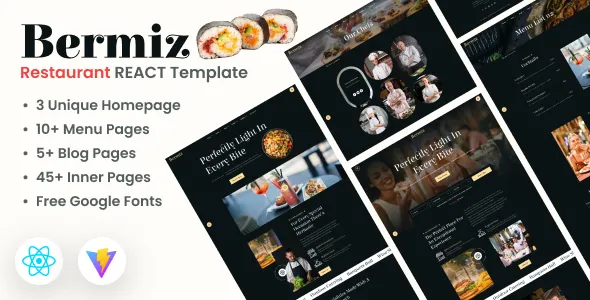
Bermiz – Restaurant and Food Delivery React Template
Bermiz – Restaurant and Food Delivery React Template is a modern website template designed for restaurants, cafés, food delivery businesses, dining establishments, and food service startups looking to establish a professional online presence. Built around the React ecosystem, Bermiz provides a potential starting point for creating an engaging restaurant website that showcases menus, presents food photography, introduces dining services, and helps customers discover available offerings. Whether the goal is to promote a local restaurant, introduce a takeaway service, showcase a café menu, or build a digital presence for a food delivery business, a well-structured restaurant website can make information easier to access and help customers interact with the brand.
The food industry relies on attractive presentation, clear menu information, convenient ordering experiences, and reliable communication. Customers often want to explore dishes, compare prices, review restaurant details, and understand delivery or pickup options before deciding where to order. A dedicated restaurant and food delivery template helps organize these details into a consistent website experience. Bermiz can be evaluated as a foundation for presenting food categories, featured dishes, restaurant information, promotional content, and customer contact options, depending on the included components and customization requirements.
React is a JavaScript library used to build interactive user interfaces through reusable components. A React-based template can provide a structured starting point for developing website pages and interactive elements while allowing developers to customize the interface according to a restaurant’s branding and business requirements. The actual functionality of Bermiz depends on its supplied source code, installed dependencies, project configuration, and any backend services or third-party integrations added during development. Before using the template, review its current demo, documentation, package requirements, and included features to confirm that it matches your project.
What Is Bermiz – Restaurant and Food Delivery React Template?
Bermiz is a restaurant and food delivery website template intended for developers and businesses that want to create a food-focused digital experience using React. Its restaurant-oriented purpose makes it a potential option for projects that need to present menus, highlight dishes, communicate business information, and guide customers toward ordering or contacting the restaurant.
A restaurant website serves several purposes beyond displaying photographs of food. It introduces the business, communicates the type of cuisine available, provides menu information, shares opening hours, and explains how customers can place orders or make inquiries. A food delivery website may also need to explain delivery coverage, pickup arrangements, ordering procedures, and available payment methods.
Bermiz can serve as a visual and technical starting point for organizing these elements into a consistent interface. Developers can adapt the page structure, content, typography, colors, imagery, and navigation to suit different restaurant concepts, subject to the template’s existing components and configuration.
The React framework can support reusable interface elements, making it easier to maintain repeated sections such as food cards, menu categories, promotional banners, and navigation components. However, a React template does not automatically provide a complete restaurant management system, payment processing, or live delivery tracking. These capabilities may require additional development, backend services, APIs, or third-party integrations.
Modern Restaurant Website Design
A professional restaurant website should reflect the character of the business while helping visitors find the information they need. Bermiz can be evaluated for a design that combines food photography, menu presentation, restaurant details, and calls to action within a consistent visual identity.
Different restaurant businesses have different presentation requirements. A casual dining restaurant may prioritize popular meals and affordable combinations, while a premium dining establishment may emphasize its atmosphere, culinary approach, and signature dishes. A café might highlight beverages, desserts, and comfortable dining spaces, whereas a takeaway business may focus on convenient ordering and collection information.
A successful website balances visual appeal with usability. Food photographs can attract attention, but visitors also need readable descriptions, clear prices, and straightforward navigation. Important information should not be hidden behind unnecessary effects or complicated interactions.
With suitable customization, Bermiz can be adapted to reflect the restaurant’s logo, brand colors, typography, photography, and content style. The finished website should communicate a recognizable identity across the homepage, menu pages, food listings, and contact sections.
The exact design controls and available layouts should be checked in the current template demo and documentation before implementation.
Restaurant Homepage and Food Presentation
The homepage is often the first interaction a customer has with a restaurant online. It should introduce the business, communicate its main offering, and help visitors discover menu items or ordering information.
A Bermiz-based website can be organized around the sections supported by the template and the restaurant’s business goals. Potential content areas include an introductory banner, featured dishes, menu categories, restaurant highlights, promotional offers, customer feedback, and contact details.
The introductory section should explain the restaurant’s identity and make its primary offering clear. A short headline and supporting description can introduce the cuisine, dining concept, or food delivery service. A prominent link can then guide visitors toward the menu or ordering information.
Featured dishes help customers discover popular or seasonal items without browsing the entire menu. Promotional sections can communicate current offers when they are available and accurately described.
Restaurant photographs should reflect the actual food and dining environment. Original photography can help establish credibility and create a more distinctive brand identity than generic images unrelated to the business.
A homepage should not contain every possible detail. It should provide a clear overview and direct visitors to dedicated sections for the full menu, restaurant information, delivery details, and contact options.
Digital Menu and Food Category Organization
A digital menu is one of the most important elements of a restaurant website. Customers need to understand which dishes are available, what they contain, and how much they cost before placing an order.
Bermiz can be evaluated for presenting food items through menu sections, cards, category listings, or other components available in the template. The final organization depends on the supplied code and any customization performed by the developer.
A restaurant might organize its menu into categories such as:
- Starters and appetizers: Small dishes served before the main course.
- Main courses: Primary meals organized by cuisine or preparation style.
- Vegetarian dishes: Options suitable for customers seeking vegetarian meals.
- Non-vegetarian dishes: Meat, poultry, seafood, or other offerings where available.
- Burgers and sandwiches: Convenient meal options for casual dining and takeaway.
- Pizza and pasta: Popular choices for Italian-inspired or casual restaurants.
- Desserts: Cakes, pastries, ice cream, and other sweet dishes.
- Beverages: Tea, coffee, juices, soft drinks, and other available refreshments.
- Combos and meal deals: Bundled offerings that clearly explain their contents and pricing.
- Seasonal specials: Limited-time dishes that are currently available.
These are examples of possible menu categories, not a claim that Bermiz includes every category by default. Restaurant owners should adapt the menu to their actual offerings.
Each food item should display accurate information. Useful details may include the dish name, description, price, image, portion size, and relevant dietary or allergen information where appropriate. Keeping this information updated helps reduce confusion and supports a better ordering experience.
Food Delivery Website Experience
Food delivery websites need to make the journey from browsing to ordering understandable and convenient. Customers should be able to explore available dishes, review prices, understand delivery conditions, and identify the next step without unnecessary complexity.
Bermiz provides a potential interface foundation for a restaurant that wants to communicate its delivery services online. Depending on the included components and additional development, the website may be adapted to display food listings, delivery information, order-related calls to action, and customer support details.
A complete online ordering process involves more than the appearance of the interface. It may require cart management, order validation, availability checks, delivery address collection, payment processing, order confirmation, and communication with restaurant staff.
These functions should not be assumed to be included in the React template. Developers may need to connect the frontend to a backend application, database, restaurant management system, or suitable third-party ordering service.
Delivery information should be accurate and easy to understand. Restaurants should explain their service area, minimum order requirements if applicable, estimated delivery arrangements, operating hours, and any relevant fees.
Before launching an ordering workflow, test the complete customer journey from selecting food through submitting an order. Ensure that prices, quantities, delivery details, and confirmation messages behave correctly.
Responsive Design for Desktop, Tablet, and Mobile
Customers often browse restaurant websites on smartphones while deciding what to eat or arranging a takeaway order. A responsive interface helps ensure that menu information and essential business details remain accessible across different devices.
Bermiz should be evaluated for responsive behavior using its current demo and supplied code. Developers should confirm that layouts adapt appropriately to desktop computers, tablets, and smartphones rather than assuming every component will work correctly at all screen sizes.
On mobile devices, menu cards should remain readable, photographs should fit the available space, and navigation should be easy to operate. Buttons and interactive elements should be sufficiently large for touch input.
The menu deserves particular attention because food listings often combine images, descriptions, prices, and action buttons. If these elements are too crowded, customers may struggle to compare dishes or interact with the page.
Responsive testing should cover the homepage, menu categories, food details, promotional sections, contact forms, and any ordering components. Third-party widgets, custom styles, and embedded services can introduce layout issues even when the original template appears responsive.
Test the website on different screen sizes and browsers before launch. Repeat these checks after major design changes or dependency updates to maintain a consistent experience.
Customization and Restaurant Branding
A restaurant website should communicate the business’s personality and create a recognizable visual identity. Branding choices influence how customers perceive the restaurant and how easily they recognize it across digital channels.
Depending on the available components and source code, Bermiz can be customized to reflect a restaurant’s logo, color palette, typography, food imagery, page layouts, and content structure. Developers should review the template documentation to understand its styling approach and supported customization methods.
A family restaurant may use warm colors and approachable imagery, while a contemporary dining brand might choose a restrained palette and more spacious layouts. A café could emphasize coffee photography and comfortable surroundings, whereas a takeaway service may prioritize menu clarity and convenient ordering information.
Consistency matters across the entire website. Buttons, headings, navigation elements, food cards, and promotional banners should follow a coherent design system. Reusable React components can help developers maintain consistent presentation when the project is structured appropriately.
Images should be selected carefully and used with the necessary permissions. Authentic photographs of the restaurant’s dishes, staff, and interior can provide a stronger sense of the actual experience.
Before making extensive visual changes, understand how the supplied components and styles interact. Keep a working backup or version-controlled copy of the project so changes can be reviewed and restored if needed.
React Components and Frontend Development
React is widely used for developing interactive interfaces through components that represent reusable parts of a website. A restaurant template built with React can provide a starting point for organizing interface elements and adapting them to the requirements of a food business.
Depending on its implementation, Bermiz may contain reusable sections for navigation, menu displays, promotional content, food listings, and other interface elements. Developers should inspect the actual source code to determine the component structure, styling approach, routing configuration, and dependencies.
Reusable components can help reduce duplication. For example, a consistent food card component can display a dish image, name, description, and price across different menu categories. Updating the component may then improve the presentation of multiple listings at once.
React also supports state-driven interface behavior, which can be useful for interactive elements. However, the availability of features such as filters, cart updates, quantity controls, and dynamic menus depends on the code provided and any additional implementation.
A frontend template is not automatically connected to a database or restaurant ordering backend. Dynamic data, user accounts, order processing, and administrative controls require suitable architecture and development.
Before customizing the project, review the package configuration, dependency versions, available scripts, and setup instructions. Understanding the existing structure makes it easier to extend the website without introducing unnecessary complexity.
Menu Management and Dynamic Food Listings
Restaurants frequently update their menus to reflect seasonal ingredients, changing prices, new dishes, and temporary availability. A website should make these updates manageable and ensure that published information remains accurate.
The approach to menu management with Bermiz depends on how its data is stored. A simple implementation may use local data files or components, while a more advanced project may retrieve menu information from an API or content management system.
For a small restaurant, a straightforward configuration may be sufficient if menu updates are infrequent and managed by a developer. A larger operation may benefit from a backend interface that allows authorized staff to change dishes, prices, photographs, and availability without modifying frontend source code.
A dynamic menu system may also need to support categories, dietary labels, search, filters, and featured items. These features require appropriate data structures and implementation and should not be assumed to exist in the original template.
Regardless of the technical approach, the menu should remain accurate. Remove unavailable dishes when necessary, update prices promptly, and make limited-time offers clearly identifiable.
If a content management system or restaurant platform is integrated, verify that it supports the required data fields, access controls, and publishing workflow. Test changes to ensure that updated information appears correctly across relevant pages.
Restaurant Promotions and Special Offers
Promotions can help restaurants communicate seasonal menus, limited-time dishes, meal combinations, and other current offers. A website provides a convenient place to present these promotions alongside the regular menu.
Bermiz can be considered for displaying promotional content through available banners, featured sections, or customized components. The exact options depend on the supplied implementation.
A promotion should clearly explain what is included, how much it costs, when it is available, and whether any conditions apply. If an offer is limited to certain days, locations, or ordering methods, communicate those restrictions accurately.
Featured sections can draw attention to new dishes or special combinations without requiring visitors to search through every menu category. However, too many competing promotional elements can make the website feel cluttered.
If offers need to update automatically or use customer-specific discounts, additional business logic or integrations may be required. A simple visual banner does not automatically validate coupon codes, calculate discounts, or apply ordering restrictions.
Review promotional content regularly and remove expired offers. Accurate information protects customer confidence and reduces misunderstandings during the ordering process.
SEO-Friendly Structure for Restaurant Websites
Search engine optimization can help customers discover a restaurant when searching for relevant food options, dining experiences, or delivery services. A React template provides a starting point for the website interface, but effective SEO also depends on technical implementation and content quality.
Each important page should have a clear purpose and descriptive content. A restaurant may create dedicated pages for its menu, location, dining services, and food delivery information, depending on the structure of the business.
Page titles and headings should accurately describe the content. Relevant phrases can be used naturally, but excessive repetition can make pages less useful and harder to read.
Descriptive URLs and internal links help visitors move between related sections. A food category page can link to relevant menu information, while the homepage can direct customers toward the main ordering or contact destination.
Images should use appropriate file sizes and descriptive alternative text when they convey useful information. Large food photographs should be optimized to reduce loading time without compromising visual quality.
Technical SEO requires particular attention in React applications. Search engine accessibility depends on how pages are rendered, how metadata is provided, and how navigation and URLs are configured. Server-side rendering, static generation, or other rendering approaches may be appropriate depending on the project architecture, but their availability should not be assumed from the template name alone.
No template can guarantee search rankings, indexing, or customer growth. Useful content, sound technical implementation, accurate business information, and ongoing maintenance all contribute to a stronger website.
Local SEO for Restaurants and Food Businesses
Many restaurants depend on customers in a specific neighborhood, city, or delivery area. Local SEO can help people discover a business, check its location, review its menu, and determine whether its services meet their needs.
A Bermiz-based website can include accurate business details such as the restaurant’s name, address, phone number, opening hours, and available service options. Delivery coverage should be stated clearly and should reflect the areas the business can actually serve.
Maintain consistent business information across the website and relevant online listings. If the restaurant has a Google Business Profile, regularly check its address, opening hours, contact details, menu links, and photographs.
Useful location-specific content can explain the restaurant’s setting, available dining options, pickup arrangements, parking information where applicable, and delivery service area. Such details help customers decide whether to visit or order.
Avoid creating multiple nearly identical location pages if the business does not operate separate locations or offer meaningfully different local services. Each page should provide genuine information.
Customer reviews can provide useful feedback and help prospective diners understand the restaurant’s reputation when collected and displayed appropriately. Do not fabricate testimonials or publish customer information without permission.
Contact Information and Restaurant Reservations
Customers may need to ask questions about ingredients, group dining, catering, operating hours, or special arrangements before visiting or ordering. Clear contact information makes it easier for them to reach the restaurant.
Bermiz can be adapted to display contact details and inquiry options according to the available layouts. A contact section may include the restaurant’s address, phone number, email address, opening hours, and links to relevant social profiles.
If the restaurant accepts table reservations, it can explain how customers should request a booking. An actual reservation system may require a compatible booking service, backend functionality, or third-party integration.
Similarly, contact forms need appropriate frontend and backend handling if submitted information is to be stored or delivered to restaurant staff. A visual form alone does not guarantee that messages will be received.
Before launch, test all contact links, form submissions, confirmation messages, and reservation workflows. Ensure that published opening hours and contact details are current.
If customers provide personal information, explain how it will be used and protect it through appropriate technical and organizational safeguards. Collect only the information necessary to handle the inquiry or reservation.
Website Performance and Loading Speed
Website speed influences how comfortably customers can explore food menus and restaurant information. Slow-loading pages can interrupt browsing and make ordering more difficult, especially on mobile connections.
The performance of a Bermiz website depends on its implementation, hosting, images, scripts, dependencies, external services, and any backend integrations. A React template does not automatically guarantee fast performance.
Food websites often contain numerous photographs, so image optimization is especially important. Use suitable dimensions, compress image files, and avoid loading unnecessarily large assets when smaller versions are sufficient.
Review the dependencies and scripts used by the project. Remove unnecessary code and avoid adding heavy third-party widgets without a clear business need. Performance improvements should be based on measurement rather than assumptions.
Test the homepage, menu pages, food listings, and contact or ordering flows. Pages with large images or interactive elements may behave differently from simpler informational sections.
Depending on the project architecture, caching, code splitting, lazy loading, or other optimization techniques may improve performance. Developers should apply them carefully and confirm that essential content remains accessible.
Regular testing after updates helps identify performance regressions and keeps the website usable as the menu and content library expand.
Accessibility and User-Friendly Navigation
An accessible restaurant website helps customers with different abilities and browsing preferences navigate the menu and understand important information. Clear text, meaningful headings, sufficient contrast, and recognizable interactive elements all contribute to usability.
When customizing Bermiz, use logical heading structures, descriptive link text, and suitable alternative text for informative images. Ensure that menu prices, dietary information, and other important details are not communicated through color alone.
Navigation should make essential sections easy to find. Visitors should be able to locate the menu, restaurant information, contact details, and ordering instructions without navigating through confusing menus.
Buttons and controls should be distinguishable and usable with appropriate input methods. If the website includes filters, quantity selectors, or other interactive elements, ensure that their labels and states are understandable.
Forms should provide clear labels and useful validation messages. Important instructions should not rely solely on placeholder text that disappears when a customer begins typing.
Accessibility depends on the template, its source code, and the way developers implement additional functionality. Automated checks can identify some issues, but keyboard testing and manual reviews across different devices are also important.
Integrations, APIs, and Backend Functionality
A restaurant website may require integrations for online ordering, payments, delivery management, menu updates, analytics, or customer communication. These requirements should be assessed separately from the frontend design.
Bermiz can serve as a starting point for a React interface that connects to suitable external services or a custom backend, provided the architecture supports the required implementation. The actual integration work depends on the available source code and the APIs or platforms selected.
An online ordering system may require a backend to manage dishes, prices, customer details, order totals, order status, and availability. Payment processing generally requires an appropriate payment provider and secure server-side handling.
Delivery tracking, customer accounts, automated notifications, and restaurant administration can introduce additional technical requirements. They may need authentication, database design, API integration, and careful access control.
Before choosing an external service, review its documentation, pricing, supported regions, security requirements, and compatibility with the project. Avoid exposing secret API keys or payment credentials in client-side React code.
Test integrations using appropriate development or sandbox environments before processing real customer orders. Confirm that errors are handled clearly and that the website remains usable when an external service is temporarily unavailable.
Who Should Consider Bermiz Restaurant and Food Delivery React Template?
Bermiz may be worth evaluating for different types of food-related businesses and web development projects.
Restaurants: Present the menu, dining environment, business information, and ways to contact the establishment.
Food delivery businesses: Create a frontend for displaying dishes, communicating delivery details, and guiding customers toward an ordering process.
Cafés and coffee shops: Showcase beverages, snacks, desserts, opening hours, and the character of the business.
Fast-food outlets: Organize menu items, meal combinations, featured products, and takeaway information.
Cloud kitchens: Introduce available cuisines and provide a digital interface for customers to explore food offerings.
Catering businesses: Present food packages, service information, event options, and inquiry details.
Restaurant startups: Establish a visual foundation for a new food business while planning additional functionality according to its needs.
Developers and agencies: Use a React-based starting point for a restaurant project that requires customized branding, content, and integrations.
Food brands: Present products, menu information, promotions, and business details in an organized digital format.
The best choice depends on the actual project requirements. Before using the template, review its demo, source code, supported dependencies, responsive layouts, licensing terms, documentation, and the amount of additional development required.
Tips for Building a Successful Website with Bermiz
A successful restaurant website starts with a clear understanding of the business and its customers. Decide whether the primary goal is to promote dine-in services, provide menu information, receive inquiries, support takeaway orders, or develop a complete food delivery workflow.
Prepare accurate content before extensive customization. This includes the restaurant introduction, menu categories, dish descriptions, prices, photographs, opening hours, location, delivery information, and contact details.
Create a consistent visual identity using a defined color palette, readable typography, and relevant food photography. Ensure that images are appropriately licensed and represent the actual dishes or dining environment wherever possible.
Keep the menu organized and make important details easy to find. Each food listing should provide sufficient information for customers to understand what they are considering. Update prices and availability whenever the business changes its offerings.
Test the website on desktop computers, tablets, and smartphones. Review navigation, image loading, forms, menu interactions, and any connected ordering or payment services. Check that important information remains accessible when network connections are slow or external integrations experience errors.
If online ordering is required, plan the backend and payment workflow carefully instead of treating the frontend template as a complete ordering system. Test order totals, customer notifications, error handling, and the restaurant’s process for receiving and fulfilling orders.
Finally, maintain the project with dependency updates, backups, performance checks, security reviews, and regular content updates. These practices help keep the website useful as the restaurant’s menu and business requirements evolve.
Final Thoughts on Bermiz Restaurant and Food Delivery React Template
Bermiz – Restaurant and Food Delivery React Template is a potential starting point for restaurants, cafés, takeaway businesses, food delivery services, and developers building food-focused websites with React. Its restaurant-oriented positioning makes it relevant to projects that need to present menu items, showcase food photography, communicate business information, and guide customers toward useful actions.
A thoughtfully customized website can combine organized food categories, attractive visuals, responsive layouts, clear contact information, and an easy-to-understand navigation structure. Restaurant owners can use these elements to communicate their brand and help customers discover the available offerings.
The final capabilities depend on the supplied template version, its source code, dependencies, project architecture, and any additional services or backend integrations used. Functions such as online ordering, payment processing, reservations, customer accounts, and live delivery tracking should be verified separately rather than assumed to be included.
Long-term success also depends on accurate menu information, suitable SEO practices, website performance, accessibility, security, and regular maintenance. A React template cannot guarantee search rankings or increased sales, but it can provide a useful foundation for developing a well-organized restaurant website.
For businesses and developers seeking a restaurant-focused React starting point, Bermiz is worth assessing against the project’s design preferences, technical requirements, and operational needs. With appropriate customization, accurate content, and carefully implemented integrations, the resulting website can support restaurant branding and provide customers with a convenient way to explore food offerings online.