My Account
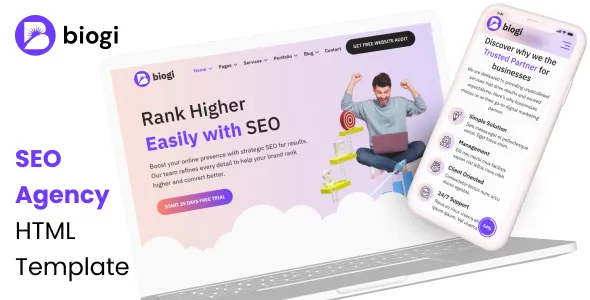
Biogi – Multipurpose Agency HTML Template
Biogi – Multipurpose Agency HTML Template is a versatile website template designed for creative agencies, digital marketing companies, branding studios, web development teams, consulting businesses, and professional service providers that want to establish a strong online presence. With a multipurpose approach, Biogi provides a starting point for building a modern business website that introduces your brand, communicates your services, showcases your projects, and encourages potential clients to get in touch. Its HTML-based structure makes it relevant to developers and businesses looking for a customizable frontend foundation for an agency or corporate website.
In today’s competitive digital environment, a professional website plays an important role in how customers discover and evaluate service providers. Businesses need more than an attractive homepage; they need a clear presentation of their expertise, service offerings, previous work, company values, and contact information. Biogi can help organize these essential elements into a cohesive website experience that introduces visitors to your business and guides them toward relevant information.
Whether you operate a creative agency, manage a digital marketing team, provide branding services, develop websites, or offer business consulting, Biogi can be adapted to reflect your brand identity and commercial objectives. By customizing the available layouts, colors, typography, imagery, and page content, you can develop a website that communicates your business personality while presenting your services in a professional and organized format.
As an HTML template, Biogi serves primarily as a frontend starting point. Its actual features, included page layouts, scripts, and supported functionality depend on the supplied package. Additional capabilities, such as content management, online booking, advanced forms, or dynamic data processing, may require separate development or third-party integrations.
Modern Design for Creative and Digital Agencies
A modern agency website should communicate professionalism, creativity, and clarity from the moment a visitor arrives. The visual presentation should support the business message rather than distract from it. Clear headings, organized content, carefully selected imagery, and consistent spacing can help visitors understand the agency’s purpose and explore its services.
Biogi provides a foundation for developing this kind of digital experience. Businesses can customize the presentation to match their industry, target audience, and preferred visual identity. A creative studio might choose a distinctive, expressive appearance, while a corporate consulting firm may prefer a more restrained and information-focused design.
An effective homepage should introduce the business, explain its primary value proposition, highlight important services, and provide a clear route to further information. Supporting sections can introduce the team, display selected projects, communicate client feedback, and direct visitors toward a consultation or inquiry.
The exact sections available depend on the template files, but the multipurpose concept makes Biogi a suitable starting point for a range of agency website projects. Thoughtful customization can help turn the initial design into a brand-specific experience that supports real business goals.
A Flexible Solution for Different Agency Types
Agencies work across a wide range of industries and offer different combinations of creative, technical, and professional services. A flexible website template can help businesses organize these offerings without designing every page from the beginning.
Biogi can be adapted for creative agencies, digital marketing companies, branding studios, advertising firms, web development businesses, design consultancies, and other service-oriented organizations.
A creative agency may use its website to emphasize visual projects, artistic direction, and brand campaigns. A digital marketing company may focus on campaign strategy, search engine optimization, paid advertising, social media marketing, and content creation. A web development agency may highlight website design, frontend development, application development, and technical consulting.
Consulting firms can use a similar structure to explain their areas of expertise, introduce their professional team, and describe how they help clients solve business challenges.
The key is to customize the website around one primary audience and a clearly defined set of services. Rather than presenting every possible capability, businesses should prioritize the offerings most relevant to their ideal customers.
Professional Branding and Business Identity
A company’s website is one of its most visible brand touchpoints. Visitors often form an initial impression based on the site’s typography, color palette, imagery, layout, and messaging. Consistency across these elements helps the business appear organized and recognizable.
Biogi can serve as a foundation for creating a unified brand experience. Developers can adapt the logo placement, colors, typography, backgrounds, buttons, and other visual details to match an existing brand guide or establish a new identity.
For example, a branding studio may use bold typography and distinctive visuals to communicate creativity. A marketing consultancy may prefer a clear, structured design that emphasizes measurable business objectives. A technology agency may adopt a contemporary visual style that reflects innovation and technical expertise.
Brand consistency should extend across every page. Service descriptions, project galleries, company information, and contact sections should use a coherent tone and visual language.
Businesses should also use authentic photography, original project images, and accurate company information wherever possible. A consistent and credible presentation can help visitors better understand the organization and distinguish it from competing service providers.
Website Design for Digital Marketing Agencies
Digital marketing agencies need websites that explain their capabilities and demonstrate how their services support business growth. A professional website can introduce the agency’s strategy, communicate its areas of expertise, and help prospective customers determine whether its services match their needs.
Biogi can be customized for agencies offering search engine optimization, content marketing, paid advertising, social media management, email marketing, conversion optimization, and digital campaign planning.
Each service should have a clear description that explains what the agency provides, which businesses may benefit, and how the service fits into a broader marketing strategy. Where appropriate, businesses can include case studies that describe the challenge, approach, and outcome of previous projects.
Marketing agencies may also use the website to present industry experience, explain their working process, and introduce the specialists responsible for delivering campaigns. Clear calls to action can guide interested visitors toward a discovery call or project inquiry.
Any performance statistics or campaign results should be accurate and supported by reliable information. Avoid making guarantees about search rankings, sales growth, or advertising outcomes that cannot be substantiated.
With relevant content and a focused presentation, Biogi can help digital marketing professionals build a website that communicates their expertise and encourages meaningful client conversations.
A Suitable Foundation for Branding and Creative Studios
Branding agencies help businesses develop their identity, communicate their values, and create a recognizable market presence. Their websites should reflect the same attention to design and consistency that they provide to clients.
Biogi can be adapted for branding studios that offer logo design, brand strategy, visual identity systems, packaging design, creative direction, and related services.
A portfolio-focused presentation can help prospective clients understand the studio’s design approach. Each project may include selected visuals, a concise overview, the client’s objectives, and a description of the creative decisions behind the final result.
Branding agencies can also introduce their methodology, explaining how research, strategic planning, concept development, and visual execution contribute to a completed project.
A dedicated service section can clarify the difference between individual deliverables and broader branding engagements. This helps potential customers understand whether they need a logo, a complete identity system, or ongoing creative support.
When the website communicates both visual quality and strategic thinking, it can present the studio as a professional partner rather than simply a provider of design files.
Website Development and IT Service Companies
Web development and IT service businesses need to communicate technical expertise in a way that remains understandable to nontechnical customers. A professional website can explain available services, show examples of completed work, and outline how projects move from planning to delivery.
Biogi can be customized for businesses offering website development, frontend development, custom web applications, software consulting, interface design, technical support, and digital product development.
Service descriptions should explain the business problems addressed by each offering. For example, a web development agency might describe how it helps companies improve their online presence, build customer-facing platforms, or modernize an existing website.
Project case studies can show the type of work completed and provide context about the challenges involved. Useful details may include the project’s objectives, technology choices, design considerations, and the final solution, provided the information can be shared publicly.
Businesses can also explain their development workflow, including discovery, planning, implementation, testing, launch, and ongoing maintenance where those services are available.
By combining technical information with a clear structure and professional branding, Biogi can support agencies that want to build credibility and attract relevant development projects.
Showcase Projects with a Compelling Portfolio
A portfolio helps prospective clients evaluate an agency’s capabilities before making contact. It provides concrete examples of the business’s work and communicates the quality, style, and range of its services.
Biogi can be adapted to present projects in an organized format suited to the agency’s portfolio requirements. Depending on the available layouts, projects may be arranged as image galleries, individual case studies, or categorized collections.
Creative agencies can display branding campaigns, advertising concepts, and visual design projects. Marketing agencies can highlight selected campaigns and explain the strategy behind them. Development companies can present websites, applications, and other digital products they have delivered.
Each project should include enough context to help visitors understand the work. A useful description may cover the client’s objective, the agency’s contribution, the approach taken, and the outcome achieved.
High-quality visuals can strengthen the presentation, but images should be optimized so that they do not unnecessarily slow down the website. Use images you own or have permission to publish, and obtain approval before sharing confidential client work.
An authentic portfolio can help establish credibility and allow potential clients to assess whether the agency’s experience matches their requirements.
Present Services with Clear Information Architecture
Visitors should be able to understand what an agency offers without navigating through confusing or overly complicated pages. Clear information architecture helps users locate the services that matter to them and understand the next step in the decision process.
Biogi can be customized with service sections that organize offerings into meaningful categories. Depending on the business, these might include digital strategy, website design, development, brand identity, marketing campaigns, content creation, or consulting.
Each service description should explain the purpose of the offering, the type of customer it serves, and the value it can provide. Short summaries can appear on the homepage, with more detailed information presented on individual service pages when needed.
Businesses offering several related services can organize them into broader categories to prevent the website from becoming difficult to navigate. Internal links can connect service descriptions to relevant projects, case studies, and contact pages.
This structure helps visitors move naturally from discovering the business to evaluating its capabilities. It also gives search engines clearer signals about the subject and purpose of each page.
Build Trust Through Company Information
Potential clients often want to know who they will be working with before discussing a project. Company information can help establish trust by explaining the agency’s background, professional approach, team, and working principles.
Biogi can be adapted to introduce the business through an About section or a dedicated company page. This content may describe the agency’s history, its main areas of expertise, the industries it serves, and the values that guide its work.
Team profiles can introduce the people responsible for strategy, design, development, or client communication. Relevant professional experience and qualifications can help visitors understand the team’s capabilities.
Businesses may also present genuine testimonials, client feedback, awards, certifications, or partnerships where applicable. All claims should be accurate, current, and authorized for publication.
A transparent presentation is more effective than relying entirely on broad promotional statements. Visitors should be able to understand what the agency does, how it works, and why it may be suitable for their project.
Responsive Layout for Different Screen Sizes
Visitors may discover an agency through a desktop computer, laptop, tablet, or smartphone. A responsive website helps maintain accessibility and usability across these devices.
Biogi should be evaluated for responsive behavior using the actual files supplied with the template. When customizing the website, developers should ensure that navigation, text, images, buttons, and content sections adapt appropriately to different viewport sizes.
On desktop screens, a homepage may use multiple columns or a wide project gallery. On mobile devices, the same content may need to stack vertically, reduce spacing, or use a more compact navigation menu.
Special attention should be given to portfolio images, long headings, contact forms, and interactive elements. These components can become difficult to use when the layout is not tested on smaller screens.
Responsive testing should include realistic content rather than only short placeholder text. Long service names, large project images, and multiple navigation items can reveal issues that are not visible in a simple demonstration.
A well-tested responsive layout helps visitors browse the website comfortably and supports a more consistent brand experience across devices.
Search Engine Optimization for Agency Websites
Search engine optimization helps prospective customers discover an agency through relevant searches. A useful website should communicate its services clearly, provide original content, and make important pages easy for search engines to understand.
Biogi can provide a foundation for an SEO strategy that includes service pages, portfolio content, company information, and helpful articles where appropriate.
Start by identifying the search terms used by the intended audience. A local web design company, for example, may target searches related to website design in its service area, while a branding studio may focus on brand identity and creative strategy.
Use descriptive page titles, clear headings, concise meta descriptions, and natural keyword placement. Avoid repeating the same keyword excessively or creating pages that offer little value beyond targeting search phrases.
Portfolio pages can support search visibility when they include original project descriptions and meaningful context. Image alternative text should describe the image accurately rather than contain unrelated keywords.
Additional technical SEO work may include descriptive URLs, internal links, XML sitemaps, canonical tags where appropriate, structured data when suitable, and a properly configured robots.txt file. Some of these tasks require additional tools or development and may not be included in a static HTML template.
Search performance depends on many factors, including content quality, competition, website accessibility, technical implementation, and ongoing maintenance. No template can guarantee particular rankings or traffic levels.
Conversion-Focused Calls to Action
A professional agency website should guide visitors toward an appropriate next step. Depending on the business, this may involve requesting a quotation, arranging a consultation, asking a question, or submitting a project brief.
Biogi can be customized to place clear calls to action in relevant sections of the website. A prominent homepage action can help visitors begin a conversation, while service and portfolio pages can provide more specific options.
Effective calls to action use direct, understandable language. Examples include requesting a project estimate, discussing a new website, exploring branding services, or scheduling an introductory consultation when that service is available.
The destination should match the promise made by the button. A quotation request should lead to a suitable form or contact page rather than a generic page with no clear next step.
Contact forms should collect only the information needed to begin the conversation. Depending on the agency’s workflow, this may include a name, email address, company name, project type, approximate budget, and project description.
Form processing, email delivery, spam protection, appointment scheduling, and CRM connections may require additional implementation. Test all conversion paths before publishing the website to ensure that inquiries reach the correct team.
A Foundation for Freelancers and Independent Professionals
Freelancers and independent professionals often need a website that communicates their skills, presents previous work, and helps them attract clients without requiring a complex digital platform.
Biogi can be adapted into a personal agency-style website for independent designers, developers, marketers, consultants, and creative specialists.
A freelancer may use the homepage to introduce their expertise, explain the services they offer, and display selected projects. A short professional biography can help visitors understand the person’s background and approach to collaboration.
The portfolio should focus on work relevant to the services being promoted. Project descriptions can explain the freelancer’s role, the challenges addressed, and the deliverables produced.
Independent professionals can also use the website to explain their working process, service packages, availability, and preferred methods of communication. Clear information helps potential clients determine whether the professional is a good fit before initiating contact.
By customizing the template around a specific niche and target audience, freelancers can create a more focused online presence that supports their business development efforts.
Useful for Startups and Growing Businesses
Startups and growing businesses often need a professional website that can evolve as their services, team, and market position develop. A multipurpose HTML template can provide a starting point for communicating the business without requiring every design element to be created from scratch.
Biogi can be adapted for technology startups, service businesses, small agencies, consultancies, and emerging brands that need a structured online presentation.
A startup website may introduce the product or service, explain its value proposition, describe the target audience, and provide a clear route to inquiries or demonstrations where relevant.
As the business develops, additional pages can introduce new services, publish case studies, share company updates, and answer common customer questions. The website’s structure should remain focused so that new content does not make navigation unnecessarily complicated.
A static HTML template is particularly relevant when the website can be maintained through direct file editing or an established deployment workflow. Businesses that need frequent nontechnical content updates may prefer to connect the frontend to a content management system or use a suitable alternative platform.
The best approach depends on the team’s technical resources, publishing requirements, and long-term maintenance plans.
Clean HTML Structure and Frontend Customization
HTML provides the structural foundation for website content. A well-organized HTML implementation can make pages easier to understand, style, maintain, and adapt to different business needs.
Biogi is an HTML template, making it relevant to developers who want to work directly with frontend files rather than begin with a complete content management system. The actual organization of the source code should be reviewed in the supplied package.
Customization may involve updating text, replacing images, adjusting stylesheets, changing navigation links, and modifying page sections to reflect the business’s requirements.
Developers should use appropriate HTML elements for headings, navigation, sections, forms, and other content. Semantic markup can improve maintainability and support accessibility when implemented correctly.
Before changing the code, review the directory structure, stylesheet references, JavaScript files, image assets, fonts, and any external dependencies. Understanding these relationships can reduce the risk of broken layouts or missing resources.
If the template includes third-party libraries, check their versions and licenses. Keep modifications organized and test the website after significant changes to ensure that the intended design and interactions continue to work.
Visual Storytelling for Better Brand Communication
Visual storytelling helps agencies communicate their identity through images, project examples, and carefully organized content. The right visuals can show the type of work a business performs and help visitors understand its style.
Biogi can be customized with visual content that matches the agency’s services. A design studio might emphasize brand identity projects and creative compositions, while a technology company could feature digital products and interface designs.
Images should support the message of each section. A project gallery should show relevant work, and a company introduction should use photography that reflects the real team or business when possible.
Avoid filling every section with decorative images that do not contribute meaningful information. Too many visual elements can distract from service descriptions and calls to action.
Use appropriate image dimensions and compression to preserve visual quality while controlling file size. Descriptive alternative text can help make meaningful images more accessible.
When visual presentation and written content reinforce one another, the website can communicate the agency’s strengths more effectively.
Performance and Loading Optimization
Website speed influences how quickly visitors can access information and begin interacting with a business. A slow agency website may create frustration, especially when it relies on large project images, unnecessary scripts, or numerous external resources.
When preparing Biogi for launch, review the size and format of images, fonts, stylesheets, scripts, and other assets. Compress images appropriately and use modern formats when supported by the intended browsers and hosting environment.
Avoid loading libraries or effects that are not needed for the final design. Where appropriate, configure caching, compression, and other hosting-level optimizations to reduce unnecessary transfer and improve repeat visits.
Review JavaScript behavior and remove unused resources when it is safe to do so. Test important pages after customization because the performance of the finished website may differ substantially from the original template.
Actual loading speed depends on hosting quality, network conditions, asset sizes, browser behavior, and third-party services. Use performance testing tools to evaluate the published implementation instead of assuming that the template guarantees a particular result.
Accessibility and User-Friendly Navigation
A professional website should make its information accessible to as many visitors as possible. Clear navigation, readable typography, sufficient contrast, descriptive links, and properly labeled forms can improve usability for a wide range of users.
When customizing Biogi, use a consistent heading hierarchy and ensure that page content is organized logically. Navigation labels should communicate their destinations, while interactive elements should be identifiable and usable with a keyboard where appropriate.
Text should remain readable against its background, and essential information should not be available only through an image. Meaningful images should have appropriate alternative text, while decorative imagery should not introduce unnecessary noise for assistive technology.
Contact forms should include clear labels and understandable validation messages. Buttons and links should describe their purpose rather than rely on vague wording.
Accessibility requires testing and careful implementation. Review the actual pages, scripts, and interactive components to identify problems before the website is published.
Integrations and Additional Website Functionality
Many agency websites need more than static content. Depending on the business, the finished website may require contact forms, newsletter subscriptions, analytics, social media links, appointment booking, live chat, or customer relationship management integrations.
Biogi can serve as a frontend starting point for these additions, subject to compatibility with the supplied files and the services selected.
For example, a contact form may need a backend endpoint or form-processing service to deliver submissions. A newsletter signup may require integration with an email marketing platform, while appointment booking may depend on an external scheduling tool.
Analytics can help businesses understand which pages attract visitors and which calls to action receive engagement. Any tracking tools should be configured responsibly and in accordance with applicable privacy requirements.
Do not assume that these services are automatically included in a static HTML template. Verify the available features, review the required third-party services, and test each integration before making it available to customers.
Content Strategy for Long-Term Growth
A business website can become more useful over time by adding content that answers customer questions and demonstrates professional expertise. Service guides, project case studies, industry insights, and company updates can all contribute to a stronger online presence when they serve a clear purpose.
Biogi can be adapted to include additional content pages, provided the required layouts and development work are available. Agencies can publish practical articles related to their expertise, such as branding considerations, website planning, digital campaign strategy, or selecting a suitable technology partner.
Each article should focus on a real question or problem. Helpful explanations can establish credibility and support the customer decision-making process more effectively than promotional copy alone.
Portfolio content should also be updated as new work becomes available. Removing outdated information and reviewing existing service descriptions helps ensure that the website accurately reflects the business.
For teams that publish frequently, a content management system may simplify ongoing updates. A static HTML website can remain appropriate for businesses with limited content changes or a development workflow that supports direct editing.
Customization Tips for the Best Results
A successful implementation begins with a clear plan. Before editing Biogi, identify the target audience, the main services to promote, the desired visual identity, and the primary action visitors should take.
Start by reviewing the supplied pages and identifying which sections are relevant to the business. Remove unnecessary content and reorganize the remaining sections to create a focused user journey.
Next, replace the original text and imagery with accurate company information. Prepare clear service descriptions, concise headlines, professional project images, and appropriate calls to action.
Customize the colors, typography, spacing, and other visual details to establish a consistent brand identity. Ensure that the chosen design remains readable and usable across different screen sizes.
Review every navigation link, button, form, and interactive element. If new functionality is required, determine whether it can be implemented directly or needs a separate service or backend.
Finally, test the website on major browsers and different devices. Check page loading, accessibility, form behavior, and basic SEO elements before deploying the finished website.
Important Considerations Before Purchase or Installation
Before choosing Biogi – Multipurpose Agency HTML Template, review the product listing and current documentation to confirm that it meets your technical and design requirements.
Check the included page layouts, source files, responsive behavior, JavaScript dependencies, browser compatibility, licensing terms, and installation instructions. If you require a specific feature, such as a working contact form, a content management system, appointment booking, or advanced animation, confirm whether it is included or requires additional development.
Remember that an HTML template generally provides frontend structure and styling rather than a complete business application. Features that depend on stored data, email delivery, user accounts, or external services may require additional configuration.
Consider whether the template’s design can accommodate your intended content and whether your team has the technical resources needed to maintain it. Businesses that expect frequent content updates from nontechnical staff should also evaluate whether a content management system would be beneficial.
Reviewing these requirements before installation can help reduce unexpected work and ensure that the selected template is appropriate for your project.
Conclusion: Create a Professional Agency Website with Biogi
Biogi – Multipurpose Agency HTML Template provides a starting point for businesses and professionals seeking to establish a modern online presence for creative, marketing, branding, development, consulting, and other agency-related services.
Its multipurpose approach allows the website to be adapted to different business identities and communication goals. With appropriate customization, agencies can present their services, showcase completed projects, introduce their teams, communicate their expertise, and guide potential clients toward meaningful inquiries.
A successful website depends on more than the initial design. Original content, authentic project imagery, clear navigation, responsive implementation, accessibility, performance optimization, and search-friendly page structure all contribute to the finished experience.
Whether you are developing a website for a creative studio, launching a digital marketing business, presenting a freelance portfolio, or establishing an online presence for a growing agency, Biogi can serve as a practical frontend foundation. Review the included files and functionality, customize the presentation around your brand, and build a website that communicates your services clearly and supports your long-term business goals.