My Account
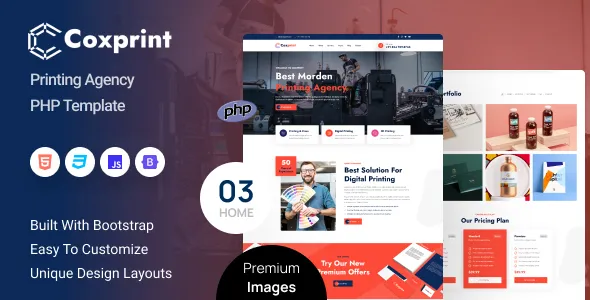
Coxprint – Printing Agency PHP Template
Coxprint – Printing Agency PHP Template is a website template designed for printing businesses, commercial print shops, custom printing services, packaging companies, and creative production agencies looking to establish a professional online presence. With a focus on presenting printing services and business information, Coxprint provides a starting point for building a website that introduces print solutions, showcases completed projects, communicates service details, and helps potential customers get in touch. Its PHP-based structure makes it suitable for developers who want to customize a printing agency website according to specific business requirements.
A professional printing website should make it easy for customers to understand the available services, explore examples of previous work, and request information about their printing needs. Whether a company specializes in business cards, brochures, flyers, banners, promotional materials, product packaging, labels, or custom merchandise, a well-organized website can help communicate its capabilities and establish customer confidence.
Coxprint can be adapted to represent different printing businesses, from local print shops serving individuals and small companies to commercial printing agencies working with larger organizations. By combining clear service descriptions, relevant project images, business information, and convenient contact options, businesses can create a digital presence that supports their marketing and customer communication goals. The specific pages and features available depend on the template version and its implementation, so reviewing the current demo and documentation is recommended before beginning customization.
What Is Coxprint Printing Agency PHP Template?
Coxprint is a website template intended for printing companies and businesses that provide professional print-related services. It offers a starting point for presenting a company’s identity, describing its services, and displaying examples of printed materials or completed client projects.
Printing agencies often work with customers who have different requirements, budgets, quantities, and deadlines. A business may need branded stationery, promotional flyers, event banners, product labels, packaging materials, or large-format graphics. A dedicated website helps organize these offerings so visitors can find the information relevant to their needs.
With a PHP-based template, developers can customize page content, integrate suitable server-side functionality, and adapt the website structure to the business. Depending on the supplied files, this may involve modifying PHP templates, stylesheets, images, navigation elements, and reusable page components.
The template should be considered a design and development starting point rather than an assumption that every business feature is included. Features such as online ordering, file uploads, price calculations, customer accounts, payment processing, and order tracking may require additional development or compatible integrations.
Professional Website Design for Printing Businesses
A printing agency website should communicate professionalism, creativity, and attention to detail. Customers often evaluate a printing provider based on the quality of its presentation, the variety of services offered, and the relevance of its previous work.
Coxprint can be customized to create a visual identity that reflects the company’s approach to printing and design. A clean layout, readable typography, consistent colors, and high-quality project images can help visitors understand the business without overwhelming them with unnecessary information.
A commercial printing company may prefer a structured design that emphasizes production capabilities and business services. A creative print studio might focus on colorful portfolio images, packaging designs, and distinctive promotional materials. A local print shop could prioritize its most popular services, location, operating hours, and contact information.
The design should support the company’s brand rather than simply reproduce a generic layout. Replacing placeholder images with genuine project photography, using accurate service descriptions, and maintaining consistent visual elements can help create a more credible online presence.
Showcase Printing Services and Solutions
A printing business may offer several services to meet the needs of individuals, small businesses, marketing teams, and larger organizations. Organizing these services into clear sections helps visitors identify the right solution.
Coxprint can be adapted to present services such as:
- Business card printing: Professional cards for entrepreneurs, employees, sales teams, and organizations.
- Brochure and flyer printing: Marketing materials for promotions, product introductions, events, and campaigns.
- Banner and poster printing: Large-format graphics for advertising, exhibitions, retail displays, and public events.
- Packaging printing: Printed packaging materials for product presentation, retail distribution, and brand communication.
- Label and sticker printing: Custom labels for product identification, packaging, promotions, and business use.
- Stationery printing: Letterheads, envelopes, folders, and other branded office materials.
- Catalog and booklet printing: Multi-page publications for product information, company profiles, and marketing campaigns.
- Custom promotional printing: Branded materials designed for events, customer engagement, and business promotions.
Each service should include a concise explanation of the available options and the types of customers it serves. Where appropriate, businesses can provide information about paper stocks, finishes, sizes, quantities, and customization possibilities.
The services displayed should match the company’s actual production capabilities. Accurate descriptions help customers make informed decisions and reduce confusion during the inquiry process.
Homepage Design and Content Organization
The homepage is often the first point of contact between a printing company and a potential customer. It should communicate the business’s main offering and make essential information easy to find.
A Coxprint-based homepage can be organized around several useful sections, depending on the available layouts and the company’s objectives.
Hero section: Introduce the printing business with a clear headline, a short description, and a relevant call to action. The message should explain what the company provides and who it serves.
Service overview: Present the main printing services using concise descriptions and relevant visuals. Visitors should be able to identify the services they need without reading lengthy blocks of text.
Featured projects: Display selected examples of printed materials, packaging, promotional campaigns, or branding work. Strong examples help demonstrate the company’s range and attention to detail.
Company introduction: Explain the business’s experience, approach, capabilities, or commitment to quality using accurate information.
Customer feedback: Include genuine testimonials or reviews when permission and reliable sources are available.
Contact section: Provide a convenient way for visitors to request information, discuss a project, or ask about printing requirements.
Not every homepage needs every section. A small print shop may benefit from a simple structure focused on popular services and contact details, while a larger commercial printing company may need additional information about production capabilities and business solutions.
Portfolio and Printed Project Gallery
A portfolio is especially valuable for a printing agency because customers often want to see examples before choosing a provider. Images of finished work can communicate the quality, variety, and style of the company’s services more effectively than general descriptions alone.
Coxprint can serve as a starting point for a project gallery featuring business stationery, brochures, product packaging, labels, posters, event graphics, and promotional materials. The portfolio should be organized so visitors can quickly locate examples relevant to their requirements.
A printing company could group projects by product type, industry, printing technique, or campaign. For example, a packaging section might display boxes and product labels, while a marketing section could feature brochures, catalogs, and promotional flyers.
Each portfolio item can include a short description explaining the project, the type of material produced, and the customer’s objective where disclosure is permitted. This provides context and helps prospective clients understand the business’s experience.
Use high-quality photographs or accurate digital mockups that represent the finished work clearly. Images should be optimized for web delivery so that the gallery remains visually appealing without unnecessarily slowing down the website.
Only display client work, logos, and project images that the business has permission to publish.
Customization and Brand Identity
A professional website should reflect the printing company’s brand identity. Consistent colors, typography, imagery, and messaging help visitors recognize the business and understand its positioning.
Coxprint can be customized according to the company’s preferred visual style and communication goals. Depending on the included files, developers may be able to modify page layouts, color schemes, fonts, navigation, image assets, and other design elements.
A premium print studio may emphasize elegant typography, carefully selected imagery, and generous spacing. A commercial printer may prefer a practical design that highlights service categories, production capabilities, and business contact details. A promotional printing company might use a more energetic visual style to reflect its marketing-oriented services.
The website’s logo, colors, and typography should remain consistent across the homepage, service pages, portfolio, and contact sections. Clear visual hierarchy also helps customers identify important information and understand the next step.
Before making extensive modifications, review the template’s file structure, stylesheet organization, image directories, and any included setup instructions. Keeping customizations organized makes the website easier to maintain as the business grows.
PHP-Based Website Development
PHP is a server-side scripting language commonly used to build dynamic websites and process web requests. A PHP-based template provides developers with a foundation for customizing page output and connecting the website to additional functionality where required.
For a Coxprint project, PHP may be used to organize reusable page sections, manage navigation components, process form submissions, or connect the presentation layer to other application components, depending on the supplied implementation.
Developers can adapt the template to a company’s existing website structure or extend it with additional functionality when the business requires more than static service pages. Any extensions should be planned according to the hosting environment, PHP version, and other technical dependencies.
It is important to distinguish between a PHP template and a complete printing management system. The presence of PHP does not automatically mean that the website includes a database, online ordering workflow, customer account system, payment gateway, or production management tools.
Before implementation, check the documentation and source files to confirm the included functionality. Additional features should be developed and tested according to the company’s operational needs.
Responsive Design for Mobile and Desktop
Customers may browse a printing agency website from desktop computers, tablets, or smartphones. Responsive design helps ensure that service information, portfolio images, and contact details remain accessible across different screen sizes.
When customizing Coxprint, developers should test the navigation, text, buttons, forms, and image galleries on different devices. Content should fit the available screen space without creating unnecessary horizontal scrolling or making important information difficult to read.
Mobile usability is particularly important for customers searching for a nearby printing service, reviewing a portfolio, or requesting a quotation while away from their office. Contact information should be easy to locate, and interactive elements should be comfortable to use on touchscreens.
Responsive behavior should be checked across the entire website, not just the homepage. Service pages, project galleries, and contact forms may need additional adjustments depending on their content and structure.
The final mobile experience depends on the template’s implementation, custom CSS, image sizes, and any third-party components. Testing after major changes helps maintain a consistent user experience.
SEO-Friendly Structure for Printing Services
Search engine optimization can help a printing business attract people searching for relevant products and services. A well-organized website provides a foundation for SEO, but visibility also depends on content quality, competition, technical implementation, and ongoing maintenance.
Each important page should focus on a clear topic. For example, a printing agency may create separate pages for business cards, brochures, banners, packaging, labels, and commercial printing services when these offerings are relevant to the business.
Use descriptive page titles, meaningful headings, natural keyword placement, and original service descriptions. Content should explain what the company offers, who it serves, and how customers can request more information.
Internal links can connect related services and portfolio examples. A brochure printing page might link to relevant marketing projects, while a packaging page could direct visitors to examples of product labels and printed boxes.
Images should use appropriate file sizes and descriptive alternative text when they convey meaningful information. Developers should also review page loading behavior, broken links, metadata, canonical URLs, and indexing settings as appropriate.
If the business serves a particular geographic area, location-specific content can explain its service area and local capabilities. Location information should be accurate and should not be repeated unnaturally throughout the website.
No template can guarantee search rankings or a particular volume of traffic. Sustainable SEO depends on useful information, a sound technical foundation, and a positive visitor experience.
Lead Generation and Quotation Requests
Many printing projects require customers to discuss specifications before receiving a quotation. A website can make this process easier by providing a clear contact pathway and explaining what information customers should prepare.
Coxprint can be adapted to present contact details and inquiry forms, depending on the included components. A printing quotation form might request the customer’s name, email address, required service, quantity, preferred dimensions, material preferences, and a short project description.
Keep the form practical and avoid asking for unnecessary information. Customers should understand which fields are required and how their details will be used.
If the business accepts artwork files, a file-upload workflow may be useful. However, file uploads require appropriate server-side implementation, file-type and size restrictions, secure storage, and validation. Such functionality should not be assumed to exist unless it is included in the current template.
A reliable inquiry process should provide clear confirmation after submission and ensure that the business receives the request. Developers should test form validation, spam protection, error handling, and email delivery before launch.
Clear calls to action, such as requesting a quote or discussing a printing project, can help visitors understand how to proceed.
Online Printing Orders and E-Commerce Expansion
Some printing businesses want customers to place orders directly through their websites. An online ordering system can allow customers to choose products, select specifications, provide artwork, and complete a purchase through a supported checkout process.
Coxprint may be used as a visual starting point for such a project, but the availability of e-commerce functionality must be confirmed in the template documentation. A standard PHP website template does not automatically include a product catalog, shopping cart, secure checkout, payment processing, or order management.
If online ordering is required, developers can evaluate an appropriate e-commerce platform or build a suitable application layer. The implementation may need product options, quantity selection, pricing rules, artwork submission, customer notifications, and order records.
Printing prices can depend on several variables, including material, size, finishing, quantity, and production requirements. A reliable price calculator therefore needs clearly defined business rules and accurate pricing data.
Payment processing should use an appropriate payment provider and secure integration. The website should also explain delivery arrangements, production timelines, file requirements, and order terms.
These additional capabilities should be planned separately and tested thoroughly before the website accepts real customer orders.
Website Performance and Image Optimization
Website speed contributes to a smoother experience for customers browsing services and reviewing project examples. Large portfolio images and unnecessary scripts can make pages slower, particularly on mobile connections.
To maintain good performance, optimize images before uploading them and use dimensions suitable for their display areas. Portfolio photographs should retain enough detail to show the quality of printed materials without using unnecessarily large files.
Review external scripts, fonts, animations, and embedded components to ensure that each element provides a meaningful benefit. Remove unused assets and avoid adding overlapping plugins or scripts without a clear reason.
The performance of a Coxprint website also depends on its hosting environment, PHP configuration, server response times, caching setup, and implementation quality.
Test important pages, including the homepage, service listings, project galleries, and contact forms. Recheck performance after adding new images, changing layouts, or integrating additional services.
Regular monitoring helps identify problems before they affect too many visitors and supports a more dependable online presence.
Accessibility and User-Friendly Navigation
An effective printing agency website should make it easy for visitors to find information and understand their options. Clear navigation, readable typography, adequate color contrast, and descriptive links improve usability for a broad range of users.
Organize services into understandable categories and use familiar labels for navigation items. Customers should be able to move between service descriptions, portfolio examples, company information, and contact details without confusion.
Use logical heading structures and descriptive alternative text for informative images. Contact forms should have clear labels, useful validation messages, and understandable instructions.
Interactive elements should be visually distinguishable and usable with appropriate input methods, including keyboard navigation where applicable. Decorative effects should not interfere with reading or accessing essential information.
Accessibility should be reviewed during development rather than treated as a final design adjustment. Manual testing alongside automated checks can help identify areas that need improvement.
Integration with Business Tools
A printing agency may need its website to work alongside existing business processes. Depending on its requirements, the website could be extended to connect with customer relationship management systems, email marketing platforms, analytics tools, or other business services.
For example, inquiry forms could be connected to an approved customer management workflow, allowing staff to review new requests and follow up with prospective clients. Analytics tools may help the business understand which service pages attract attention, subject to applicable privacy requirements.
Businesses that accept online orders may also require integrations for payments, shipping, customer notifications, or order management. Each integration needs to be selected according to the website’s architecture and operational needs.
Coxprint should not be assumed to include these integrations by default. Developers should review the supplied code and documentation, confirm compatibility, and test each connection before making it available to customers.
Only collect the information required for the intended service, and ensure that customer data is handled securely.
Security and Ongoing Website Maintenance
A business website should be maintained regularly to protect its reliability and preserve customer confidence. Security requirements become particularly important when the website processes inquiries, accepts uploaded files, or connects to external services.
Developers should use supported PHP versions, keep dependencies updated, configure HTTPS, and protect sensitive configuration values. Input validation and appropriate output escaping help reduce the risk of common web vulnerabilities.
If the website includes contact forms, uploads, or database-driven functionality, those features should be tested for correct validation and secure handling. Access to administrative or server resources should be limited to authorized users.
Routine maintenance should include backups, software updates, link checks, performance reviews, and content updates. Service descriptions, contact details, business hours, and portfolio information should remain accurate.
Before making substantial changes, use a staging environment where practical and maintain a reliable backup. These practices make it easier to recover from accidental changes and reduce avoidable disruption.
Who Should Use Coxprint Printing Agency PHP Template?
Coxprint can be evaluated by a variety of businesses involved in printing, design, and promotional production.
- Commercial printing companies: Present large-scale printing services, production capabilities, and business solutions.
- Local print shops: Share service information, contact details, operating hours, and examples of completed work.
- Digital printing businesses: Showcase short-run printing, personalized materials, and custom print products.
- Packaging companies: Display packaging designs, printed boxes, labels, and product presentation solutions.
- Marketing agencies: Introduce promotional printing services alongside branding and campaign support.
- Graphic design studios: Present design services, creative projects, and printed deliverables.
- Corporate printing providers: Explain services for business stationery, catalogs, brochures, and company materials.
- Promotional product businesses: Highlight printed merchandise and customized materials for events or business campaigns.
The best choice depends on the company’s requirements and the functionality included in the current template version. Businesses should review the available pages, customization options, technical dependencies, and demonstration site before deciding whether Coxprint fits their project.
Tips for Building a Successful Printing Website
Begin by identifying the primary audience and the printing services the business wants to promote. A website serving local customers may need straightforward service information and contact details, while a commercial provider may require more detailed production information and project examples.
Prepare accurate descriptions of each service, including relevant specifications and available options. Use genuine portfolio images that demonstrate the quality and variety of the company’s work.
Keep the navigation simple and organize services into logical categories. Important information, such as contact details and quotation options, should be easy to locate on both desktop and mobile devices.
Customize the template to match the company’s branding. Consistent typography, colors, imagery, and calls to action help create a professional presentation.
Before launch, test all navigation links, forms, responsive layouts, and external integrations. Review spelling, grammar, image quality, page loading speed, and the accuracy of business information.
Finally, establish a maintenance routine that includes backups, updates, security checks, performance monitoring, and periodic content reviews. A well-maintained website can continue supporting the business as its services and customer needs evolve.
Final Thoughts on Coxprint Printing Agency PHP Template
Coxprint – Printing Agency PHP Template is a potential starting point for printing companies, commercial print shops, packaging providers, and creative businesses seeking a professional website. Its intended focus on printing services makes it relevant to businesses that need to present their offerings, showcase completed projects, communicate their brand identity, and encourage customer inquiries.
A successful website should combine clear service descriptions, relevant portfolio examples, responsive layouts, useful contact options, and consistent branding. Printing businesses can use these elements to explain their capabilities and help prospective customers understand the solutions available to them.
The final functionality depends on the supplied template files, PHP implementation, configuration, and any additional integrations. Features such as online ordering, artwork uploads, quotation calculators, payment processing, and order tracking should be verified or developed separately when required.
With thoughtful customization, accurate content, appropriate technical implementation, and regular maintenance, Coxprint can form part of a practical website development strategy for a printing agency. A clear and reliable online presence helps customers explore services, evaluate previous work, and take the next step toward their printing projects.