My Account
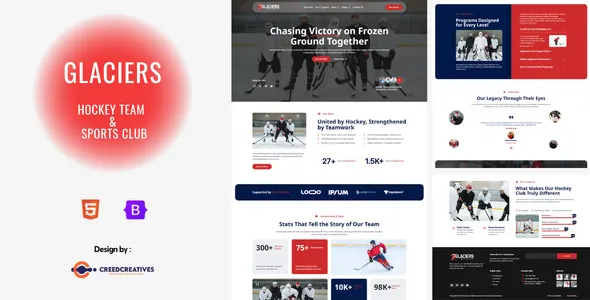
Glaciers – Hockey Team & Sports Club HTML Template
Glaciers – Hockey Team & Sports Club HTML Template is a modern, sports-focused website template designed for hockey teams, sports clubs, ice hockey academies, athletic organizations, and competitive sporting communities. With a bold visual identity and a professional presentation style, Glaciers provides a practical foundation for building a website that communicates team spirit, showcases sporting achievements, shares match updates, and connects players with fans. Whether you are creating an official website for a professional hockey team, promoting a local sports club, managing an amateur hockey organization, or establishing an online presence for a hockey training academy, this HTML template can help you develop a recognizable and engaging digital platform.
Built for sports-related websites, Glaciers combines the flexibility of an HTML template with a design direction suited to the energy, excitement, and competitive atmosphere of hockey. It can serve as a starting point for presenting team information, introducing players and coaching staff, publishing news, displaying fixtures, promoting upcoming matches, and highlighting memorable moments from competitions. By bringing essential sports content together in a structured website, the template can help organizations communicate more effectively with supporters, prospective members, sponsors, and the wider sporting community.
A well-designed sports website is more than an online brochure. It is a central destination where fans can follow their favorite team, discover upcoming events, explore club history, and stay connected throughout the season. Glaciers offers a foundation for creating this experience with a dedicated hockey identity and a layout approach suitable for dynamic sports content. With appropriate customization, the template can be adapted to reflect your club colors, team branding, competition level, and communication goals.
A Professional Website Solution for Hockey Teams
Hockey organizations need a website that reflects the speed, determination, teamwork, and excitement associated with the sport. Glaciers – Hockey Team & Sports Club HTML Template is intended for this environment, helping clubs establish an online presence that feels relevant to athletes, supporters, and sports enthusiasts.
From an established ice hockey club to a developing community team, the template can provide a consistent structure for presenting important organizational information. Visitors can use the website to learn about the team, explore club activities, discover scheduled matches, and find relevant updates. A clear content structure also helps administrators organize information as the season progresses.
The template can be customized for different types of hockey organizations, including professional teams, semi-professional clubs, amateur leagues, university hockey programs, youth sports organizations, and recreational hockey groups. Its sports-oriented identity makes it suitable for organizations that want a website focused on athletic competition rather than a generic business presentation.
Clubs can personalize the visual appearance by adding their official logo, choosing team colors, replacing demonstration images, and incorporating authentic club content. These adjustments help create a more distinctive identity and provide supporters with a familiar destination for team-related information.
Modern and Engaging Sports Design
The visual presentation of a hockey website plays an important role in communicating the personality of a team. Strong photography, clear typography, well-organized content, and carefully selected colors can help create an atmosphere that reflects the intensity of the sport.
Glaciers provides a sports-focused design foundation that can be developed into an engaging website for hockey fans and club members. Team photographs, action shots, player portraits, arena images, and competition highlights can be used to strengthen the overall presentation. When combined with relevant headlines and concise supporting text, these visual elements can make important information easier to discover.
The design can also help establish a clear distinction between major website sections. Team introductions, match information, player profiles, club announcements, and news articles can each be presented according to their importance. A thoughtful hierarchy encourages visitors to explore the website without feeling overwhelmed by unrelated information.
Sports websites often contain frequently updated content, especially during competitive seasons. A consistent design system helps maintain a professional appearance even as match reports, player details, announcements, and event information change. By adapting the template to your brand guidelines, you can establish a recognizable visual style across the entire website.
Dedicated Website for Ice Hockey Clubs
Glaciers is particularly relevant to organizations involved in ice hockey, where team identity, player performance, competition schedules, and supporter engagement are central to the club experience.
An ice hockey club can use a customized website to introduce its organization, explain its mission, share its history, and highlight its participation in leagues or tournaments. Visitors may also want to learn about training programs, coaching staff, player development opportunities, membership requirements, and club facilities.
A well-organized website can bring these details together in a single destination. Instead of relying entirely on social media posts or scattered announcements, the club can maintain a central information source that remains accessible throughout the year.
The template can also be adapted for different levels of competition. A professional organization might emphasize player profiles, official announcements, match reports, and sponsor visibility. A community club could focus on registrations, youth development, training schedules, and local events. A university team might prioritize competition results, student participation, and team achievements.
This flexibility makes Glaciers a useful starting point for organizations that need a sports-specific website but want to shape the final experience around their individual goals.
Team Profiles and Player Information
Players are at the heart of every hockey team. A dedicated player section can help visitors learn about the athletes who represent the club, understand their roles, and follow their progress during the season.
Using the template as a starting point, website administrators can create individual player profiles featuring names, photographs, positions, jersey numbers, biographies, and selected career highlights. Depending on the information available and the organization’s requirements, profiles may also include statistics, previous teams, achievements, or other relevant details.
For example, a team roster might distinguish between forwards, defensemen, goaltenders, and reserve players. This organization allows supporters to locate the information they need while helping the club maintain a more complete presentation of its roster.
Player profiles can also support youth academies and development programs. Coaches and administrators may use them to introduce emerging athletes, recognize individual achievements, and communicate the structure of the team. With suitable content management arrangements, the club can update profiles when players join, leave, change positions, or achieve new milestones.
The precise layout and available page structures depend on the template files and the customization you implement. Individual profiles can be created or expanded as required to suit the club’s roster size and presentation style.
Match Schedules and Upcoming Fixtures
Match schedules are among the most valuable resources on a sports website. Supporters want to know when their team plays, which opponent it will face, and where the next game will take place.
Glaciers can be customized to present fixture information in an organized and accessible format. A match listing might include the date, start time, opposing team, competition name, venue, and match status. Important fixtures can receive greater visual emphasis so that visitors can quickly identify upcoming games.
Clubs may organize fixtures by league, tournament, season, home games, or away games. This structure is particularly useful when an organization participates in several competitions or maintains multiple teams across different age groups.
A dedicated fixtures area can also support promotional activities. The club can publish previews before important games, share venue information, and encourage supporters to attend matches. Where appropriate, links can direct visitors to ticketing pages, venue directions, or official event information.
An HTML template does not automatically provide a live scheduling system unless the required functionality is included separately. Dynamic fixtures, automatic calendar synchronization, live updates, and data integrations may require JavaScript development, a backend service, or an external sports data provider. Nevertheless, a well-structured template offers a starting point for creating a useful match information experience.
Match Results and Competition Updates
After a game, supporters often look for the final score, key moments, and information about the team’s performance. A dedicated results section can help a hockey organization keep this information accessible.
With suitable customization, Glaciers can be used to display completed matches, including opponent names, final scores, match dates, competition details, and brief summaries. Results may be grouped by season or tournament to make historical information easier to explore.
A match report can provide more context than a score alone. Administrators might describe important periods of play, highlight decisive goals, recognize outstanding performances, and summarize the team’s overall effort. These articles can become a useful record of the season and help supporters remain connected to the club.
Competition tables and standings can also be incorporated where relevant. Such content may show points, games played, wins, losses, overtime results, or other statistics used by the applicable league. The precise scoring categories should reflect the rules of the competition rather than relying on a generic format.
Live scores and automatically updated standings require an appropriate data source and implementation. If the club prefers manual updates, administrators can publish results through the website’s existing content workflow or through additional tools selected for the project.
Coaching Staff and Club Management
Behind every successful hockey team is a group of coaches, trainers, administrators, and support personnel. Introducing these individuals helps visitors understand the structure of the organization and recognize the people responsible for its development.
A customized staff section can include coaching profiles, professional photographs, role descriptions, experience summaries, and relevant qualifications. Depending on the club’s needs, it may feature the head coach, assistant coaches, goalkeeper coach, fitness staff, medical personnel, team manager, and administrative contacts.
Presenting staff information clearly can also improve communication with prospective players and parents. Youth academies, for example, may want to explain their coaching approach, development philosophy, training environment, and commitment to athlete progression.
For larger organizations, staff information can be organized by department or team category. Smaller clubs may prefer a straightforward overview of their key personnel. The final structure should reflect the size and complexity of the organization.
Glaciers can provide a visual starting point for this content, while the exact profile layouts and navigation can be adjusted during implementation.
News, Articles, and Hockey Blog Content
Regularly updated news helps transform a sports website into an active destination for fans. Instead of visiting only when they need a fixture or contact detail, supporters can return to read match reports, club announcements, player interviews, tournament previews, and other hockey-related articles.
Glaciers can be adapted to present news content through article listings and individual post pages, depending on the structures included in the template. A club may publish updates about upcoming matches, roster changes, training activities, youth competitions, community programs, or major achievements.
A hockey blog can also offer educational content for athletes and enthusiasts. Topics might include skating development, teamwork, game preparation, equipment care, fitness routines, coaching perspectives, and the history of the sport. Informative articles can attract readers who are interested in hockey beyond the club’s immediate supporter base.
To maintain a professional news section, use descriptive headlines, readable paragraphs, relevant photographs, and consistent publication dates. Organize articles into meaningful categories so visitors can find content related to their interests.
Search-friendly article URLs, descriptive page titles, suitable image alternative text, and useful internal links can further improve the accessibility of this content. These details should be implemented and reviewed as part of the website’s overall search engine optimization strategy.
Photo Galleries and Hockey Highlights
Hockey is a visually engaging sport, making photography an important part of a club’s online identity. Action shots, player celebrations, team photographs, training sessions, and tournament moments can help communicate the atmosphere of the organization.
A customized Glaciers website can include a gallery section featuring selected images from matches, practices, club events, award ceremonies, and community activities. Galleries can be organized by season, competition, opponent, or event, depending on the quantity of available material.
High-quality photography can make the website more memorable and encourage visitors to explore additional pages. However, images should be selected carefully to maintain a consistent visual style and avoid unnecessarily slowing down page loading.
Image optimization is especially important for sports websites that use large action photographs. Compress images appropriately, select suitable dimensions, and use modern image formats when supported by the target browsers and implementation. Descriptive alternative text can also improve accessibility for visitors who use assistive technology.
If video highlights are important to the club, video embeds or a dedicated media section can be added where appropriate. Video hosting, playback controls, and streaming performance may depend on the selected service and any additional implementation work.
Club History, Achievements, and Trophies
A team’s history can communicate its values, tradition, and progress. Clubs with an established record may want to document championship victories, memorable seasons, notable athletes, and important milestones.
Glaciers can be customized to present historical information through a dedicated club profile, timeline, achievement section, or collection of featured stories. Photographs of past teams, archived match results, and trophy images can help bring the organization’s story to life.
An achievements section may highlight league titles, tournament placements, individual awards, community recognition, and youth development milestones. When possible, include dates and contextual details so visitors understand the significance of each accomplishment.
For a new organization, the same section can focus on its mission, founding story, future goals, and early progress. The objective is not simply to list awards but to communicate what makes the club distinctive.
A clearly presented history can strengthen the connection between long-standing supporters and the organization while introducing new visitors to the team’s identity.
Sports Club Membership and Registration
Membership is an important part of many hockey organizations. Clubs may need to explain how players can join, how families can register young athletes, and how supporters can participate in club activities.
A customized website based on Glaciers can provide information about membership categories, eligibility requirements, training programs, registration periods, and contact procedures. Clear explanations help visitors understand the process before contacting the organization.
If the club offers several programs, registration information can be separated by age group, skill level, or participation type. For example, a hockey academy may distinguish between introductory training, junior development, competitive squads, and recreational sessions.
Online registration forms can also be added if required. However, form submissions, payment collection, automated confirmations, membership databases, and secure handling of personal information require appropriate functionality beyond a purely static HTML presentation unless those capabilities are already included.
When collecting information from minors or families, organizations should implement suitable privacy notices, consent procedures, and data protection practices. Registration workflows should be tested thoroughly before they are used for real applications.
Hockey Training Academies and Youth Programs
Youth development is a major focus for many hockey organizations. Training academies need to explain their programs, introduce coaches, communicate schedules, and help prospective players understand how to participate.
Glaciers can be adapted for these needs by adding sections for academy information, training locations, age categories, coaching methods, program descriptions, and application details. This information can help parents and young athletes evaluate whether a program suits their needs.
A training page might describe skating instruction, puck control, passing, shooting, positional awareness, teamwork, and match preparation. Any claims about coaching qualifications, safety procedures, facilities, or program outcomes should reflect the actual services provided by the academy.
Clubs can also use their websites to publish seasonal announcements, trial dates, camp information, and tournament participation details. A clearly structured presentation helps reduce confusion and makes important deadlines easier to locate.
For organizations offering multiple training locations, each location can have its own page with relevant contact details, schedules, and directions. Such content can be incorporated through customization based on the template’s existing layout and navigation.
Sponsors and Commercial Partnerships
Sponsors can provide valuable support for sports organizations, helping fund equipment, training facilities, travel, tournaments, and community initiatives. A professional website can recognize these partnerships and make sponsorship opportunities easier to understand.
A customized Glaciers website can include a sponsor section displaying approved company logos, partnership descriptions, and links to sponsor websites. Sponsors may be grouped according to their partnership level, such as principal sponsor, official partner, equipment partner, or community supporter.
Organizations seeking new sponsorships can also create a dedicated partnership page. This page might explain the club’s audience, competition schedule, community involvement, and available promotional opportunities.
Where relevant, sponsorship packages can describe logo placement, event visibility, digital promotion, and other benefits offered by the organization. All commercial claims and partnership details should be accurate and approved by the relevant parties.
A consistent sponsor presentation helps maintain a professional appearance while acknowledging the businesses and individuals who support the club.
Fan Engagement and Supporter Communication
A strong supporter community contributes to the atmosphere surrounding a hockey team. A well-maintained website can give fans a reliable place to discover announcements, follow results, learn about players, and find information about upcoming games.
Glaciers can be adapted to highlight supporter-oriented content such as match previews, post-game summaries, fan events, team announcements, and community initiatives. Calls to action can direct visitors to official social media accounts, ticketing services, membership pages, or contact channels.
Clubs can also publish supporter information about arena access, parking, match-day policies, merchandise availability, and event schedules when these details are relevant.
Social media links may help visitors move between the official website and the club’s active social channels. If social feeds are embedded, consider performance, privacy, accessibility, and the possibility that external services may change their integration requirements.
Interactive fan features, discussion forums, voting systems, newsletters, and member accounts require additional functionality where they are not included in the original template. Select features according to the needs of the organization rather than adding unnecessary complexity.
Ticket Information and Match-Day Planning
For clubs that host public matches, ticket information can be an important part of the visitor experience. Fans need to understand where a game takes place, how to obtain admission, and whether special arrangements apply.
A customized Glaciers website can present ticket details, venue information, match-day announcements, and links to an external ticketing platform. Important information might include the match date, venue address, admission instructions, available ticket categories, and relevant access guidance.
If tickets are sold online, the website can direct visitors to a suitable third-party ticketing service or integrate with a compatible ticketing solution. Payment processing and ticket issuance should be handled by a secure, appropriately configured system.
Clubs should keep match-day information current and clearly distinguish confirmed details from provisional announcements. This helps supporters plan their visits and reduces the risk of confusion when schedules or venues change.
For organizations that do not sell tickets, the same area can be used to communicate attendance policies, spectator information, and directions to training sessions or club events.
Responsive Website Customization
Visitors may access a hockey website from desktop computers, laptops, tablets, and smartphones. A responsive layout helps the content adapt to different screen sizes and supports a more consistent experience across devices.
Glaciers can serve as a foundation for a responsive sports website, with the final behavior depending on the template’s supplied styles, scripts, and responsive implementation. During customization, check that navigation, images, team listings, fixture tables, buttons, and contact information remain usable on smaller screens.
Mobile visitors may be especially interested in quick access to the next match, latest result, venue address, and club announcements. Placing frequently requested information where it can be found easily helps improve usability.
Responsive testing should include common screen widths, different browsers, touch interaction, text scaling, and content of varying lengths. Tables containing fixtures or statistics may need a carefully designed mobile presentation to avoid horizontal scrolling and unreadable text.
A website that works consistently across devices is better positioned to serve players, parents, supporters, sponsors, and visitors wherever they access it.
HTML Structure and Developer Customization
As an HTML template, Glaciers provides a starting point for developers who want direct access to website markup, styling, and client-side behavior. This approach is suitable for projects where the team wants to customize the presentation without relying exclusively on a visual website builder.
Developers can review the supplied HTML files, modify page content, update navigation, adjust stylesheets, and replace demonstration assets with official club materials. Existing JavaScript components can be examined and configured according to the template’s documentation and dependencies.
The degree of customization depends on the files supplied with the purchased version. Review the included page layouts, stylesheet organization, JavaScript libraries, asset folders, and installation instructions before planning major changes.
Developers can also adapt the template to fit an existing website architecture. Depending on project requirements, the HTML can serve as a static site, be incorporated into a supported backend framework, or be converted into reusable components for a suitable content management system.
A conversion into WordPress or another CMS is a separate development task unless that version is specifically included. Dynamic data, authentication, content editing, and administrative functionality may require additional programming.
Flexible Branding and Visual Identity
Every hockey organization has its own character. Team colors, logos, uniforms, photography, slogans, and club traditions all contribute to a recognizable identity.
Glaciers can be personalized to align the website with these visual elements. Administrators and developers can replace placeholder logos, select appropriate colors, update headings, modify page backgrounds, and introduce official photography.
A consistent branding approach helps visitors recognize the club across its website, printed materials, social media, and match-day communications. Color choices should maintain sufficient contrast so that navigation, headings, buttons, and other important elements remain readable.
Typography also contributes to the site’s personality. Strong display headings may help communicate sporting energy, while clear body text supports longer articles and informational pages. Use a consistent typographic hierarchy rather than introducing too many unrelated styles.
Before publishing the customized website, review all pages for outdated demonstration content, inconsistent branding, broken image references, and links that still point to example destinations.
Search Engine Optimization for Hockey Websites
Search engine optimization helps users discover a hockey club through relevant searches. A well-organized website provides a useful foundation, but strong visibility depends on content quality, technical implementation, competition, and ongoing maintenance.
Glaciers can be customized with descriptive page titles, relevant meta descriptions, meaningful headings, clean internal links, and informative text. Each important page should communicate its purpose clearly rather than repeating the same generic content across the website.
For example, a club might create separate pages for its team roster, match fixtures, youth academy, training facilities, news, and contact information. These pages can target different user needs while supporting a coherent website structure.
Local hockey organizations may benefit from accurate venue details, contact information, location-specific content, and links to relevant community resources. Ensure that location information matches the organization’s actual operating area.
Image optimization also matters. Use descriptive filenames, appropriate alternative text, suitable dimensions, and compressed image assets. Performance should be measured after implementation rather than assumed from the template’s design alone.
A static HTML template does not automatically guarantee search rankings, indexing, or traffic. Search performance depends on the published website, its technical configuration, the usefulness of its content, and how search engines access and evaluate it.
Website Speed and Performance Considerations
Sports websites often rely on large photographs, visual effects, and media-rich sections. These elements can improve presentation, but they should be balanced against loading performance.
When customizing Glaciers, optimize image sizes, remove unused assets where appropriate, and review the scripts and stylesheets loaded on each page. Avoid including large libraries or third-party integrations that do not contribute meaningful value to the user experience.
Where suitable, use responsive images so that mobile visitors do not have to download unnecessarily large desktop assets. Browser caching, compression, and appropriate hosting configuration can also contribute to a faster experience.
Performance should be tested with realistic content, including the photographs, player listings, galleries, and news articles that will appear on the live website. A demo page with only a few images may perform differently from a fully populated club website.
The final speed of the site depends on implementation quality, hosting, asset sizes, third-party services, and the devices and networks used by visitors. Regular testing helps identify opportunities for improvement as the website grows.
Accessibility and Usability
An effective sports website should be straightforward to navigate and usable by visitors with different abilities. Accessibility considerations help ensure that important team information is not limited to people who interact with the site in only one way.
During customization, use semantic HTML elements, maintain sufficient text contrast, provide alternative text for meaningful images, and ensure that interactive controls can be operated using a keyboard. Form fields should have clear labels, and links should communicate their purpose.
Headings should follow a logical hierarchy so that visitors can understand the structure of each page. Avoid relying on color alone to communicate match status, results, or other important information.
For video content, captions can make relevant information more accessible. Navigation menus and interactive components should also be tested with keyboard controls and, where practical, assistive technologies.
Accessibility is an ongoing implementation responsibility rather than an automatic guarantee of any template. Reviewing the finished site against appropriate accessibility guidelines can help identify issues before publication.
Content Management and Future Expansion
A sports club’s information changes throughout the year. Rosters may be updated, new fixtures announced, results published, and staff details revised. A maintainable website structure makes these tasks easier to manage.
Glaciers can be used as a foundation for a website whose content is updated manually in HTML, or it can be extended through an appropriate backend or content management system. The best approach depends on the organization’s technical resources, publishing frequency, and need for administrative access.
A smaller club with occasional updates may be comfortable using a simple deployment workflow. A larger organization that publishes news every week may prefer a CMS or a custom administration interface that allows authorized staff to edit content without directly changing code.
Additional features can be introduced as the website’s requirements evolve. Potential enhancements include searchable player profiles, season archives, event calendars, newsletter subscriptions, merchandise links, sponsor directories, and structured competition data.
Each enhancement should be evaluated for its development cost, maintenance requirements, privacy implications, and compatibility with the existing implementation. Planning for future growth helps avoid unnecessary rework.
Suitable Uses for Glaciers HTML Template
Glaciers – Hockey Team & Sports Club HTML Template can be considered for a variety of hockey and sports-related website projects, including:
- Professional hockey teams: Create an official online presence for team announcements, player profiles, match information, and supporter news.
- Amateur hockey clubs: Share club information, training schedules, results, membership details, and community updates.
- Youth hockey academies: Introduce training programs, coaches, registration procedures, and player development opportunities.
- University hockey teams: Present rosters, competition schedules, student participation, and team achievements.
- Ice hockey leagues: Develop an informational website for league announcements, participating clubs, fixtures, and results, subject to appropriate customization.
- Sports associations: Communicate organizational information, events, programs, and achievements to members and the public.
- Hockey tournaments: Create an event-focused website with participating teams, match schedules, venue details, and tournament news.
- Sports training centers: Promote hockey coaching services, training sessions, facilities, and enrollment information.
- Recreational sports groups: Build a community hub for local hockey activities, announcements, and member communication.
- Sports media projects: Develop a hockey-focused editorial website featuring match reports, team news, interviews, and commentary.
Although the template’s primary identity is hockey-focused, developers may be able to adapt its visual direction for other sports organizations. Such adaptations may require changes to the page structure, imagery, content categories, and terminology to suit the new sport.
Benefits of Choosing an HTML Sports Template
Starting with a dedicated sports template can reduce the amount of initial design work required to establish a club website. Rather than creating every page from an empty project, developers can begin with an existing visual structure and adjust it to the organization’s needs.
An HTML template can offer direct control over the website’s code, making it useful for developers who prefer to customize markup and stylesheets. This can be advantageous when a project requires a distinctive design, a tailored navigation structure, or integration with an existing technical environment.
A sports-specific starting point also helps maintain consistency across related pages. Player profiles, match listings, news content, and club information can be presented within a coordinated visual system instead of appearing as unrelated sections.
The actual time saved depends on the completeness of the supplied files, the quality of the existing implementation, and the amount of customization required. Projects that need complex live data, payment systems, or user accounts may still require substantial development.
Installation and Customization Overview
Before using Glaciers, review the downloaded package and identify the main HTML files, asset folders, stylesheets, scripts, and documentation. The exact file structure and installation steps should be confirmed against the version supplied with your purchase.
A typical customization workflow may include the following steps:
- Review the documentation: Understand the available pages, dependencies, and recommended setup process.
- Prepare the development environment: Use a suitable code editor and local preview environment to inspect the website.
- Update the branding: Replace example logos, colors, typography, and visual assets with approved club materials.
- Edit the website content: Add accurate club details, team information, staff profiles, fixtures, results, and contact information.
- Customize the navigation: Organize pages around the most important visitor needs.
- Configure interactive elements: Test menus, buttons, forms, galleries, and other included components.
- Check responsiveness: Review the website on desktop, tablet, and mobile screen sizes.
- Optimize media: Compress images and remove unnecessary assets where appropriate.
- Test all links and pages: Confirm that navigation works and that no demonstration text or broken links remain.
- Deploy the website: Upload the finished files to a compatible hosting environment and test the published version.
This workflow provides a general starting point. Specific installation instructions, build tools, dependencies, and hosting requirements may differ according to the package.
Important Compatibility Considerations
Before purchasing or deploying Glaciers, review the product’s current documentation and preview to confirm which pages, design elements, scripts, plugins, and supporting files are included. Do not assume that every feature described as a possible customization is available as a built-in function.
Because Glaciers is an HTML template, advanced functionality such as automated match updates, live scores, user registration, payment processing, member dashboards, and database-backed player statistics may require additional development or third-party services unless explicitly included.
Check any stated browser requirements, responsive behavior, included frameworks, external dependencies, and licensing conditions. If you plan to integrate the template with a CMS, backend application, or sports data API, verify compatibility before committing to the implementation.
Keeping these requirements clear from the beginning can help establish realistic expectations and ensure that the final website matches the club’s operational needs.
Why Glaciers – Hockey Team & Sports Club HTML Template Is Worth Considering
Glaciers – Hockey Team & Sports Club HTML Template provides a hockey-oriented starting point for organizations that want to establish a professional online identity. Its intended sports focus makes it relevant to teams that need to communicate their identity, present athletes, share competition information, publish news, and maintain contact with their supporters.
By adapting the supplied layouts and assets, a developer can build a website that reflects the organization’s branding and priorities. The content structure can be expanded to accommodate club history, coaching information, youth programs, sponsor partnerships, match reports, and other useful resources.
The template can support both straightforward informational websites and more ambitious projects that evolve through additional development. A smaller team may concentrate on essential information and seasonal announcements, while a larger organization may extend the site with structured data, dedicated staff pages, or integrations with external services.
A successful result depends on more than the initial design. Accurate content, accessible navigation, optimized media, responsive implementation, and regular maintenance all contribute to a useful website experience.
Build a Strong Online Identity for Your Hockey Club
A dedicated website can help a hockey organization communicate with its community, promote upcoming matches, introduce players, celebrate achievements, and make important information easier to find. It also provides a stable online destination that the club can reference in announcements, promotional materials, and social media communications.
Glaciers – Hockey Team & Sports Club HTML Template offers a foundation for creating this kind of sports-focused website. With thoughtful customization, relevant team photography, clear content, and suitable technical implementation, it can be developed into an online hub for hockey players, fans, coaches, sponsors, and club administrators.
Whether your objective is to promote a competitive team, organize information for a local hockey club, showcase an academy, or establish a dedicated tournament website, Glaciers can serve as a starting point for a tailored digital experience. Review the supplied features, customize the content to reflect your organization, and build a website that communicates the passion, teamwork, and competitive spirit of hockey.