My Account
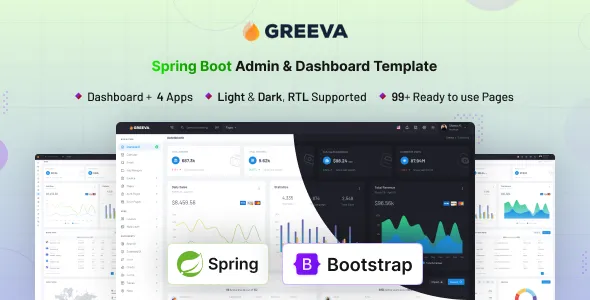
Greeva – Spring Boot Admin & Dashboard Template
Greeva – Spring Boot Admin & Dashboard Template is a modern web development solution designed for developers, software engineers, backend teams, enterprise application developers, and technology businesses looking to create professional administrative interfaces for Java-based applications. Built around the Spring Boot development ecosystem, this template provides a foundation for developing admin panels and dashboard interfaces that help organize application data, display operational information, and present business insights through a structured user interface.
Administrative dashboards play an important role in modern software applications. Businesses and development teams often need centralized interfaces for reviewing information, managing application resources, monitoring operational activities, and accessing different sections of their systems. Greeva provides a starting point for creating such interfaces while allowing developers to customize the frontend according to project requirements, application architecture, and organizational workflows.
Whether you are developing an enterprise administration panel, a business management dashboard, an internal application interface, or an administrative frontend for a Java-based software project, Greeva can serve as a practical foundation for your development workflow. Its Spring Boot-oriented positioning makes it relevant to developers working within the Java ecosystem, while the final implementation depends on the supplied source code, available components, technical documentation, and integration requirements.
What Is Greeva Spring Boot Admin & Dashboard Template?
Greeva is an admin and dashboard development template intended for projects involving Spring Boot and Java-based application environments. It provides a starting point for creating administrative interfaces where users can access information, navigate application sections, and interact with relevant business or operational data.
Spring Boot is a Java framework used for building standalone applications and backend services. It provides an ecosystem for developing web applications, APIs, and enterprise software systems. An administrative dashboard can complement a Spring Boot application by offering a frontend interface for accessing data and managing supported operations.
Greeva can be considered for projects that require a structured administrative interface rather than a conventional marketing website. Developers may customize the dashboard layout, navigation, data presentation, and other interface elements according to the requirements of the application.
The exact implementation, technology stack, and included functionality should be confirmed through the supplied documentation and source code before development begins.
Designed for Java and Spring Boot Development
Spring Boot is widely used for building Java-based applications across different industries. Developers use it to create web services, enterprise applications, backend systems, and business software solutions.
Greeva is positioned for projects within this ecosystem, making it relevant to developers who need an administrative interface for a Java-based application.
Potential applications include:
- Enterprise application administration panels
- Business management dashboards
- Internal company management systems
- Java-based web application interfaces
- Backend administration platforms
- Operational reporting dashboards
- Application configuration interfaces
- Data management systems
- Software project administration panels
- Custom enterprise dashboard solutions
Each implementation can be customized according to the application’s business logic, user requirements, and technical architecture. Developers should verify the actual framework integration and included features before selecting the template for a project.
Spring Boot-Based Application Architecture
Spring Boot provides a structured environment for developing Java applications and backend services. It can be used to build REST APIs, process application data, manage business logic, and connect to databases and other services.
Greeva can serve as a starting point for developing an administrative interface associated with a Spring Boot project, depending on the supplied package and its implementation.
Developers should review the included source code to understand how the frontend and backend are organized. The template may require configuration or integration with a Spring Boot application to retrieve data and perform administrative operations.
A complete application architecture may include:
- Frontend dashboard components
- Spring Boot backend services
- REST API endpoints
- Database connectivity
- Authentication and authorization
- Application business logic
- Data validation and processing
- Deployment configuration
The actual architecture depends on the project requirements and available components. Reviewing the documentation helps developers determine which elements are included and which need additional implementation.
Modern Admin Dashboard Interface
An administrative dashboard should provide a clear overview of important information while making it easy to navigate between different application sections.
Greeva can be customized to create a structured dashboard interface featuring relevant administrative and business information.
Possible dashboard sections include:
- Overview and summary panels
- Data tables and record listings
- Information cards
- Navigation menus
- User and account sections
- Reports and analytics
- Application settings
- Business data management
- Administrative actions
- Additional project-specific modules
The precise availability of these components depends on the supplied template.
A well-organized dashboard helps users locate important information and understand the application structure. Developers should prioritize relevant content and maintain a consistent interface across different sections.
Suitable for Enterprise Application Development
Enterprise applications often require administrative interfaces that support business operations, data access, and application management.
Greeva can be considered for enterprise-oriented projects where a structured dashboard is required alongside a Java-based backend.
An enterprise application may include modules for employee information, business records, operational reports, internal workflows, or other organization-specific functions.
Developers can customize the dashboard according to the actual application requirements and integrate the frontend with the relevant Spring Boot services.
Enterprise interfaces should be designed around clear navigation, appropriate access permissions, and reliable data presentation. Administrative actions should also be implemented with suitable validation and security controls.
Data Tables and Information Management
Data tables are commonly used in administrative applications to present structured information in a convenient format.
Greeva can be evaluated for projects that require organized data presentation through tables, listings, or related dashboard components, depending on the available source code.
An administrative interface may display records such as user accounts, business information, application resources, transactions, or other data relevant to the project.
Useful data management features may include pagination, sorting, filtering, search, and record selection. However, developers should verify which capabilities are included in the supplied package and which require additional implementation.
When connecting the frontend to a Spring Boot backend, data should be retrieved through appropriately designed APIs. Developers should also consider loading states, empty results, error handling, and data validation to maintain a consistent user experience.
Customizable Dashboard Layouts and Components
Different applications have different administrative requirements. A flexible dashboard structure allows developers to organize interface elements according to the purpose of the application.
Greeva can serve as a starting point for customizing dashboard layouts, navigation elements, content sections, and other interface components, depending on the supplied source code.
A business management application may require summary cards and data tables, while an operational dashboard may prioritize system information and activity reports. An internal application may need a simpler structure focused on frequently used functions.
Developers should organize components logically and maintain consistency across the interface. Reusable frontend elements can help simplify future modifications and support a more maintainable development workflow.
User Management and Administrative Interfaces
User management is a common requirement for business and enterprise applications. Administrative interfaces may need to provide information about users, roles, permissions, and account-related operations.
Greeva can be customized for user-related dashboard sections if the required frontend components are available in the supplied package.
A user administration interface may include account listings, profile information, role descriptions, status indicators, and other relevant details.
However, user registration, authentication, password management, role-based access control, and secure account operations require appropriate backend implementation unless explicitly included in the template.
Developers should connect these functions to secure Spring Boot services and implement appropriate access controls. Sensitive account information should be handled according to application security requirements.
Integration with Spring Boot REST APIs
Many Spring Boot applications expose REST APIs that allow frontend interfaces to retrieve and update application data.
Greeva can be evaluated as a frontend foundation for integrating with REST endpoints, depending on its supplied implementation and documentation.
API integration may involve:
- Retrieving application data
- Displaying records in dashboard tables
- Loading summary information
- Submitting forms
- Updating existing records
- Processing administrative actions
- Managing error responses
- Handling loading and empty states
Developers should review the existing frontend structure and determine how API calls should be implemented.
A Spring Boot backend may require appropriate endpoint configuration, request validation, authentication, and error handling. The exact implementation depends on the application architecture and API specifications.
Responsive Design for Administrative Applications
Administrative applications are often accessed through desktop computers, but mobile and tablet compatibility can also be important for certain workflows.
Greeva should be evaluated for responsive behavior according to the supplied layout and styling implementation.
Dashboard components such as navigation menus, data tables, summary cards, and form elements should remain usable across different screen sizes.
Developers should test the interface on desktop computers, tablets, and smartphones. Data-heavy layouts may require adjustments to table presentation, content spacing, and navigation behavior.
Responsive testing should cover the complete dashboard rather than only the initial overview page. Different administrative sections may require separate layout adjustments.
Customization and Application Branding
A dashboard should reflect the visual identity and requirements of the application it supports.
Greeva can be customized according to the available source code and styling structure. Depending on the implementation, developers may adjust colors, typography, spacing, navigation, icons, and dashboard components.
A corporate application may require a restrained and professional interface, while a modern SaaS administration platform may use a more contemporary visual presentation.
Consistency across headings, buttons, tables, cards, and navigation elements helps create a recognizable interface.
Developers should also consider usability when making design changes. Administrative dashboards often contain dense information, so visual customization should support readability and convenient navigation rather than introduce unnecessary complexity.
Backend Functionality and Database Connectivity
A functional administrative dashboard often depends on backend services and a database to manage application information.
Greeva can be considered as a starting point for a dashboard associated with a Spring Boot backend, but the actual data management capabilities depend on the supplied implementation.
A complete application may require:
- Database configuration
- Data models and entities
- Repository and service layers
- REST controllers
- Business logic
- Data validation
- Authentication and authorization
- API error handling
- Transaction management
These backend capabilities should be verified before assuming that they are included in the template.
Spring Boot developers can implement the required services according to the application’s architecture and database requirements. The frontend should communicate with the backend through suitable endpoints and handle responses appropriately.
Security and Access Control
Security is an important consideration for administrative applications because they may provide access to business records, user accounts, operational information, and application settings.
Greeva can be customized for administrative interfaces, but secure authentication and authorization must be implemented according to the application’s requirements.
Developers should consider appropriate security measures such as:
- Authentication and session management
- Role-based access control
- Secure API communication
- Input validation
- Protection of sensitive information
- Authorization checks for administrative actions
- Secure configuration management
- Appropriate error handling
Spring Boot applications may use security-related libraries and configuration to implement these controls. The exact approach depends on the project architecture.
A frontend dashboard should not be treated as a security boundary by itself. Access restrictions and sensitive operations must be enforced by the backend.
Reporting and Data Visualization
Reporting dashboards can help businesses review operational information, understand trends, and access important data.
Greeva can be evaluated for projects requiring summary panels, reports, and data visualization components, depending on the available template features.
A business dashboard may present information such as activity summaries, operational records, performance metrics, or other application-specific data.
Additional charts, reporting modules, and data visualization libraries may need to be integrated according to project requirements.
Developers should ensure that data is presented accurately and that charts or summary indicators are based on verified backend information. Clear labels and appropriate context help users interpret the information correctly.
Performance and Application Optimization
Performance is important for administrative applications that display large datasets or communicate frequently with backend services.
The performance of a Greeva-based application depends on the supplied source code, Spring Boot configuration, database performance, frontend assets, API design, hosting environment, and additional integrations.
Developers can evaluate frontend loading behavior, optimize unnecessary assets, and review how data is requested and displayed.
Backend optimization may involve efficient database queries, pagination, caching where appropriate, and suitable API response structures.
Performance testing should include important dashboard pages, data tables, administrative forms, and reporting sections.
Regular testing after customization helps identify performance issues and maintain a reliable user experience.
Who Should Use Greeva Spring Boot Admin & Dashboard Template?
Greeva may be suitable for developers and organizations working on Java-based applications and administrative interfaces.
Spring Boot developers: Create or customize dashboard interfaces for Java backend projects.
Enterprise software teams: Develop administrative frontend structures for internal business applications.
IT service companies: Build dashboard interfaces for custom software and enterprise technology projects.
Backend development teams: Use a frontend starting point for projects requiring structured administration panels.
Business application developers: Customize dashboard layouts for business data and operational workflows.
SaaS development teams: Evaluate the template for administrative interfaces associated with software products.
Freelance Java developers: Use the template as a starting point for client projects involving Spring Boot applications.
Web development agencies: Adapt the dashboard for custom enterprise and business application projects.
The suitability of Greeva depends on the project’s requirements, included functionality, framework compatibility, and customization work.
Important Considerations Before Using Greeva
Before beginning development with Greeva, review the supplied documentation and source code to understand its technical requirements and capabilities.
Consider the following points:
- Confirm the included frontend and backend technologies.
- Verify the supported Java and Spring Boot versions.
- Review dependencies and installation instructions.
- Examine the available dashboard components and layouts.
- Check database and API integration requirements.
- Review authentication and authorization implementation.
- Verify responsive behavior across devices.
- Check the build, configuration, and deployment process.
- Identify additional libraries required for charts or reporting.
- Test forms, data tables, and administrative actions.
- Review application security and performance before deployment.
These steps help developers evaluate the template and prepare an implementation that aligns with their project requirements.
Final Thoughts on Greeva Spring Boot Admin & Dashboard Template
Greeva – Spring Boot Admin & Dashboard Template is a potential development solution for Java developers, enterprise software teams, backend engineers, and organizations building administrative interfaces for business applications.
Its Spring Boot-oriented positioning makes it relevant to projects involving Java-based backend systems, operational dashboards, internal management platforms, and enterprise application interfaces.
The final implementation depends on the supplied source code, technical architecture, framework compatibility, customization decisions, and additional backend services. Reviewing documentation, configuring APIs, implementing security controls, testing responsive layouts, and optimizing application performance are important parts of the development process.
For developers seeking an admin dashboard foundation within the Spring Boot ecosystem, Greeva can be considered as part of a broader application development workflow. With thoughtful customization, reliable backend integration, and appropriate security implementation, it can support the development of a professional administrative interface for modern business and enterprise applications.