My Account
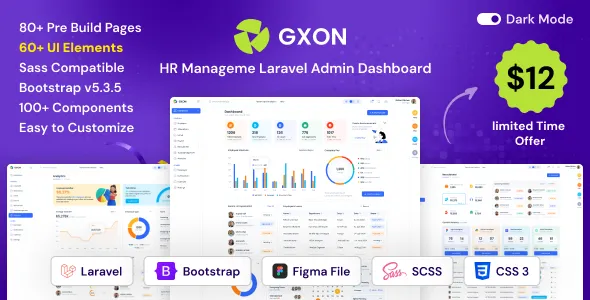
GXON | HR Management Laravel Admin Dashboard Template
GXON | HR Management Laravel Admin Dashboard Template is a professional web development solution designed for building human resource management systems, employee administration platforms, HR portals, workforce management applications, and business management dashboards. Developed for projects using the Laravel framework, GXON provides a structured foundation for creating modern administrative interfaces that support employee-related operations, organizational management, and business workflows. Whether you are developing an HR management system, employee information portal, recruitment dashboard, payroll administration platform, or workforce management application, GXON can serve as a starting point for creating a customized administrative experience.
Human resource management plays an important role in maintaining employee information, organizing organizational activities, managing recruitment processes, and supporting workforce administration. Businesses increasingly rely on digital systems to simplify HR operations and provide convenient access to employee-related information. A well-structured HR dashboard helps administrators navigate different modules, review relevant information, and manage operational activities through a centralized interface.
GXON is intended for developers and businesses looking for a Laravel-oriented admin dashboard design foundation. Its interface can be customized according to the requirements of an HR application, including employee management, attendance tracking, leave administration, recruitment workflows, and other organizational processes. The actual functionality depends on the included package, Laravel version, backend implementation, database configuration, and supported integrations. Developers should verify the product documentation and demo before assuming that particular HR features are included.
What Is GXON HR Management Laravel Admin Dashboard Template?
GXON is a Laravel admin dashboard template intended for developers building human resource management and business administration applications. An administrative dashboard provides a centralized interface where users can access application modules, review information, and perform tasks according to their assigned permissions.
An HR management platform typically requires an organized interface for handling employee records, department information, attendance, recruitment, leave requests, and other workforce-related operations. GXON can provide a starting point for designing these interfaces while allowing developers to customize the application according to their organizational requirements.
Laravel is a PHP framework used for developing web applications with structured architecture and development tools. It can support backend functionality such as routing, request handling, database operations, authentication, validation, and application logic, depending on the framework version and configuration.
The exact role of GXON depends on the contents of the purchased package. Developers should confirm whether it includes frontend assets, Blade templates, Laravel integration, sample pages, or other resources. Actual HR functionality may require additional backend development, database design, and integration work unless explicitly included.
HR Dashboard Design for Modern Businesses
An HR dashboard provides a central interface for accessing workforce-related information and administrative functions. It helps organize different HR activities within a consistent application structure.
GXON can be evaluated as a starting point for developing a dashboard that presents employee information, department summaries, HR activities, and administrative navigation, depending on the available components.
A dashboard may display employee statistics, department information, attendance summaries, leave request updates, or recruitment activity. These elements should be connected to appropriate data sources and reflect the actual functionality implemented in the application.
For HR professionals, an organized dashboard can simplify navigation between different administrative sections. Managers may require access to workforce information, while employees may need a separate interface for personal records and requests.
The dashboard should prioritize relevant information and avoid unnecessary complexity. Clear labels, consistent visual elements, and logical navigation help users understand the interface and access the functions they need.
Laravel Framework for HR Application Development
Laravel provides a development framework for creating PHP-based web applications. It includes tools and architectural features that help developers organize application logic and implement dynamic functionality.
GXON is intended for Laravel-oriented projects, making it relevant to developers building administrative systems that require a structured application environment.
Laravel can support the development of HR application components such as employee records, department management, leave requests, recruitment workflows, and reporting systems. The actual implementation depends on the application’s architecture, database design, framework version, and included package resources.
Developers can work with Laravel routes, controllers, models, views, validation, middleware, and other framework features to customize the application. If the package includes Blade templates or Laravel-specific resources, these can be reviewed and adapted according to the project’s requirements.
Before development, verify the supported Laravel and PHP versions, dependency requirements, installation instructions, and available documentation. This helps ensure that the template is compatible with the intended development environment.
Employee Management and Information Systems
Employee management is a fundamental component of many HR applications. Organizations need structured systems for maintaining employee information and organizing workforce-related records.
GXON can serve as a starting point for developing employee administration interfaces, depending on the available dashboard components. Developers may customize the application to present employee lists, profile information, organizational roles, department assignments, and employment details.
An employee management module may include search, filtering, sorting, and pagination to make information easier to navigate. Profile pages can organize relevant employee information into clearly defined sections.
Dynamic employee management requires appropriate database integration and backend implementation. Creating, updating, deleting, searching, and managing employee records must be connected to suitable application logic and database operations unless included in the package.
Organizations should also consider access permissions and data privacy when designing employee information systems. HR records should be accessible only to authorized users, according to their assigned responsibilities.
Department and Organizational Structure Management
Organizations often need to maintain information about departments, teams, reporting relationships, and job positions. An HR application can help administrators organize these details within a structured system.
GXON can be customized to support department management interfaces where suitable components are included. Developers may create pages for department listings, team information, organizational roles, and other workforce-related details.
A department management module can help administrators organize employee assignments and maintain a clearer view of organizational structure.
The implementation may require database relationships between employees, departments, job roles, and other organizational entities. These relationships should be designed according to the organization’s actual requirements.
For larger organizations, additional features such as hierarchical reporting structures, role-based access, and department-specific dashboards may require custom development.
A well-organized departmental structure can support HR administration and make workforce information easier to maintain.
Attendance Tracking and Workforce Administration
Attendance management is an important HR function for organizations that need to maintain records of employee working hours, attendance patterns, and workplace participation.
GXON can provide a dashboard design foundation for attendance-related interfaces, depending on the included components. Developers can customize the application to display attendance summaries, employee records, reporting sections, and relevant administrative information.
A complete attendance management system may require features such as clock-in and clock-out records, shift schedules, attendance corrections, holiday management, and reporting.
These features require suitable backend logic, database integration, and potentially external services or device integrations. A dashboard template alone should not be assumed to provide a fully operational attendance tracking system.
Organizations should determine the attendance rules and reporting requirements before implementation. Proper validation and access controls are important when managing employee attendance records.
Leave Management and Employee Requests
Leave management helps organizations organize employee time-off requests and maintain relevant administrative records. An HR system can provide a structured workflow for employees, managers, and HR administrators.
GXON can be customized to support leave-related frontend interfaces, depending on the available package components. These interfaces may present leave categories, request information, approval status, and relevant administrative sections.
A leave management system may include request submission, approval workflows, leave balances, holiday calendars, and historical records.
Dynamic functionality requires backend implementation, database integration, and appropriate business rules. The system must determine how leave is calculated, how requests are processed, and which users have permission to approve or modify records.
Developers should consider different organizational policies, such as annual leave, sick leave, personal leave, and other applicable categories. The final implementation should reflect the company’s actual HR policies.
A clearly organized leave management interface can make employee requests easier to review and support more consistent administrative processes.
Recruitment and Applicant Management
Recruitment management helps organizations organize hiring activities, track applications, and maintain information about candidates throughout the selection process.
GXON can be evaluated as a starting point for developing recruitment-related dashboard interfaces. Depending on the available layouts, developers may customize pages for job listings, candidate information, application status, and recruitment activity.
A recruitment application may require job posting management, applicant registration, resume uploads, interview scheduling, candidate evaluation, and communication workflows.
These features require appropriate backend implementation, database integration, and secure file handling unless explicitly included in the package.
Developers should also consider how applicant information is stored, who can access it, and how long it should be retained. Recruitment systems often handle personal information that requires responsible management.
An organized recruitment dashboard can help HR professionals navigate hiring activities and maintain a structured application process.
Payroll and Compensation Administration
Payroll administration involves managing employee compensation, salary information, deductions, allowances, and payment-related records. It is a sensitive part of HR management that requires accurate calculations and careful data handling.
GXON may serve as a frontend foundation for payroll-related administrative interfaces, depending on the included components. Developers can customize the dashboard to present relevant salary records, payroll summaries, and administrative information.
A complete payroll system requires appropriate calculation logic, database integration, validation, and potentially connections to accounting or payment systems. Tax calculations, statutory deductions, compensation rules, and payment processing depend on the applicable jurisdiction and organizational policies.
Payroll information should be protected through appropriate access permissions and security measures. Only authorized HR personnel and relevant administrators should be able to access sensitive compensation records.
Before implementing payroll functionality, organizations should review their operational requirements, legal obligations, and technical dependencies.
Employee Performance and Evaluation Management
Performance management helps organizations review employee progress, establish professional goals, and organize evaluation activities.
GXON can be customized to provide dashboard interfaces for performance-related information, depending on the components included in the package. Developers may create sections for employee goals, evaluation records, review schedules, and performance summaries.
A performance management application may support goal setting, review cycles, manager feedback, evaluation forms, and progress tracking.
The actual functionality requires appropriate business logic, database integration, and permissions. Developers should establish how performance data is recorded, who can review it, and how employees and managers interact with the system.
Performance evaluation workflows vary between organizations. The application should be designed around the company’s policies rather than assuming that every business uses the same evaluation structure.
Reports and HR Analytics Dashboard
HR reports and analytics can help organizations review workforce information and understand administrative trends. A dashboard can present relevant information in a visual and organized format.
GXON can serve as a starting point for developing reporting interfaces, depending on the available dashboard components. Developers may customize pages to present employee statistics, department summaries, attendance information, recruitment activity, or other HR metrics.
Reporting features may include data tables, charts, filters, date ranges, and downloadable reports. These capabilities depend on the data sources, charting libraries, and backend implementation.
Organizations should ensure that reports are accurate and based on appropriate data. Workforce metrics should be interpreted carefully and used in accordance with organizational policies.
The reporting interface should also consider user permissions. Different users may need access to different levels of workforce information, and sensitive records should not be exposed unnecessarily.
Customization and Dashboard Branding
A professional administrative dashboard should reflect the organization’s visual identity while maintaining a clear and consistent interface.
GXON can be customized using the available frontend resources, including HTML, CSS, JavaScript, and Laravel-related view files where supplied. Depending on the package structure, developers may adjust typography, colors, spacing, navigation, page layouts, icons, and dashboard components.
An HR dashboard should prioritize clarity and usability. A consistent color palette and typography system help distinguish headings, navigation elements, forms, and important information.
Developers may also customize the dashboard to match different application modules, including employee management, recruitment, attendance, payroll, and reporting.
Before making extensive modifications, review the source code structure and documentation. Keeping customizations organized helps simplify future updates and ongoing maintenance.
Responsive Design for HR Management Applications
Responsive design is important for administrative applications because employees and managers may access HR systems from different devices.
GXON can be evaluated for developing responsive dashboard interfaces, depending on the supplied layouts and supported components. The final application should remain readable and usable across desktop computers, laptops, tablets, and mobile devices.
Employee self-service portals may benefit particularly from mobile-friendly interfaces because users may need to review information or submit requests without using a desktop computer.
Developers should test forms, tables, navigation menus, charts, and other interactive elements across different screen sizes.
Responsive behavior can also be affected by custom code, additional libraries, and third-party integrations. Testing the finished application helps identify layout issues and improve usability.
Authentication and Role-Based Access Control
HR applications often handle confidential employee information, making authentication and access control essential parts of application development.
GXON can provide a dashboard design foundation for authentication-related interfaces, depending on the package contents. A complete authentication system requires backend implementation and appropriate security configuration.
Role-based access control can help determine which users are permitted to access particular application modules. For example, HR administrators, managers, employees, and recruitment personnel may require different permissions.
Laravel provides development tools for implementing authentication and authorization, but the actual configuration depends on the framework version and application architecture.
Developers should establish clear access rules and test them carefully. Unauthorized users should not be able to access employee records, payroll details, or other sensitive information through direct URLs or application requests.
Secure authentication, proper session management, and appropriate permission checks are important for maintaining a reliable HR application.
Database Integration and Dynamic Application Functionality
A dynamic HR management system typically requires a database to store employee information, department records, attendance details, leave requests, recruitment data, and other application information.
GXON can be used as a frontend and dashboard foundation for an application connected to a suitable database. The actual integration depends on the included source code, Laravel configuration, database requirements, and development work.
Developers may create data models and relationships between employees, departments, roles, attendance records, leave requests, and other HR entities.
The database structure should reflect the organization’s operational requirements. Appropriate validation, access controls, and data management practices should be included wherever users create or modify records.
Before deployment, developers should test database operations, error handling, and application behavior under different conditions. Proper backup and recovery procedures are also important for systems that maintain employee information.
SEO and Technical Structure for Administrative Applications
SEO is generally less important for private administrative dashboards than for public-facing websites because many HR application pages require authentication and should not be indexed by search engines.
However, a clean technical structure remains important for maintainability, performance, and application development.
GXON can be customized according to the application’s routing and frontend structure. Developers should ensure that public pages, such as login or informational pages, are configured appropriately while private HR modules remain protected.
Technical considerations may include descriptive page titles, organized frontend assets, efficient scripts, and proper application routing. Search engine indexing should be managed according to the privacy and accessibility requirements of the system.
For public-facing recruitment pages, SEO may be relevant when organizations want job listings to be discoverable. The implementation should distinguish between public recruitment content and private applicant management interfaces.
Performance Optimization for HR Dashboards
Performance is important for administrative dashboards that display employee records, tables, reports, charts, and other dynamic information.
The performance of a GXON-based application depends on frontend implementation, backend architecture, database queries, server configuration, and additional integrations.
Developers can optimize frontend resources by reviewing image sizes, unnecessary scripts, and oversized assets. Backend performance may require efficient database queries, pagination, caching, and appropriate server configuration.
Large employee lists and reporting tables should be designed to handle the expected volume of information. Filtering, pagination, and other data management techniques may improve usability and performance.
Performance testing should include important application pages, including employee listings, reports, attendance interfaces, and other data-intensive sections.
Regular monitoring can help identify bottlenecks as the application grows.
Security and Data Privacy in HR Applications
Security and data privacy are essential for HR management systems because they may handle employee identities, employment information, compensation records, attendance details, and other confidential data.
When customizing GXON, developers should review the security requirements of the complete Laravel application rather than relying on the dashboard design alone.
Important considerations include authentication, authorization, input validation, secure file uploads, session management, database access controls, and protection against common web application vulnerabilities.
Organizations should also establish appropriate policies for handling employee information and maintaining access permissions.
The application should use secure communication protocols and follow relevant data protection requirements. Sensitive records should only be accessible to authorized users with a legitimate operational need.
Regular updates, security testing, backups, and maintenance help support a reliable HR application over time.
Who Should Use GXON HR Management Laravel Admin Dashboard Template?
GXON can be evaluated by developers, organizations, and businesses planning to build human resource management or employee administration applications.
HR software developers: Developers can use the template as a starting point for building customized HR applications.
Businesses and organizations: Companies can develop employee administration interfaces suited to their workforce management requirements.
Recruitment agencies: Agencies can create administrative dashboards for organizing recruitment activities and candidate information.
Workforce management platforms: Developers can customize interfaces for attendance, scheduling, and employee administration systems.
Payroll software providers: Organizations can use the dashboard as a starting point for developing compensation administration interfaces, subject to additional implementation.
Employee self-service portal developers: Developers can create interfaces where employees access relevant information and submit requests.
Laravel development agencies: Freelancers and agencies can adapt the template for client projects involving HR management and administrative dashboard development.
The suitability of GXON depends on the actual package contents, supported Laravel version, technical requirements, and functionality needed for the intended application.
Tips for Building a Successful HR Application with GXON
Building a reliable HR management application requires careful planning of the interface, backend architecture, security, and organizational workflows.
Start by identifying the primary HR functions required by the organization. Determine whether the application needs employee records, attendance tracking, leave management, recruitment, payroll, performance evaluation, reporting, or other modules.
Prepare a clear application structure and define how different modules interact. Establish the required database relationships, user roles, and permissions before implementing dynamic features.
Review the supplied GXON package and documentation to understand its available components and technical requirements. Confirm the supported Laravel and PHP versions and identify any additional dependencies.
Customize the dashboard using consistent branding, clear navigation, and accessible interface elements. Test the application on different devices and screen sizes.
Pay particular attention to security, data privacy, validation, and access control when implementing employee-related functionality.
Finally, establish a maintenance plan that includes backups, security reviews, performance monitoring, and framework updates. These practices help keep the application reliable as organizational needs evolve.
Final Thoughts on GXON HR Management Laravel Admin Dashboard Template
GXON | HR Management Laravel Admin Dashboard Template is a potential development foundation for building HR management systems, employee administration applications, recruitment platforms, and workforce management dashboards using Laravel.
Its administrative interface can help developers organize employee-related pages, dashboard sections, and business workflows into a consistent application structure. The template can be customized to reflect different organizational requirements and visual branding preferences.
As a Laravel-oriented admin dashboard template, its actual capabilities depend on the supplied package, framework compatibility, backend implementation, and additional integrations. Features such as employee database management, attendance tracking, leave approvals, payroll calculations, recruitment workflows, authentication, and reporting should be verified before assuming they are fully functional.
Before selecting GXON for a project, review the product demo, included source files, technical documentation, installation instructions, and supported framework versions.
With appropriate customization, secure backend development, database integration, responsive testing, and ongoing maintenance, GXON can serve as a useful foundation for creating a professional HR management application that supports workforce administration and organizational operations.