My Account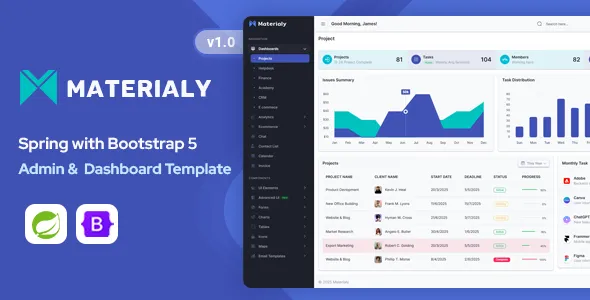
Materialy – Spring Boot Admin & Dashboard Template
Introduction
Materialy – Spring Boot Admin & Dashboard Template is a modern, enterprise-grade, and developer-focused solution designed for software companies, SaaS platforms, enterprise applications, CRM systems, ERP solutions, analytics platforms, fintech products, healthcare management systems, eCommerce administration panels, and custom business applications. Built using the power of Spring Boot, this template provides developers and organizations with a professional dashboard foundation that accelerates development while delivering exceptional user experiences.
In today’s digital landscape, businesses rely heavily on data-driven applications to manage operations, monitor performance, automate workflows, and support decision-making. Behind every successful application is an administration interface that enables teams to interact with data efficiently and confidently. While end-user experiences often receive significant attention, administrative dashboards play an equally important role in ensuring productivity, operational efficiency, and business growth.
Materialy has been created to address these needs by combining modern interface design with practical functionality, enabling development teams to build sophisticated backend applications without starting from scratch.
Why Admin Dashboards Matter in Modern Applications
As organizations adopt increasingly complex software ecosystems, the demand for intuitive administration environments continues to grow.
Administrative users often perform mission-critical tasks such as reviewing reports, managing users, monitoring transactions, configuring settings, and analyzing operational performance. When dashboard experiences are poorly designed, efficiency suffers and productivity declines.
An effective administration interface should simplify workflows rather than complicate them.
Materialy supports this objective by helping teams create environments where information is accessible, actions are intuitive, and users can perform responsibilities with confidence.
Built Specifically for Spring Boot Applications
Spring Boot has become one of the most widely adopted frameworks for enterprise Java development due to its flexibility, reliability, and ability to streamline application architecture.
Organizations across industries rely on Spring Boot to build scalable systems that support both internal operations and customer-facing experiences.
Materialy has been developed to complement these environments by providing interfaces specifically suited to enterprise-grade applications.
Whether supporting a SaaS platform, financial application, healthcare portal, logistics management system, educational platform, or internal business tool, the template adapts naturally to a variety of operational requirements.
This versatility makes it a valuable asset for development teams working across diverse industries.
Modern Design That Prioritizes Productivity
Dashboard users spend extended periods interacting with administrative interfaces.
Visual clarity therefore becomes essential.
Materialy embraces a design philosophy focused on usability, consistency, and efficiency.
Layouts are carefully structured to reduce distractions while emphasizing the information users need most frequently. Typography enhances readability during prolonged sessions, while intuitive navigation minimizes unnecessary clicks.
Balanced visual hierarchy guides attention toward critical metrics and actions without overwhelming users.
These design principles contribute to improved productivity and more satisfying experiences.
Accelerating Development Workflows
Building administration interfaces from the ground up requires significant time and resources.
Development teams frequently face tight deadlines while managing evolving business requirements.
Materialy helps reduce implementation complexity by offering a professionally designed foundation that can be adapted according to project needs.
Rather than allocating valuable resources toward recreating common dashboard components, teams can focus their efforts on developing unique business functionality.
This efficiency can accelerate project delivery while maintaining high standards of quality.
Supporting Diverse Business Applications
Administrative systems serve a wide variety of operational purposes.
Materialy has been designed to accommodate applications ranging from startup products to enterprise environments.
Organizations can leverage the template within customer relationship management systems, inventory solutions, subscription platforms, employee management tools, educational portals, analytics environments, healthcare administration systems, and financial products.
Because the structure remains flexible, teams can tailor experiences according to user responsibilities and organizational objectives.
Helping Teams Manage Data Efficiently
Modern businesses generate enormous volumes of information.
Administrative users require interfaces that transform this information into actionable insights.
Materialy supports effective data interaction by encouraging logical content organization and intuitive workflows.
Users can navigate confidently between different sections of the application while maintaining awareness of their tasks and objectives.
This emphasis on clarity helps reduce errors and improve decision-making efficiency.
Enhancing User Experience for Internal Teams
Internal software users deserve the same attention to usability as external customers.
Poor experiences can increase frustration, reduce productivity, and contribute to costly inefficiencies.
Materialy focuses on creating environments that simplify daily operations.
Thoughtful interactions help users complete tasks comfortably while minimizing cognitive overload.
These improvements often contribute to stronger adoption rates and higher satisfaction among administrative teams.
Supporting Scalable Enterprise Growth
Businesses evolve rapidly.
Applications expand to support additional users, new services, evolving regulations, and increasingly sophisticated operational requirements.
Materialy provides the flexibility necessary to accommodate this growth.
Development teams can refine interfaces, expand functionality, and introduce additional modules without abandoning established design consistency.
This adaptability supports long-term sustainability while protecting development investments.
Responsive Experiences Across Devices
While administrative systems are frequently accessed through desktop environments, modern professionals increasingly rely on multiple devices throughout the workday.
Executives reviewing reports, managers monitoring performance, and team leaders approving workflows often expect accessibility beyond traditional workstations.
Materialy supports responsive experiences that adapt gracefully across different screen sizes while preserving functionality and usability.
This flexibility enables teams to remain productive regardless of location.
Performance Considerations for Enterprise Applications
Performance influences both productivity and perception.
Slow interfaces can disrupt workflows and create unnecessary friction.
Materialy encourages streamlined experiences that prioritize efficiency without compromising visual quality.
Fast interactions enable users to move confidently through tasks, improving operational effectiveness and supporting positive workplace experiences.
Reliable performance becomes particularly valuable within environments where time-sensitive decisions matter.
Security and Reliability Awareness
Administrative systems often manage sensitive business information.
Although security implementation depends on development practices and infrastructure decisions, well-structured interfaces support environments where operational integrity remains a priority.
Materialy provides a professional foundation upon which organizations can build systems aligned with their security requirements and governance standards.
This awareness contributes to trust among stakeholders and end users alike.
SEO and Discoverability in Business Contexts
While internal dashboards do not typically rely on search visibility, organizations developing public-facing administrative products can benefit from clear information architecture and maintainable structures.
Well-organized experiences simplify ongoing development and contribute to sustainable growth.
These qualities support both usability and long-term maintainability.
Adapting to Future Technology Demands
Technology landscapes continue evolving.
Organizations increasingly integrate analytics, automation, artificial intelligence, and cloud services into their operations.
Materialy offers the flexibility required to support these advancements while maintaining cohesive user experiences.
Development teams can continue enhancing applications without disrupting established workflows.
This adaptability extends the value of the template well beyond initial implementation.
Features
- Spring Boot compatibility
- Modern admin dashboard layouts
- Enterprise-ready interface concepts
- Professional visual hierarchy
- Responsive design support
- Analytics and reporting sections
- User management presentation areas
- Flexible navigation structures
- Developer-friendly architecture
- Productivity-focused experiences
- Scalable design framework
- Performance-conscious implementation
- Cross-browser compatibility
- Maintainable interface organization
- Customization flexibility
Frequently Asked Questions
Who should use Materialy?
Materialy is ideal for software companies, enterprise teams, SaaS providers, and developers building Spring Boot applications.
Is Materialy designed specifically for Spring Boot?
Yes. The template has been created to complement Spring Boot environments and enterprise Java applications.
Can it support large-scale business systems?
Absolutely. The structure is flexible enough to accommodate both growing startups and enterprise-grade applications.
Is the dashboard responsive?
Yes. Materialy adapts effectively across desktops, tablets, and other supported devices.
Can developers customize the interface easily?
Yes. Its organized architecture enables teams to modify layouts and extend functionality efficiently.
Will the template remain useful as applications evolve?
Yes. The scalable framework supports future expansion and changing business requirements.
Why Development Teams Choose Materialy
Successful business applications depend not only on powerful functionality but also on administration experiences that enable users to work efficiently and confidently. Materialy provides a professional Spring Boot dashboard foundation that combines modern aesthetics, usability, flexibility, and enterprise readiness. By helping development teams accelerate implementation, simplify workflows, and support long-term scalability, Materialy empowers organizations to build administration systems that enhance productivity, improve operational efficiency, and adapt to the evolving demands of modern digital businesses.