My Account
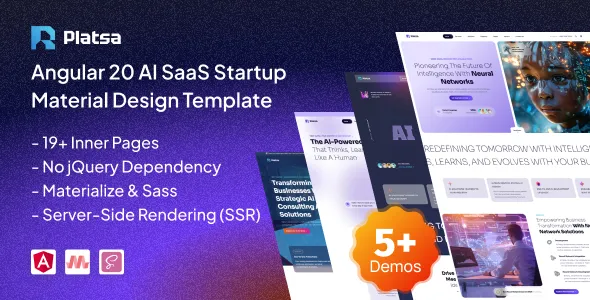
Platsa – Angular 20 AI SaaS Startup Material Design Template
Platsa – Angular 20 AI SaaS Startup Material Design Template is a modern web development template designed for AI-powered startups, SaaS businesses, technology companies, and digital service providers looking to establish a professional online presence. Built with Angular 20 and inspired by Material Design principles, Platsa provides a structured and contemporary foundation for creating websites that communicate innovation, technology, and business value. Whether you are launching an artificial intelligence startup, introducing a SaaS platform, presenting a software product, promoting cloud-based services, or developing a technology-focused landing page, this template offers a flexible starting point for building an engaging digital experience.
Modern technology businesses need websites that explain their products clearly, communicate their value proposition, and encourage visitors to explore their services. Platsa can be used as a foundation for presenting AI solutions, software applications, automation platforms, business tools, and digital products. Its contemporary design approach helps businesses organize information into understandable sections while maintaining a professional visual identity.
Angular 20 provides a component-based development environment that helps developers structure interfaces, reuse elements, and maintain application code. Material Design principles offer a consistent visual approach to interface elements, spacing, typography, and interactions. Together, these technologies create a development foundation suitable for startups and businesses that want to build a modern and maintainable frontend experience.
The final capabilities of a Platsa-based website depend on the template package, its included components, configuration, and additional integrations. Developers should review the available documentation, dependencies, and demo pages before implementation to understand the complete scope of the product.
What Is Platsa Angular 20 AI SaaS Startup Template?
Platsa is an Angular 20 website template designed for AI startups, SaaS companies, software businesses, and technology-oriented organizations. It provides a frontend foundation for presenting digital products, introducing services, communicating company information, and creating promotional pages for software solutions.
Rather than starting a website project entirely from scratch, developers can use an existing template structure to organize their content and visual presentation. This can help simplify the initial development process and provide a consistent starting point for customization.
An AI startup may use Platsa to introduce its artificial intelligence product, explain its capabilities, showcase use cases, and communicate its business model. A SaaS company can use it to present subscription-based software, explain product benefits, and guide prospective customers toward demonstrations or registration pages.
The template can also be adapted for technology agencies, software development companies, cloud service providers, digital transformation businesses, and entrepreneurs launching innovative online services.
As an Angular-based template, Platsa is intended for developers who are comfortable working with modern frontend technologies. Its source code can be customized according to project requirements, subject to the structure and functionality included in the purchased package.
Angular 20 for Modern Web Development
Angular is a popular frontend framework used to develop structured, maintainable, and component-oriented web applications. Angular 20 provides a modern development environment for building user interfaces and managing frontend application architecture.
Platsa uses Angular 20 as its development foundation, making it relevant for developers who want to work within the Angular ecosystem. The component-based approach can help organize website sections, interface elements, and reusable layouts into manageable parts.
Developers can customize the frontend structure, adjust content, modify styles, and extend components according to their project requirements. Angular also supports integration with APIs and backend services, allowing a frontend website to communicate with external data sources when the necessary implementation is provided.
For businesses planning to develop a larger web application, using an Angular-based template may offer a familiar starting point for frontend development. However, the availability of routing, authentication, API integration, data management, and other application-level functionality should be verified against the included package and documentation.
Material Design-Inspired User Interface
Material Design provides a visual design approach focused on consistency, clarity, and usability. Its design principles help developers create interfaces that feel organized and familiar across different pages and screen sizes.
Platsa follows a Material Design-inspired approach, making it suitable for technology businesses that want a clean and structured website presentation. Interface consistency can help visitors navigate product information, understand services, and interact with relevant page elements.
A consistent design system is especially useful for SaaS and AI businesses because their websites often contain several different types of information. These may include product descriptions, feature summaries, pricing details, customer testimonials, FAQs, and documentation links.
Developers can customize the visual presentation to align with their brand identity. Colors, typography, imagery, layouts, and content sections can be adjusted according to the needs of the business and the customization options supported by the template.
Responsive Design for Desktop and Mobile Devices
Responsive design is essential for websites that need to provide a consistent experience across different devices. Visitors may discover a SaaS product through a mobile search, explore its features on a tablet, or return to the website using a desktop computer.
Platsa is intended for modern responsive website development, allowing developers to build layouts that adapt to different screen sizes. A responsive structure helps maintain readable text, organized content, and accessible interface elements across devices.
For an AI startup, responsive design is important when introducing product capabilities, presenting pricing information, or encouraging visitors to request a demonstration. A mobile-friendly layout can make it easier for prospective customers to explore the website without unnecessary navigation difficulties.
Developers should test the complete website on different screen sizes before deployment. Particular attention should be given to navigation menus, pricing tables, forms, feature sections, and interactive elements. Responsive behavior may also need additional adjustments when custom components or third-party integrations are introduced.
Website Solutions for AI Startups
Artificial intelligence startups require websites that communicate advanced technology in a simple and understandable way. Visitors should be able to identify the product’s purpose, understand the problem it addresses, and learn how the solution may fit their needs.
Platsa can serve as a frontend foundation for AI-focused business websites, including platforms offering automation, AI assistants, generative AI services, machine learning solutions, productivity applications, and intelligent business software.
A startup can organize its website around an introductory section, product overview, key capabilities, use cases, customer benefits, and contact information. Dedicated pages may provide additional details about individual solutions or industry applications.
For example, an AI writing platform could explain how its software supports content workflows. An automation startup might describe repetitive tasks that its product is designed to simplify. A machine learning company could introduce its technical capabilities and industry-specific applications.
The content should focus on practical benefits and accurate product information. Clear explanations help potential customers understand the solution without requiring extensive technical knowledge.
SaaS Product Landing Page Development
A SaaS landing page introduces software products and helps visitors understand their value. It typically includes a headline, product overview, key features, benefits, supporting visuals, and calls to action.
Platsa can be adapted for SaaS landing pages that promote subscription-based software, cloud applications, productivity tools, analytics platforms, CRM solutions, and business management systems.
A strong landing page should communicate the product’s purpose immediately. The introductory section can explain what the software does and who it is intended for. Feature sections can then provide more detailed information about its capabilities.
Additional sections may include pricing plans, frequently asked questions, customer testimonials, integrations, and product demonstrations, depending on the requirements of the business and the layouts available in the template.
A SaaS company should avoid overwhelming visitors with excessive technical information. Organizing content into focused sections makes it easier for potential customers to compare benefits and understand the product.
Modern Website Structure and Page Organization
A well-organized website helps visitors find information quickly and understand the relationship between different sections. Platsa can be customized to create a structured website experience for AI startups and technology businesses.
A typical SaaS website may include the following pages and sections:
- Home: Introduces the product, company, and primary value proposition.
- About: Explains the startup’s mission, vision, background, and approach.
- Features: Describes the software’s main capabilities and benefits.
- Solutions: Presents use cases for different industries or customer groups.
- Pricing: Explains available plans, billing options, and service details.
- Blog: Publishes educational articles, product updates, and industry insights.
- Contact: Provides information for inquiries, partnerships, and support.
- FAQ: Answers common questions about the product or service.
The actual pages available in the template should be checked before implementation. Developers can adapt the structure to include only the sections necessary for their business.
A startup launching a single product may require a concise landing page, while a growing SaaS company may benefit from a more comprehensive website with dedicated feature and solution pages.
Customization for Startup Branding
Brand identity plays an important role in how a technology business communicates with potential customers. A consistent visual presentation can help establish recognition and make the website feel more professional.
Platsa provides a starting point for creating a branded website for an AI startup or SaaS business. Developers can customize the presentation according to the brand’s identity and project requirements, depending on the available styling and configuration options.
Customization may include adjusting colors, typography, images, icons, content sections, spacing, and page layouts. A startup focused on enterprise AI may prefer a restrained and professional visual style, while a creative AI product may use more expressive graphics and contemporary imagery.
Branding should remain consistent throughout the website. Headings, buttons, navigation, illustrations, and supporting visuals should follow a coherent design direction.
Original content and relevant visuals are also important. Replacing generic placeholder material with accurate product information can make the website more distinctive and meaningful to visitors.
Component-Based Development and Reusable Elements
Angular uses a component-based architecture that allows developers to organize interfaces into reusable building blocks. This approach can be helpful when building websites with repeated sections and consistent interface elements.
Platsa’s Angular foundation provides a development structure that can be customized and extended according to the needs of a project. Developers can organize interface elements into components and maintain consistent styling across different parts of the website.
Reusable components may include navigation elements, buttons, feature cards, content sections, pricing layouts, and other interface elements, depending on the package structure.
Component-based development can make it easier to maintain a website as the business grows. When a reusable element requires an update, developers can manage changes within the appropriate component rather than manually adjusting every instance.
The precise component organization and included functionality depend on the template source code. Reviewing the project structure and documentation before development helps establish an efficient customization workflow.
Present AI Features and Technology Solutions
AI-focused websites often need to communicate technical capabilities to audiences with different levels of expertise. A website should explain what a solution does while providing enough information for visitors to evaluate its usefulness.
Platsa can be adapted to present AI features through organized sections, product descriptions, illustrations, and supporting content. Developers can structure feature pages around specific use cases, workflows, or business challenges.
For example, an AI analytics company could describe how its platform supports data analysis and reporting. A conversational AI startup might explain its chatbot or assistant capabilities. An AI automation business could introduce workflows designed to reduce repetitive tasks.
Technical claims should remain accurate and supported by the actual product. Website content should not promise guaranteed performance, perfect accuracy, or results that the software cannot consistently deliver.
Clear communication helps businesses present their technology responsibly while allowing visitors to make informed decisions.
Product Features and Benefits Presentation
Product feature sections help visitors understand what a software platform offers. They should connect technical capabilities with practical business applications.
Platsa can be customized to present product information using organized content sections and visual elements. A business may highlight its primary features, describe relevant workflows, and explain how different capabilities relate to user needs.
For an AI SaaS product, feature descriptions may cover automation workflows, intelligent assistance, analytics, collaboration tools, or other functions that are genuinely supported by the product.
Each feature should have a clear explanation. Instead of simply listing technical terms, businesses can describe what the feature does, how it is used, and why it may be valuable.
Feature presentation should also be consistent. Similar headings, descriptions, and visual treatments can help visitors compare different capabilities without confusion.
Integration With APIs and Backend Services
Modern SaaS websites may require connections to external services, application programming interfaces, databases, and backend systems. Angular can support frontend communication with APIs when the necessary integration is implemented.
Platsa provides a frontend development foundation that can be extended to communicate with backend services according to project requirements. Developers may connect the website to existing software infrastructure, external data sources, or custom application services.
Depending on the business requirements, backend integration may be needed for account registration, user authentication, subscriptions, payment processing, data storage, dashboards, or dynamic content.
These capabilities should not be assumed to be fully implemented in a frontend template. Developers should verify the actual package contents and plan additional development where required.
Proper API integration also involves error handling, loading states, data validation, security considerations, and testing. A well-planned implementation helps maintain a reliable user experience.
SEO-Friendly Website Development
Search engine optimization is an important part of establishing an online presence for AI startups and SaaS businesses. A well-structured website can make content easier to discover, understand, and navigate.
Platsa can provide a starting point for developing an SEO-friendly frontend structure, but search visibility depends on multiple factors beyond the template itself.
Important SEO practices include:
- Creating descriptive and relevant page titles.
- Writing original content that addresses user needs.
- Organizing content with a logical heading hierarchy.
- Using clear and descriptive URLs.
- Adding relevant internal links between pages.
- Optimizing images and alternative text.
- Improving loading speed and mobile usability.
- Providing useful information about products and services.
- Maintaining accurate metadata and indexable content.
A SaaS business can create dedicated pages for important product features, industry solutions, and use cases. This allows each page to address a specific topic rather than placing all information on a single landing page.
SEO content should remain natural and informative. Repeating keywords excessively may reduce readability and does not guarantee better rankings.
Website Performance and Development Optimization
Performance is an important consideration for modern websites. Visitors expect pages to load efficiently and respond smoothly, especially when accessing content through mobile devices or slower internet connections.
The performance of a Platsa-based website depends on its implementation, assets, dependencies, hosting environment, and additional integrations. Developers should evaluate performance throughout the development process.
Image optimization can reduce unnecessary file sizes while maintaining suitable visual quality. Reviewing third-party scripts and removing unnecessary assets may also improve loading efficiency.
Angular applications should be configured and built according to the framework’s recommended development and production practices. Developers should consult Angular 20 documentation and the template’s own instructions for build configuration and optimization.
Performance testing should cover the homepage, feature pages, pricing sections, and other important user journeys. Regular monitoring helps identify potential issues as the website evolves.
Suitable for Technology Companies and Digital Agencies
Platsa is not limited to AI startups. Its technology-oriented presentation and Angular foundation can also be considered for other digital businesses and professional organizations.
AI startups: Introduce artificial intelligence products, automation services, and intelligent software solutions.
SaaS businesses: Promote subscription-based platforms, cloud applications, and productivity tools.
Software companies: Present software products, technical services, and development capabilities.
Technology agencies: Explain digital solutions, consulting services, and technology expertise.
Cloud service providers: Introduce cloud-based products, infrastructure services, and business applications.
Digital entrepreneurs: Develop a professional website for launching a new software product or online service.
IT consulting businesses: Present consulting offerings, technical expertise, and industry-specific solutions.
The most appropriate use depends on the website’s requirements, available layouts, and the customization work needed to achieve the desired result.
Documentation, Compatibility, and Project Setup
Before using Platsa in a production project, developers should review the included documentation and confirm the technical requirements.
Important considerations include the Angular version, Node.js compatibility, package dependencies, installation instructions, build configuration, and supported development environment.
Developers should also examine the source code structure, available components, routing configuration, and styling approach. Understanding these details can help determine how much customization is required.
If the website needs dynamic functionality, developers should identify which features are included and which require separate implementation. Backend systems, API integrations, authentication, payment processing, and database connectivity should be planned according to the project’s scope.
Testing the template in a development environment before deploying it to production is a practical way to identify compatibility issues and confirm that the website works as expected.
Accessibility and User Experience
Accessibility is an important part of creating an inclusive website. A well-designed interface should make information understandable and navigation convenient for visitors with different needs and devices.
When customizing Platsa, developers should consider readable typography, sufficient color contrast, logical heading structures, descriptive link text, and clear labels for form fields.
Interactive elements should be distinguishable and usable through appropriate input methods. Navigation should remain understandable, while forms should provide meaningful validation and error messages.
Material Design-inspired styling can provide a consistent interface foundation, but accessibility depends on the final implementation and content. Developers should test customized components rather than assuming that the original design automatically satisfies every accessibility requirement.
Combining responsive layouts, clear navigation, and accessible interface elements can improve the overall usability of a SaaS website.
Security and Maintenance Considerations
A professionally developed website requires regular maintenance to remain reliable and secure. Angular projects should be maintained according to their framework requirements, dependency updates, and development best practices.
Developers should review dependencies for compatibility and security considerations before updating them. Changes should be tested in a development or staging environment before being applied to a production website.
If Platsa is integrated with backend services, additional security considerations may include secure communication, appropriate authentication, access control, input validation, and safe handling of sensitive data.
A regular maintenance process should include testing, dependency reviews, performance monitoring, and backups of important project files.
Maintaining the website’s content is equally important. Product descriptions, feature information, pricing details, contact information, and published articles should remain accurate and up to date.
Why Choose Platsa Angular 20 AI SaaS Startup Template?
Platsa can be a useful starting point for developers and businesses looking to create a modern website for an AI startup, SaaS product, or technology-focused company.
Its Angular 20 foundation provides a component-oriented frontend development environment, while its Material Design-inspired presentation offers a consistent approach to interface styling and layout organization.
The template can help developers establish an initial website structure, customize branding, organize product information, and build a frontend experience suited to their business objectives.
For startups, having a professional website can support product communication, brand presentation, customer education, and lead generation. For developers, an existing template structure can provide a foundation for customization rather than requiring every visual element to be created from the beginning.
The final value depends on the project’s requirements, the quality of customization, and the capabilities included in the purchased package. Reviewing the demo, documentation, and technical specifications before implementation helps ensure a suitable development approach.
Final Thoughts on Platsa Angular 20 AI SaaS Startup Material Design Template
Platsa – Angular 20 AI SaaS Startup Material Design Template is a modern frontend development option for AI startups, SaaS businesses, technology companies, and digital entrepreneurs looking to build a professional online presence. Its combination of Angular 20 and Material Design-inspired styling provides a structured foundation for developing contemporary technology websites.
The template can be customized to present AI products, software features, business solutions, company information, pricing details, and other relevant content. Its frontend architecture can also be extended according to project requirements, subject to the components and functionality included in the package.
Successful website development requires more than selecting a template. Original content, responsive design, accessibility, performance optimization, SEO practices, and ongoing maintenance all contribute to the quality of the final website.
For developers seeking an Angular-based starting point for an AI SaaS or technology startup website, Platsa offers a foundation that can be evaluated and adapted to different business goals. With careful customization, appropriate integrations, and a clear content strategy, it can support the development of a professional and user-friendly digital presence.