My Account
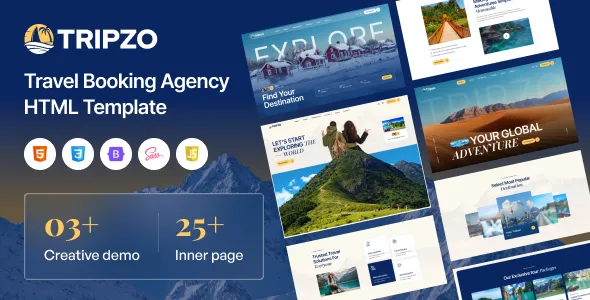
Tripzo – Tours and Travel Booking Agency HTML Template
Tripzo – Tours and Travel Booking Agency HTML Template is a modern website template designed for travel agencies, tour operators, holiday planners, travel consultants, and tourism businesses looking to establish a professional online presence. Created for travel-focused website projects, Tripzo provides a starting point for presenting tour packages, showcasing destinations, introducing travel services, and helping visitors explore holiday options. Whether you manage a local travel agency, organize international tours, offer adventure experiences, or specialize in customized vacation planning, this HTML template can be adapted to reflect your business identity and travel services.
A successful travel website needs to inspire visitors while providing practical information that helps them plan their journeys. Travelers often want to explore destinations, compare tour options, understand package inclusions, review itineraries, and contact an agency before making a booking decision. An organized website can bring these details together in one convenient place, making it easier for potential customers to discover suitable experiences. Tripzo offers a foundation for creating a visually engaging travel website that combines destination-focused content with useful business information.
As an HTML template, Tripzo is intended for developers, designers, and travel businesses that want control over their website’s structure and presentation. Its layouts and styling can be customized to match a travel brand, highlight popular destinations, and present tour packages according to the agency’s requirements. The final features and functionality depend on the supplied template files, available page designs, and any additional development or integrations used during implementation. By combining relevant travel content, appealing imagery, and a clear navigation structure, businesses can create a website that supports destination discovery and customer inquiries.
What Is Tripzo – Tours and Travel Booking Agency HTML Template?
Tripzo – Tours and Travel Booking Agency HTML Template is a website design solution for businesses operating in the travel and tourism industry. It provides a starting point for building a travel agency website that introduces destinations, presents tour packages, communicates travel services, and guides visitors toward relevant information or booking inquiries.
Travel businesses serve customers with different interests, budgets, schedules, and expectations. Some travelers prefer relaxing beach holidays, while others look for cultural experiences, outdoor adventures, family vacations, city breaks, or international travel packages. A well-structured website helps organize these options so visitors can understand what the agency offers and identify experiences that suit their preferences.
Tripzo can be evaluated for travel agencies, tour operators, holiday planners, destination specialists, adventure travel companies, and other tourism-related businesses. The website can be customized to focus on specific destinations, travel categories, seasonal packages, or specialized services.
Because Tripzo is an HTML template, it generally provides front-end website files that developers can modify using HTML, CSS, JavaScript, and any included libraries. It should not automatically be treated as a complete booking management system. Features such as live availability, payment processing, customer accounts, reservation management, and automated confirmations may require additional programming or third-party integrations unless they are explicitly included in the current product package.
Before implementation, review the official product demo and documentation to confirm the included layouts, technical requirements, responsive behavior, and available functionality.
Modern Design for Travel Agencies
A travel website should capture attention while making it easy for visitors to find useful information. Attractive destination photography, clear headings, organized tour details, and accessible navigation can help create an engaging experience without overwhelming users.
Tripzo offers a foundation for building a travel-focused visual presentation. Agencies can customize its design to reflect their brand personality, whether they specialize in luxury holidays, affordable vacations, cultural tours, family travel, or outdoor adventures.
Destination imagery can introduce the places travelers may visit, while supporting text explains the experiences available. Featured tour sections can highlight selected packages, and dedicated service areas can describe the agency’s planning assistance or travel specialties.
The overall visual identity should remain consistent throughout the website. Coordinated colors, typography, image treatments, and button styles help create a recognizable brand. A luxury travel agency may choose an elegant and spacious design, while an adventure operator may prefer energetic imagery and a more expressive presentation.
A strong design should also support practical decision-making. Visitors need to understand the destination, trip duration, general inclusions, and next steps without searching through unrelated information. By balancing visual appeal with clear content, a travel agency can make its website more useful for prospective customers.
Destination Pages and Travel Inspiration
Destination pages help travelers explore different places and understand what makes each location worth visiting. They can introduce local attractions, cultural experiences, natural landscapes, seasonal highlights, and activities available through the agency.
Tripzo can be customized to organize destination-focused content according to the agency’s travel offerings and the layouts available in the template. A travel business may create pages for countries, cities, regions, islands, national parks, or other locations that it genuinely serves.
Each destination page can include an introduction, representative photographs, recommended activities, travel considerations, and links to relevant tour packages. Practical details such as the best travel season, estimated trip duration, and local transportation options may also help visitors plan their journey when the information is accurate and current.
For example, a destination page for a coastal region could highlight beaches, local cuisine, boat trips, and nearby attractions. A mountain destination might focus on trekking routes, scenic viewpoints, outdoor activities, and seasonal conditions.
Original destination content helps the website communicate more than a collection of photographs. It gives visitors useful context and helps them compare experiences according to their interests.
Travel information should be reviewed regularly because entry requirements, local conditions, opening schedules, transportation options, and seasonal availability can change. Accurate information improves the customer experience and helps establish trust.
Tour Packages and Holiday Planning
Tour packages are central to many travel agency websites. Visitors often want to compare available experiences and understand what is included before deciding whether to request a quotation or proceed with a reservation.
Tripzo can provide a starting point for presenting tour packages in an organized format, depending on the pages and components included in the template. Each package can be customized with a title, destination, duration, description, photographs, highlights, and relevant pricing information where available.
A clear package structure helps customers evaluate their options. For example, a family holiday might emphasize convenient accommodation, sightseeing, and activities suitable for different age groups. An adventure package could focus on outdoor experiences, guided excursions, and the equipment or preparation required.
Useful tour descriptions should explain the experience accurately. Agencies should identify what is included, what is excluded, whether transportation or accommodation is provided, and which additional costs customers may need to consider.
If prices vary according to travel dates, group size, accommodation choices, or availability, the website should communicate those conditions clearly. Avoid presenting outdated prices or implying that a package is available for every date unless the business can verify that information.
A well-organized tour section helps visitors compare experiences and provides a natural pathway toward inquiries or booking-related actions.
Travel Booking Interface and Reservation Inquiries
A convenient booking journey is important for travel businesses that want visitors to move from browsing to making an inquiry or reservation. The interface should explain what information customers need to provide and what happens after they submit a request.
Tripzo is an HTML template, so its visual booking elements should be evaluated separately from the underlying reservation functionality. A booking form or search interface does not necessarily mean that the website includes live inventory, automatic confirmations, or payment processing.
Depending on the implementation, developers may add fields for destination, departure date, return date, number of travelers, travel category, or other relevant preferences. A simpler travel agency website may use an inquiry form that allows customers to describe their requirements and receive a personalized quotation.
For a functional reservation system, additional components may be required to process requests, validate dates, check availability, calculate prices, and store booking records. Payment integration and automated notifications may also require external services or custom back-end development.
The booking experience should remain straightforward. Ask only for information necessary to process the inquiry, use clear field labels, and provide helpful validation messages. After submission, visitors should receive an appropriate confirmation that explains the next step.
Testing is essential before launch. Verify that forms submit correctly, messages reach the intended recipient, date fields work as expected, and any connected booking service handles requests reliably.
Responsive Design for Mobile and Desktop
Travelers frequently research holidays using smartphones and tablets. A responsive website allows visitors to explore destinations, compare packages, and access contact information across different screen sizes.
Tripzo is positioned as an HTML template for travel agency websites, but its exact responsive behavior should be confirmed through the current product demo and supplied files. Responsive implementation generally adjusts layouts, typography, navigation, images, and spacing according to the device’s available screen space.
On smaller screens, large navigation menus may need to collapse into compact controls, while multi-column tour listings may become single-column layouts. Destination photographs should scale appropriately, and important actions should remain easy to locate and operate.
Mobile usability is especially important for travelers who access a website through search results, advertisements, or social media links. Visitors should be able to read package information, review travel details, and contact the agency without struggling with oversized elements or horizontal scrolling.
Developers should test all important pages at multiple screen sizes. The homepage, destination pages, tour listings, booking forms, and contact sections may each behave differently.
Custom CSS, third-party booking widgets, maps, and embedded media can affect responsive behavior. Regular testing after customization helps maintain a consistent experience across mobile devices, tablets, and desktop computers.
Travel Categories for Different Audiences
Travelers have varied preferences, so a travel agency may benefit from organizing its offerings into recognizable categories. Clear categories make it easier for visitors to identify experiences that match their interests.
Tripzo can be customized to present the categories that are most relevant to the business. Depending on the agency’s actual services, these may include:
- Adventure travel: Trekking, hiking, camping, outdoor exploration, and guided nature experiences.
- Family holidays: Trips designed around family activities, sightseeing, and convenient travel arrangements.
- Luxury vacations: Premium travel experiences, upscale accommodation, and personalized planning.
- Cultural tours: Heritage locations, historical landmarks, local traditions, and guided cultural experiences.
- Beach holidays: Coastal destinations, island trips, water activities, and relaxing resort stays.
- Honeymoon packages: Romantic destinations and holiday experiences planned for couples.
- City breaks: Short trips focused on sightseeing, shopping, dining, and urban attractions.
- Group tours: Organized itineraries for groups traveling together.
- Nature and wildlife trips: Nature-focused destinations and wildlife experiences, subject to local regulations and responsible travel practices.
These categories should reflect the agency’s real offerings rather than serve as generic placeholders. Each section can include relevant destination pages and package listings to help visitors continue exploring the website.
A focused category structure prevents the website from becoming confusing. Select categories based on customer demand, business expertise, and the destinations the agency can genuinely support.
Travel Agency Services and Business Information
A travel agency website should explain not only where customers can travel but also how the business can assist them. Service information helps visitors understand the available support before, during, and after their trip.
Tripzo can be adapted to introduce services such as customized itinerary planning, group travel coordination, guided tours, accommodation assistance, transportation arrangements, or travel consultation, where these services are genuinely offered.
Each service description should explain what the agency provides and how customers can request assistance. For example, a customized itinerary service may involve discussing travel dates, preferred activities, budget, accommodation expectations, and destination interests before preparing a proposed schedule.
A group travel service might explain how the agency coordinates travel arrangements for families, organizations, educational groups, or other customers. A destination consultation page could describe how travelers can receive guidance about routes, schedules, and available experiences.
Business information should also be easy to locate. Include the agency’s accurate contact details, operating hours, service area, and relevant policies. If the business works with suppliers or local guides, explain the arrangements clearly without making unsupported claims.
Transparent service information helps visitors determine whether the agency matches their requirements and prepares them for a productive inquiry.
Customization and Travel Brand Identity
A recognizable brand can help a travel agency communicate its personality and distinguish its services from competing businesses. Customization allows the website’s presentation to align with the agency’s target audience, service quality, and travel specialties.
Tripzo’s HTML structure and styling can be reviewed and customized according to the capabilities of the supplied files. Depending on the implementation, developers may adjust colors, typography, layouts, photographs, icons, navigation labels, and content sections.
A luxury travel company may prefer refined typography, spacious layouts, and carefully selected destination images. An adventure travel business may choose dynamic photographs and stronger visual contrast. A family-focused agency may prioritize welcoming imagery, readable content, and straightforward navigation.
Consistency matters across every page. The logo, brand colors, heading styles, buttons, and image treatments should follow a recognizable visual system. This makes the website easier to identify and helps create a more professional experience.
Replace placeholder content with original descriptions, accurate business information, and relevant photographs. Images should represent the destinations and activities being promoted, and their use should comply with applicable licensing requirements.
Before making extensive changes, review the template documentation and keep backups of the original files. Testing customized pages in a development environment can help identify visual or functional problems before the website goes live.
SEO-Friendly Website Structure for Travel Agencies
Search engine optimization can help a travel business make its website more discoverable to people researching destinations, tour packages, and travel services. A well-organized template provides a useful foundation, but search visibility depends on content quality, technical implementation, competition, and other factors.
Tripzo can be customized with descriptive page titles, logical headings, useful destination content, and clear internal links. Each important page should have a specific purpose and provide information that is relevant to its intended audience.
A travel agency may create separate pages for major destinations, tour categories, individual packages, and specialized services. These pages should contain original information rather than repeating the same generic description across multiple locations.
Descriptive URLs and internal links help visitors navigate related content. For example, a destination guide can link to relevant tour packages, while a package page can connect to the destination’s main information page.
Image optimization is also important for travel websites because destination photographs can be large. Use descriptive filenames, appropriate alternative text for meaningful images, and suitable image dimensions to support accessibility and loading performance.
Developers should review technical SEO elements such as metadata, canonical URLs, indexing directives, XML sitemaps, and structured data where applicable. Some elements may require manual implementation or supporting tools because a static HTML template does not automatically provide a complete SEO management system.
Write for travelers first. Useful, accurate information and clear descriptions are more valuable than excessive keyword repetition. No template can guarantee a particular ranking position, amount of organic traffic, or number of bookings.
Local SEO for Travel Agencies
Local search optimization can help travel agencies connect with customers who are looking for assistance in a specific city or region. Accurate business information and relevant service descriptions can make it easier for potential customers to understand where the agency operates.
A Tripzo-based website can display the agency’s genuine business name, address, telephone number, operating hours, and service area. These details should be consistent with the information shown on relevant business listings and social profiles.
If the agency serves customers in a particular city, its website can explain the local services available and provide appropriate contact details. Location-specific content should reflect genuine business operations rather than target places that the agency does not serve.
A map or directions link may help visitors find a physical office. Adding a map generally requires an appropriate external mapping service or embedded component, depending on the website’s implementation.
Local landing pages can be useful when an agency has multiple branches or genuinely serves different regions. Each page should provide distinct, useful information instead of simply replacing a city name in otherwise identical text.
Customer reviews can also support trust when they are genuine and displayed responsibly. Accurate information, clear services, and a convenient inquiry process help build a dependable local presence.
Website Performance and Image Optimization
Travel websites often use large photographs to showcase destinations, hotels, attractions, and activities. Although visual content can make a website engaging, poorly optimized images and unnecessary scripts can slow down page loading.
The performance of a Tripzo website depends on the supplied code, image assets, hosting environment, external services, and any customizations made during development. A template should be tested in its finished configuration rather than assumed to be fast by default.
Start by resizing images to match their intended display dimensions and compressing them without sacrificing too much visual quality. Modern image formats may help reduce file sizes where they are supported by the website’s delivery setup.
Review external scripts, font requests, animations, embedded maps, and booking widgets. Remove or simplify components that do not contribute meaningfully to the visitor experience.
Quality hosting, caching, and content delivery services may improve performance depending on the site’s requirements. Their usefulness should be evaluated through testing rather than assumed.
Test important pages on mobile and desktop devices, paying particular attention to the homepage, destination galleries, tour listings, and booking forms. Performance measurements can help identify large assets and other bottlenecks that need attention.
Ongoing monitoring is useful as new destinations, photographs, and integrations are added to the website.
Accessibility and User-Friendly Navigation
An effective travel website should help visitors find information without unnecessary effort. Clear navigation, readable typography, accessible forms, and descriptive links make it easier for people with different needs to explore available travel options.
When customizing Tripzo, use a logical heading structure and descriptive navigation labels. Menus should make important sections easy to find, while calls to action should clearly explain whether visitors can view a package, request information, or begin a booking process.
Text should have sufficient contrast against its background. Important information should not rely on color alone, and interactive controls should be distinguishable from ordinary content.
Meaningful destination images should have suitable alternative text, while decorative images can be handled appropriately to avoid unnecessary announcements for assistive technologies. Forms should have clear labels and understandable error messages.
Booking-related interfaces deserve particular attention. Date fields, traveler selectors, and submission controls should be usable with suitable input methods and should communicate errors clearly.
Accessibility depends on the original template and all later modifications. Automated tools can help identify some issues, but manual keyboard testing and practical usability reviews are also valuable.
A user-friendly interface makes it easier for visitors to compare destinations, understand travel packages, and contact the agency with confidence.
Contact Forms and Customer Inquiries
Contact forms give travelers a convenient way to ask questions, request quotations, and discuss customized travel plans. A clear inquiry process can help agencies collect the information needed to respond effectively.
Tripzo can be customized to display contact forms and inquiry interfaces according to the supplied layouts. However, a working form generally requires a suitable back-end handler or third-party form service unless the functionality is already included.
A travel inquiry form may collect a customer’s name, email address, destination of interest, travel dates, number of travelers, and a short description of their requirements. The information requested should match the agency’s actual workflow and should not create unnecessary barriers for visitors.
Clear field labels help users understand what they need to provide. Validation messages should explain errors, and a successful submission should produce an appropriate confirmation.
If the agency handles personal travel details, it should explain how submitted information will be used and stored. Sensitive information should not be collected unless it is necessary and handled securely.
Before launch, test form submission, email delivery, spam protection, and error handling. A contact form that appears visually correct but does not deliver inquiries can result in missed business opportunities.
A dependable contact process helps visitors move from researching destinations to discussing their travel plans with the agency.
Integrations and Additional Booking Features
A travel agency may need features beyond the standard presentation of destinations and packages. Depending on its business model, the website may require reservation management, availability checks, payment processing, customer accounts, or connections to external travel services.
Tripzo can provide a front-end starting point for such projects, but the actual integrations depend on the supplied template and additional development. A visual booking interface should not be treated as proof that a complete reservation system is included.
A basic inquiry-based agency website may only need a contact form and a manual process for confirming travel arrangements. A larger operation may require a database-backed booking platform, customer records, payment gateways, supplier integrations, and automated notifications.
Before selecting an integration, review its technical requirements, compatibility, licensing, costs, privacy implications, and maintenance needs. The integration should fit the agency’s actual workflow and be reliable enough for its expected usage.
If payments are accepted online, use an appropriate payment provider and follow its security requirements. Avoid storing sensitive payment details directly unless the system has been specifically designed and authorized to handle them.
Every integration should be tested with realistic scenarios before launch. Verify successful and unsuccessful submissions, date handling, error messages, and confirmation processes to ensure that the booking journey behaves as expected.
Who Can Use Tripzo – Tours and Travel Booking Agency HTML Template?
Tripzo can be evaluated by a range of businesses and professionals working in travel, tourism, and holiday planning.
Travel agencies: Present destinations, explain travel services, and showcase available tour packages through an organized website.
Tour operators: Introduce guided tours, group experiences, sightseeing trips, and other travel activities offered by the business.
Holiday planners: Build a website for customized vacation planning, itinerary consultations, and personalized travel inquiries.
Adventure travel companies: Highlight trekking, hiking, outdoor exploration, and other adventure experiences that the business provides.
Luxury travel providers: Create a refined presentation for premium holidays, customized itineraries, and specialized travel services.
Family travel specialists: Organize family-friendly destinations and vacation packages with clear information about available experiences.
Destination management businesses: Present local experiences, destination information, and relevant services for visitors.
Independent travel consultants: Establish a professional online presence for travel advice, planning assistance, and customer inquiries.
Web designers and developers: Use the HTML template as a starting point for customized travel website projects.
The best fit depends on the template’s documented features and the requirements of the finished website. Review the current demo, available pages, technical documentation, and licensing conditions before implementation.
Best Practices for Building a Successful Travel Website
A successful travel website combines attractive presentation with accurate information, convenient navigation, and a dependable inquiry or booking process. The following practices can help businesses make effective use of Tripzo.
Define the website’s main objective. Determine whether the priority is promoting tour packages, generating inquiries, presenting destination information, or supporting online reservations.
Organize destinations and packages clearly. Use meaningful categories and make it easy for visitors to compare relevant travel experiences.
Publish accurate travel information. Verify itineraries, prices, inclusions, departure details, and destination guidance before publishing them.
Use relevant photography. Select high-quality images that genuinely represent the destinations and activities being offered. Ensure that image usage complies with applicable licensing terms.
Maintain consistent branding. Apply a coordinated visual style across the homepage, destination pages, package listings, and contact sections.
Prioritize mobile usability. Test navigation, images, forms, and important actions on different screen sizes.
Optimize performance. Compress images, review scripts, and test loading behavior across important pages.
Implement useful SEO practices. Create original destination content, descriptive page titles, clear headings, and relevant internal links.
Test inquiries and booking workflows. Confirm that contact forms, booking integrations, and notifications function correctly before launch.
Review content regularly. Update prices, schedules, availability details, policies, and destination information as circumstances change.
Plan for ongoing maintenance. Keep backups, review third-party dependencies, and resolve technical issues promptly.
These practices help transform a template into a practical website that supports destination discovery, customer communication, and the agency’s business objectives.
Final Thoughts on Tripzo – Tours and Travel Booking Agency HTML Template
Tripzo – Tours and Travel Booking Agency HTML Template is a potential option for travel businesses, tour operators, holiday planners, and developers who want a customizable foundation for a tourism-focused website. Its intended application makes it relevant to projects that need destination presentations, tour package listings, travel service information, and customer inquiry pathways.
A well-planned Tripzo website can combine engaging destination imagery with organized package details, responsive layouts, consistent branding, and clear contact information. Travel agencies can use these elements to introduce their services, explain holiday options, and help visitors explore experiences that match their interests.
Because Tripzo is an HTML template, its final capabilities depend on the supplied files and any additional development or integrations. Advanced functions such as live availability, online payments, customer accounts, and automated reservation management may require separate implementation unless they are explicitly included in the product package.
Before choosing the template, review the current product demo and documentation to confirm the available layouts, responsive behavior, technical requirements, and included functionality. Test the completed website for performance, accessibility, contact form reliability, and booking workflow accuracy before making it available to customers.
For businesses seeking a flexible starting point for a travel agency website, Tripzo can be evaluated as part of a broader digital strategy. With original travel content, accurate package information, thoughtful customization, and regular maintenance, the resulting website can support destination discovery, customer inquiries, and long-term business growth.https://themeforest.net/item/tripzo-tours-and-travel-booking-agency-html-template/65167250